Gaudiya Vaisnava — Panca-tattva
Sri Gadadhara Pandita:
The Foremost Among the Internal Potencies
An Incarnation of Srimati Radharani in the Pastimes of Lord Sri Caitanya Mahaprabhu
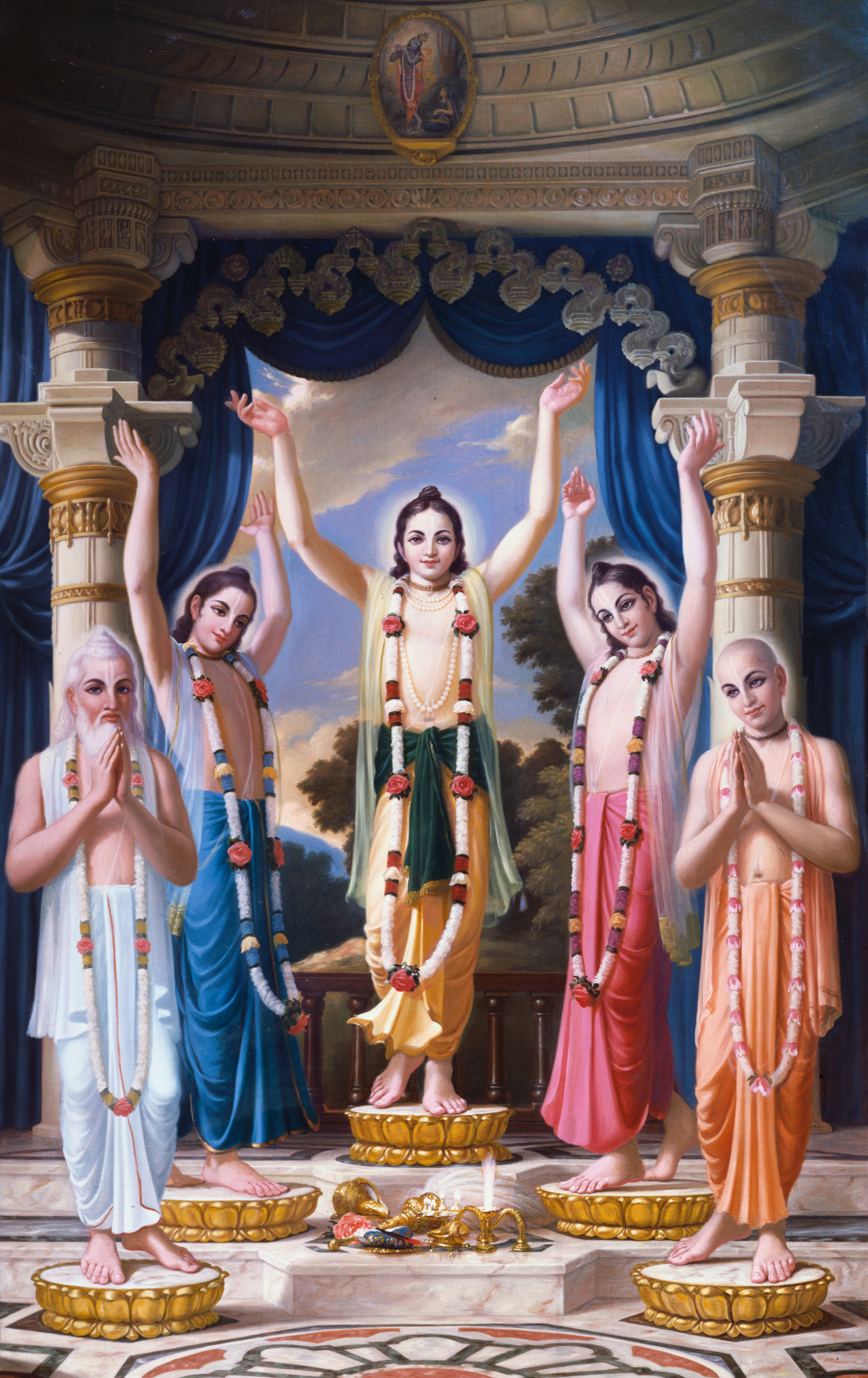 The Panca-tattva — Sri Krsna Caitanya, Sri Nityananda Prabhu, Sri Advaitacarya, Sri Gadadhara Prabhu, and Srivasa Prabhu — the five-fold manifestation of the Absolute Truth.
The One Whose Presence Could Not Be Replaced
When Lord Sri Caitanya Mahaprabhu took sannyasa and left Navadvipa for Jagannatha Puri, most of His dear associates — Advaita Acarya, Murari Gupta, Srivasa Thakura and many others — remained behind in Navadvipa. They would make the journey to Puri once a year, during the Rathayatra festival, to receive the Lord's darsana.
But one devotee could not stay behind. He followed the Lord all the way to Puri, gave up any thought of returning, took up residence there permanently, and devoted the rest of his life to serving the Lord's deity and hearing from the Lord daily. This devotee was Sri Gadadhara Pandita Gosvami.
Who is Gadadhara Pandita? The Caitanya-caritamrta describes him not merely as a great devotee but as something far more intimate and profound: he is the very internal potency of Lord Krsna, manifested in human form, inseparable from the Lord in every age and every appearance. To understand Gadadhara Pandita is to understand something essential about the very nature of divine love.
Of all the internal potencies of the Lord, Gadadhara Prabhu is the foremost. To know him is to come close to understanding the heart of Sri Caitanya Mahaprabhu Himself.
His Position in the Panca-tattva
In the Gaudiya Vaisnava tradition, Lord Sri Caitanya Mahaprabhu is understood to have appeared in this world not alone, but together with four principal associates, forming the Panca-tattva: the five-fold manifestation of the Absolute Truth. Srila Prabhupada explains in the Introduction to the Caitanya-caritamrta:
In the pastimes of Lord Caitanya, Krsna is manifested in five different features, known as the panca-tattva — Sri Krsna Caitanya, Sri Nityananda Prabhu, Sri Advaitacarya, Sri Gadadhara Prabhu and Srivasa Prabhu. In all cases, Caitanya Mahaprabhu is the source of energy for all His devotees. Since this is the case, if we take shelter of Caitanya Mahaprabhu for the successful execution of Krsna consciousness, we are sure to make progress.
— Srila Prabhupada, Introduction to Caitanya-caritamrta
Within this Panca-tattva, each member represents a distinct category of divine reality. Srila Prabhupada explains in his lecture on CC Adi-lila 7.3 (Mayapur, 1974):
Nityananda Prabhu is the immediate expansion of Sri Caitanya Mahaprabhu's personal self; Advaita Prabhu is incarnation of Visnu, Mahavisnu; and Gadadhara Prabhu is the expansion of spiritual energy; and Srinivasa Prabhu is the expansion of His marginal potency, marginal energy, jiva-tattva.
— Srila Prabhupada, Lecture on CC Adi-lila 7.3, Mayapur, March 3, 1974
The Caitanya-caritamrta (Adi-lila 1.41) identifies Gadadhara Prabhu with a direct mangalacarana verse:
tan'-sabāra caraṇe mora sahasra praṇati
"I offer my respectful obeisances unto the internal potencies of the Lord, of whom Śrī Gadādhara Prabhu is the foremost."
— Śrī Caitanya-caritāmṛta, Ādi-līlā 1.41The devotees headed by Gadadhara Pandita are to be considered incarnations of the internal potency of the Lord. They are confidential devotees engaged in the service of the Lord.
— Srila Prabhupada, CC Adi-lila 7.17, Purport
Gadadhara Prabhu is sakti-tattva — the internal potency of the Lord in human form. He is not an ordinary devotee. He is the energy of Krsna, present alongside the Lord in every age.
The Ontological Identity: An Incarnation of Srimati Radharani
The most profound and sacred truth about Gadadhara Pandita is his identity as the pleasure potency of Lord Krsna — Vrndavanesvari Herself. Srila Prabhupada presents this in his purport to CC Adi-lila 10.15:
teṃho lakṣmī-rūpā, tāṅra sama keha nāi
"Gadādhara Paṇḍita, the fourth branch, is described as an incarnation of the pleasure potency of Śrī Kṛṣṇa. No one, therefore, can equal him."
— Śrī Caitanya-caritāmṛta, Ādi-līlā 10.15Srila Prabhupada's purport explains the scriptural authority for this identification, citing the Gaura-ganoddesa-dipika (147–53):
Sri Krsna's pleasure potency, formerly known as Vrndavanesvari, is now personified in the form of Sri Gadadhara Pandita in the pastimes of Lord Caitanya Mahaprabhu. Sri Svarupa Damodara Gosvami has pointed out that in the shape of Laksmi, the pleasure potency of Krsna, she was formerly very dear to the Lord as Syamasundara-vallabha. The same Syamasundara-vallabha was present in Lord Caitanya's pastimes as Gadadhara Pandita. Formerly, as Lalita-sakhi, she was always devoted to Srimati Radharani. Thus Gadadhara Pandita is simultaneously an incarnation of Srimati Radharani and Lalita-sakhi.
— Srila Prabhupada, CC Adi-lila 10.15, Purport
This identity is further confirmed in a personal letter from Srila Prabhupada to his disciple Tamala Krsna (May 27, 1970):
Regarding your two questions, the first: Sri Gadadhara is expansion Radharani.
— Srila Prabhupada, Letter to Tamala Krsna, Los Angeles, May 27, 1970
This triple identity is unique in Gaudiya Vaisnava theology: Gadadhara Pandita is simultaneously (1) Vrndavanesvari — the queen of Vrndavana, (2) Lalita-sakhi — the most intimate companion of Radharani, and (3) Syamasundara-vallabha — the beloved of the dark Lord. He appears in Gaura-lila in the male form of a Brahmana devotee, yet his inner nature is that of the supreme sakti.
Why Gadadhara Did Not Fully Manifest Radha's Mood
A natural question arises: if Gadadhara Pandita is an incarnation of Srimati Radharani, why did he not externally display all of Her characteristic moods and ecstasies? The answer is rooted in the deeper purpose of Caitanya Mahaprabhu's appearance.
Lord Caitanya appeared as the combined form of Krsna and Radharani — Krsna taking on Radha's mood and complexion to experience Her ecstasy of loving separation. Since Mahaprabhu was already manifesting Radhika's bhava completely, Gadadhara Pandita — in order not to overlap or diminish the Lord's own experience — held back his full expression. He remained in the role of a humble devotee-servant, fully absorbed in the Lord's service, while internally burning with the same divine love.
When Krsna took Radharani's mood and became Caitanya Mahaprabhu, Radharani was still present — watching, serving, worshipping — as Gadadhara Pandita.
Birth and Early Life in Navadvipa
Gadadhara Pandita appeared in this world in the holy dhama of Navadvipa (present-day Mayapur, West Bengal). His appearance day is the amavasya — the new moon day — of the month of Vaisakha. He was born into a brahmana family; his father was Madhav Misra and his mother was Ratnavati Devi. From the very beginning of his life, he displayed exceptional devotional qualities and a naturally grave, gentle, and composed nature.
From childhood, Gadadhara Pandita was the closest associate of the young Visvambhara (who would later become Caitanya Mahaprabhu). They were inseparable companions in Navadvipa. When Mahaprabhu was a student at the school of Gangadasa Pandita, Gadadhara Pandita was among his fellow students, along with Murari Gupta, Jagadananda and others.
Even at that stage, when Visvambhara was engaged in academic debates on nyaya (logic) and confounding his classmates, Gadadhara Pandita was characteristically filled with wonder and devotion, unable to fully follow the Lord's towering intellectual arguments — yet completely captivated by His presence.
A Childhood Bond That Never Broke
The bond between Gadadhara Pandita and Lord Caitanya was one of the most intimate relationships in all of Caitanya-lila. The Caitanya-caritamrta and the Caitanya-bhagavata both describe how from the earliest years they were never far apart. When Mahaprabhu revealed His divine identity during the arambha-sankirtana period in Navadvipa, Gadadhara Pandita was always present — fanning the Lord, serving Him, absorbing His divine presence with quiet, tear-filled eyes.
Even as children, Gadadhara and Visvambhara were never separated. Their bond was not formed in Navadvipa — it was only revealed there. It is eternal.
The Lesson in Humility: Initiation from Pundarika Vidyanidhi
One of the most instructive episodes in Gadadhara Pandita's life is his initiation from Pundarika Vidyanidhi — a story that reveals the nature of a truly advanced devotee and the importance of not judging by external appearances.
Pundarika Vidyanidhi was a maha-bhagavata — a devotee of the highest order — and the spiritual master of Gadadhara Pandita. But when Gadadhara first visited him, he saw a man living in apparent luxury: fine clothing, scented oil on his hair, comfortable bedding, an opulent home. Gadadhara's first impression was one of doubt. How could such a man be a great devotee?
Mukunda Datta, who had arranged the visit, perceived the doubt in Gadadhara's mind. He began to recite a verse from the Srimad-Bhagavatam (3.2.23) in a sweet, melodious voice:
jighāṁsayāpāyayad apy asādhvī
lebhe gatiṁ dhātry-ucitāṁ tato 'nyaṁ
kaṁ vā dayāluṁ śaraṇaṁ vrajema
"How astonishing! The demoness Pūtanā was cruel and sinful — she even tried to kill the Lord by feeding Him poison from her breast. Yet even she obtained the liberation of a nursemaid! To whom else but this Lord, who is so merciful, shall I take shelter?"
— Śrīmad-Bhāgavatam 10.6.35The moment Pundarika Vidyanidhi heard this verse, he was instantly overwhelmed with ecstatic love. He began calling out "Krsna! Krsna!" with tears streaming down his face, and finally fainted in divine ecstasy on the floor.
Gadadhara Pandita was shaken to his core. He immediately understood that he had committed a grave offense by judging this maha-bhagavata by his external opulence. With deep remorse, he resolved that the only way to purify himself of this offense was to accept initiation from Pundarika Vidyanidhi directly.
When Mukunda presented Gadadhara's proposal, the great devotee was delighted. "Providence has bestowed upon me a great jewel," he said. Gadadhara received the gopala-mantra from Pundarika Vidyanidhi and became formally initiated into the Gaudiya sampradaya.
A great devotee may live among gold and silk — but his heart belongs entirely to Krsna. Gadadhara Pandita's humility taught him never to judge a saint by appearances. This lesson cost him something precious: his pride. It gave him something more precious: a great guru.
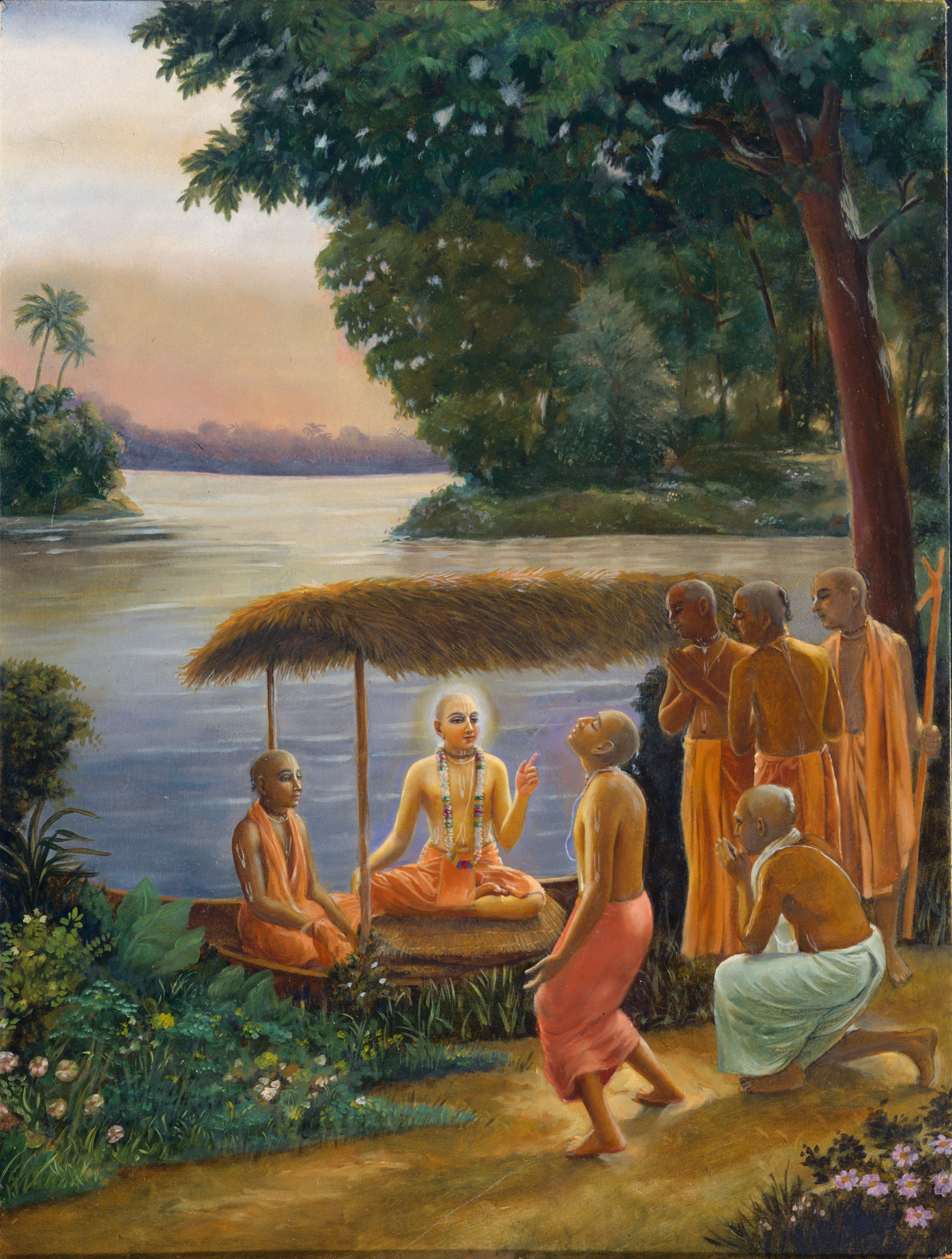 Gadadhara Pandita overwhelmed in divine ecstasy — a glimpse of the intense devotional love that characterised his entire life in the association of Lord Sri Caitanya Mahaprabhu.
Role in Navadvipa-lila: The Eternal Companion
Throughout Lord Caitanya's Navadvipa-lila, Gadadhara Pandita was present in every significant moment — the sankirtana movements, the debates with philosophers, the divine revelations, the first stirrings of the Krsna consciousness movement. He is described in the Caitanya-bhagavata as an indispensable figure in the Lord's nightly kirtana gatherings in the courtyard of Srivasa Thakura.
When Lord Caitanya revealed His divine form as the Supreme Lord to the assembled devotees in the garbhavasa of Srivasa, Gadadhara Pandita was present. When the Lord manifested His catuh-bahu form (four-armed Narayana form), Gadadhara was among those who witnessed and fell into trance.
After describing the branches and subbranches of Advaita Acarya, I shall now attempt to describe some of the descendants of Sri Gadadhara Pandita, the most important among the branches.
— Srila Prabhupada, CC Adi-lila 12.79
Gadadhara's Mood: Submission Under All Circumstances
The Antya-lila of the Caitanya-caritamrta reveals a beautiful contrast between two great devotees' moods toward the Lord. Srila Prabhupada explains in his purport to CC Antya-lila 7.145:
In the pastimes of Lord Sri Caitanya Mahaprabhu, Jagadananda Pandita was always in disagreement with the Lord like Satyabhama, whereas Gadadhara Pandita was always awed by the Lord's opulence and was therefore submissive to the Lord under all circumstances.
— Srila Prabhupada, CC Antya-lila 7.145, Purport
Gadadhara's love expressed itself through perfect, awed submission. He was always overwhelmed by the Lord's greatness. He never argued. He only surrendered.
Sannyasa and Journey to Jagannatha Puri
When Lord Caitanya Mahaprabhu suddenly took sannyasa at Katva and shaved His beautiful golden locks, the entire community of Navadvipa was plunged into grief. Nityananda Prabhu, Candrasekhara Acarya, Mukunda Datta and Gadadhara Pandita had been informed of the Lord's intention and rushed to Katva to be present and to arrange for kirtana and all the necessary paraphernalia.
When the Lord departed for Puri after taking sannyasa, Gadadhara Pandita could not remain in Navadvipa. He followed the Lord to Jagannatha Puri and settled there permanently. This was an act of total devotional commitment — the decision of a heart that could not exist without the presence of the Lord.
In Puri, Gadadhara Pandita took a vow of ksetra-sannyasa — the renounced order of one who never leaves the sacred dhama. He accepted this vow not because he wished to renounce the world in the abstract, but because it bound him to the same dhama where Mahaprabhu resided. In this way, his renunciation was entirely in the service of his love.
His ksetra-sannyasa was not merely a vow to stay in one place. It was his way of saying: I will never be separated from You. Not even by geography. Not even by any vow.
The Srimad-Bhagavatam Recitations at Tota Gopinatha
In Jagannatha Puri, Gadadhara Pandita's most defining service became his daily recitation of the Srimad-Bhagavatam. He would sit in the peaceful garden of Tota Gopinatha — "tota" being the Oriya word for garden — and recite the Bhagavatam with such depth, sweetness and divine absorption that Lord Caitanya Mahaprabhu Himself would come every day to listen.
Gadadhara Pandita's recitation of the Srimad-Bhagavatam was not an academic exercise. As an incarnation of Radharani, his explanations of the text — especially the sections dealing with Krsna's pastimes and the moods of the gopi — carried an authority and sweetness that no other expositor could equal. Mahaprabhu, relishing this recitation in the mood of loving separation, would sit and weep, absorbed in the waves of transcendental rasa.
The Bhakti-ratnakara confirms that Lord Caitanya concluded His manifest pastimes in this world by entering the deity of Tota Gopinatha — the very deity that Gadadhara Pandita worshipped.
The Deity of Tota Gopinatha: The Lord Who Sat Down for His Devotee
One of the most celebrated and moving episodes in Gadadhara Pandita's life concerns the deity of Tota Gopinatha — a deity that Lord Caitanya Mahaprabhu Himself discovered and gave to Gadadhara as a personal gift.
According to the tradition preserved in the Gaudiya sampradaya, during one of His visits to the Tota garden, Mahaprabhu began searching in the sand and touched the crown (mukuta) of a beautiful deity. As the sand was cleared, the enchanting four-armed form of Gopinatha emerged — Krsna in His most beautiful form. Mahaprabhu placed the deity in Gadadhara's lap and declared: "You should never leave Him."
From that day, Gadadhara Pandita built a hut in the Tota garden and served Gopinatha with complete devotion. Lord Caitanya's instruction — "You should never leave Him" — also became the basis of Gadadhara's ksetra-sannyasa vow, binding him to Puri for the rest of his life.
The Deity Who Sat Down
For many years after Lord Caitanya's departure from this world, Gadadhara Pandita continued worshipping Tota Gopinatha with unwavering devotion. But the intense pain of separation from Mahaprabhu began to consume him physically. He aged rapidly, his body grew thin and weakened. Eventually, he could no longer raise his arms high enough to garland the standing deity of Gopinatha.
In a dream vision, Tota Gopinatha appeared to Gadadhara and said that He would sit down so that Gadadhara could offer his service. The next morning, the devotees found that the deity — who had always stood tall in His form — was now seated. From that day to this, Tota Gopinatha has remained in a sitting position.
He is the only deity of Lord Krsna in the Vaisnava world who sits. Visitors to the Tota Gopinatha temple in Jagannatha Puri today can still witness this miracle of divine love — the Lord seated out of compassion for His devotee, as though saying: "I will come down to your level so that you can continue to serve Me. I will never let your service stop."
Tota Gopinatha sat down because His devotee could no longer stand up. This is the measure of Krsna's love for those who serve Him with their whole life — He adjusts Himself to their limitations, not the other way around.
After Mahaprabhu's Departure: The Anguish of Final Separation
Lord Caitanya Mahaprabhu concluded His manifest pastimes by entering the deity of Tota Gopinatha — Gadadhara Pandita's own worshipable deity. This moment — the Lord disappearing into the very form that Gadadhara had been serving — was simultaneously the greatest possible benediction and the most unbearable possible loss.
After Mahaprabhu's departure, Gadadhara Pandita's grief was absolute. He continued to serve Tota Gopinatha faithfully, but the intensity of his separation from Mahaprabhu consumed him physically. The Srimad-Bhagavatam recitations continued, but now every verse was colored by an ocean of soka — the grief of separation from the Supreme Lord.
Some traditions record that Mahaprabhu and Gadadhara Pandita disappeared on the same day. This would be fitting — for as the energy is inseparable from the energetic, Gadadhara's presence in this world was always a direct function of Mahaprabhu's own appearance.
What Sri Gadadhara Pandita Teaches Every Devotee
The life of Sri Gadadhara Pandita Gosvami is not merely a historical account. It is a living teaching — a demonstration of devotional principles that every practitioner of Krsna consciousness can learn from and aspire to.
- Do Not Judge by External AppearancesHis experience with Pundarika Vidyanidhi teaches us that the depth of a devotee's love for Krsna cannot be measured by his lifestyle, possessions or social circumstances. A maha-bhagavata may appear to live like a king — yet his heart may be consumed by divine love.
- Humility Is the Foundation of BhaktiWhen Gadadhara recognised his offense, he did not defend himself or rationalise. He immediately sought to purify himself through surrender — by accepting the very person he had judged as his guru. This is the Vaisnava standard.
- Love Means FollowingWhen the Lord took sannyasa, Gadadhara Pandita did not stay home. He followed. True love does not count the cost. It follows wherever the beloved goes.
- Service Transcends All LimitationsEven when his body was too weak to stand, Gadadhara continued to serve. And the Lord Himself arranged — by sitting down — so that the service could continue. This is what happens when a devotee's will to serve exceeds the body's capacity.
- Separation Is Also a Form of LoveGadadhara Pandita's grief after Mahaprabhu's departure was not weakness. It was love — the same love that he had always carried, now expressed through the anguish of separation. In the Vaisnava tradition, vipralambha — separation — is considered even richer than sambhoga (union) in terms of the depth of feeling it produces.
Gadadhara Pandita's entire life was an embodiment of one principle: total, unconditional, eternal love for the Lord. Not performed. Not proclaimed. Simply lived.
Glorifying Sri Gadadhara Pandita: The Chanting of the Panca-tattva
In practical devotional life, Sri Gadadhara Pandita is glorified every single day through the chanting of the Panca-tattva maha-mantra — the invocation that Srila Prabhupada himself always instructed to be chanted before the Hare Krsna maha-mantra:
Śrī Kṛṣṇa-caitanya prabhu-nityānanda
Śrī-advaita gadādhara Śrīvāsādi-gaura-bhakta-vṛnda
Take advantage of this journey and chant: Sri-Krsna-caitanya prabhu-nityananda Sri-advaita gadadhara Srivasadi-gaura-bhakta-vrnda. Then you'll get Krsna. Then you'll get, surely.
— Srila Prabhupada, Lecture on CC Adi-lila 7.2, Mayapur, March 2, 1974
Srila Prabhupada further explains that there are ten offenses in the chanting of the Hare Krsna maha-mantra, but when one first chants the Panca-tattva maha-mantra, these offenses are forgiven. The mercy of Gadadhara Prabhu — who is the very energy of the Lord — opens the door to the full benefit of the maha-mantra. (CC Adi 7.17, Purport)
When we chant the Panca-tattva maha-mantra, we are calling upon Gadadhara Prabhu — the internal energy of the Lord — to bless us with access to Krsna. Without sakti, Krsna cannot be approached. Gadadhara Prabhu is that sakti.
Frequently Asked Questions About Sri Gadadhara Pandita
Who is Gadadhara Pandita and what is his position in the Panca-tattva?
Gadadhara Pandita Gosvami is one of the five members of the Panca-tattva — the five-fold manifestation of the Absolute Truth in the pastimes of Lord Caitanya Mahaprabhu. He represents sakti-tattva: the internal potency of the Lord. Srila Prabhupada identifies him as the foremost among the internal potencies, citing CC Adi 1.41.
Is Gadadhara Pandita an incarnation of Srimati Radharani?
Yes. According to the Gaura-ganoddesa-dipika (147–53), as cited by Srila Prabhupada in his purport to CC Adi 10.15, Gadadhara Pandita is the incarnation of Krsna's pleasure potency, formerly known as Vrndavanesvari. He is simultaneously an incarnation of Srimati Radharani and Lalita-sakhi. This is confirmed in Srila Prabhupada's letter to Tamala Krsna (May 27, 1970): "Sri Gadadhara is expansion Radharani."
What is the significance of the Tota Gopinatha deity?
Tota Gopinatha is the deity of Lord Krsna that Lord Caitanya Mahaprabhu Himself discovered in the garden of Puri and gave to Gadadhara Pandita as a personal gift. Mahaprabhu concluded His manifest pastimes by entering this very deity. Tota Gopinatha is uniquely the only sitting deity of Lord Krsna in the Vaisnava world — He sat down to facilitate the service of Gadadhara Pandita when the devotee was too old and weakened to garland a standing deity.
Who was Gadadhara Pandita's guru?
Gadadhara Pandita's guru was Pundarika Vidyanidhi, a great maha-bhagavata devotee. The story of how Gadadhara took initiation — after initially misjudging Pundarika by his opulent external appearance — is a celebrated episode preserved in the Caitanya-bhagavata (Madhya-lila 7.78–79). It was through Mukunda Datta's recitation of SB 10.6.35 that Pundarika's true nature was revealed.
Why does the Panca-tattva maha-mantra include Gadadhara Pandita's name?
Because Gadadhara Prabhu, as the internal sakti of the Lord, is inseparable from Him. Srila Prabhupada explains that chanting the Panca-tattva maha-mantra before the Hare Krsna maha-mantra invokes the mercy of all five members of the Panca-tattva and removes offenses that would otherwise block one's access to Krsna. Without sakti — without Gadadhara's grace — Krsna cannot be easily approached.
When is Gadadhara Pandita's appearance day?
Gadadhara Pandita's appearance day (Gadadhara Pandita-Avirbhava) falls on the amavasya — new moon day — of the month of Vaisakha according to the Gaudiya Vaisnava calendar. Devotees mark this occasion by hearing his glories, chanting the Panca-tattva maha-mantra, and meditating on his extraordinary love for Lord Caitanya.
Jay Sri Gadadhara Pandita Gosvami!
The foremost internal potency of the Lord — the eternal companion of Gaura, the humble servant of Krsna, the ocean of divine love.
tan'-sabāra caraṇe mora sahasra praṇati
"I offer my respectful obeisances unto the internal potencies of the Lord, of whom Śrī Gadādhara Prabhu is the foremost."
— Śrī Caitanya-caritāmṛta, Ādi-līlā 1.41Visit Daksina Dvaraka Dham, Chennai
ISKCON Thiruvanmiyur, Chennai
Join us for daily Srimad-Bhagavatam classes, sankirtana and deity darsana
- Morning Arati 4:30 AM
- Bhagavatam Class 8.05 AM
- Evening Arati 7:00 PM
- Harinaam sankirtan 7.35 AM
Follow Us & Stay Connected
Stay connected with Srila Prabhupada's ISKCON Thiruvanmiyur for festival updates, spiritual articles and live programmes.