Vaishnava Acharyas Series
Sri Mukunda Datta
The Eternal Singer Whose Voice Made the Lord Dance
Discover Sri Mukunda Datta — Lord Chaitanya's class friend, beloved singer, and devoted associate.
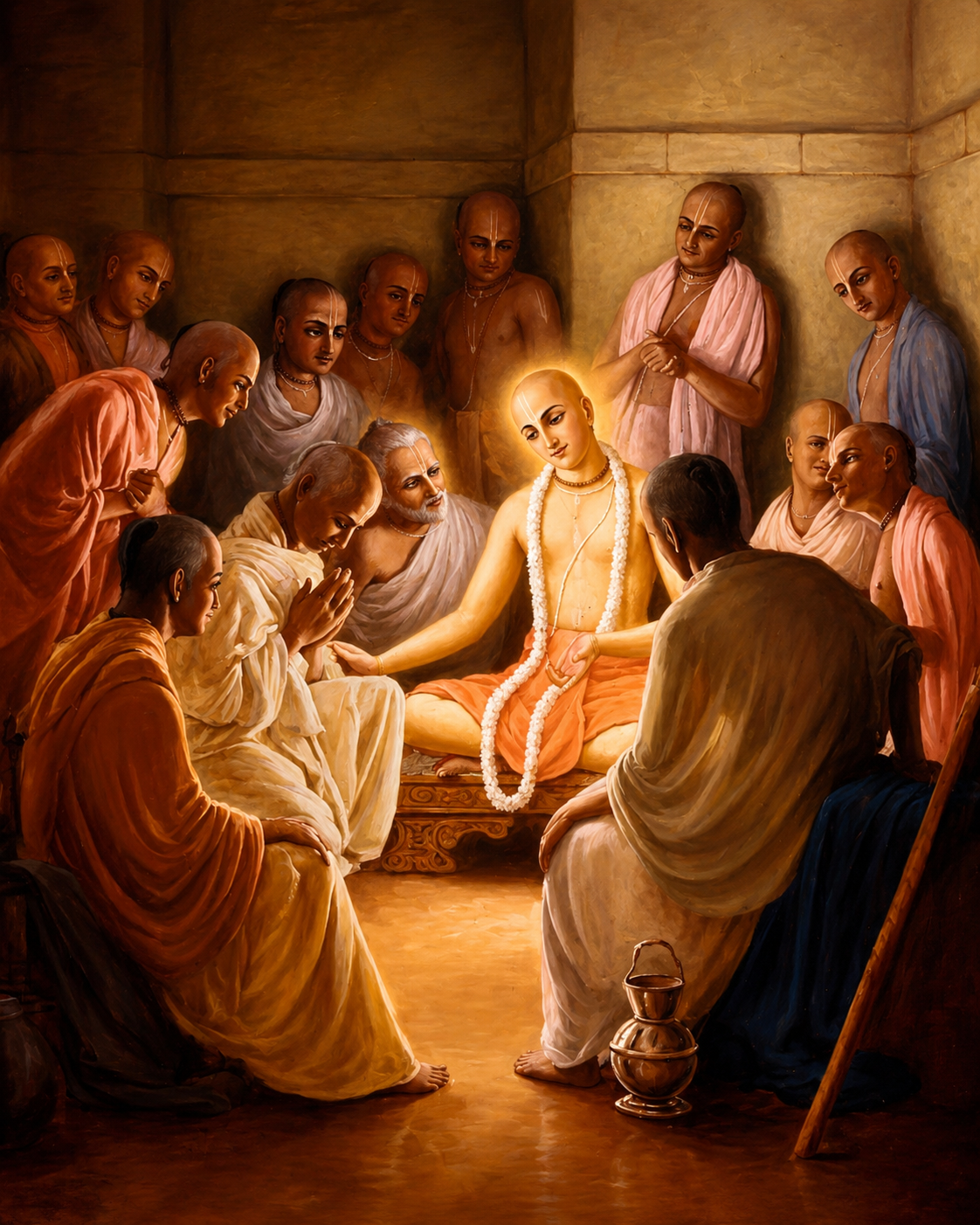 Sri Mukunda Datta — The Eternal Singer Whose Voice Made the Lord Dance.
"Mukunda Datta, a class friend of Lord Caitanya's, was another branch of the Caitanya tree. Lord Caitanya danced while he sang."
— Srila Prabhupada · Sri Caitanya-caritamrita, Adi-lila 10.40, TranslationThere is a kind of devotee the scriptures describe as priya-karau — one who is dear to the Lord and whose every act of service gives the Lord pleasure. Among all the intimate associates of Sri Chaitanya Mahaprabhu, Sri Mukunda Datta holds a singular distinction: he was the devotee whose kirtana made the Supreme Lord Himself rise and dance in ecstasy. Not once. Not occasionally. Consistently — whenever Mukunda's voice rose in the courtyard of Srivasa Prabhu, Lord Chaitanya could not remain still.
Classmate, singer, confidant, and tested devotee — Mukunda Datta's life is a treasury of lessons for every practitioner of bhakti. His story teaches us how the mercy of the Lord operates in unexpected ways; how even a devotee who momentarily touches wrong association can be fully redeemed by sincere surrender; and how the power of transcendental song is not ornamental to devotion but lies at its very heart.
On this sacred occasion — whether we honour his avirbhava (appearance day) or his tirobhava (disappearance day) — we at Dakshina Dwaraka Dham, ISKCON Thiruvanmiyur, on the shores of the Bay of Bengal, bow at the lotus feet of this great associate of the Lord and invite all devotees into the nectar of his life.
From Eternal Vraja to Navadvipa: The Origins of Mukunda Datta
To understand Mukunda Datta is to begin in Goloka Vrindavana itself. The Gaura-ganoddesa-dipika — the authoritative Gaudiya text that identifies each associate of Lord Chaitanya in terms of their eternal identity in the Lord's Vraja pastimes — reveals that Mukunda Datta was not an ordinary soul who happened to befriend the Lord of the universe. He was one of two celestially gifted singers of Vraja who descended specifically to serve in the Lord's Chaitanya-lila. Srila Prabhupada quotes this directly in his purport to Adi-lila 10.40:
"In Vraja there were two very nice singers named Madhukaṇṭha and Madhuvrata. They appeared in caitanya-līlā as Mukunda and Vāsudeva Datta, who were singers in the society of Lord Caitanya Mahāprabhu."
— Srila Prabhupada · CC Adi-lila 10.40, Purport (quoting Gaura-ganoddesa-dipika, verse 140)The very name Madhukahntha — "one who has a throat sweet as honey" — reveals the divine endowment that Mukunda Datta brought into this world. This was not a talent cultivated by practice alone; it was an eternal gift embedded in his very identity as a servant of the Lord in the spiritual world, now manifesting in Navadvipa.
In his earthly manifestation, Sri Mukunda Datta was born in the Chattagram district — present-day Chittagong in Bangladesh — in the village of Chanhaara, under the jurisdiction of the police station named Patiya. As Srila Prabhupada records in his purport to Adi-lila 10.40: "This village is situated ten krosas, or about twenty miles, from the home of Pundarika Vidyanidhi." This geographical detail is significant: Pundarika Vidyanidhi, one of the most exalted devotees of the age, was practically Mukunda Datta's neighbour. The devotional environment of Chattagram, rich with the association of such personalities, shaped Mukunda Datta from his earliest years.
His family connection with the saintly Vasudeva Datta — described by Srila Prabhupada as Mukunda Datta's brother [CC Adi-lila 10.41, Purport] — further illuminates the extraordinary devotional lineage into which he was born. Vasudeva Datta was himself so exalted that Lord Chaitanya declared: "I am only Vasudeva Datta's man. My body is only meant to please Vasudeva Datta, and he can sell Me anywhere." For Mukunda Datta to grow in the shadow of such a personality was itself divine arrangement.
The Lord's Own Classmate: A Friendship Born in the Academy
Among all the relationships that Sri Chaitanya Mahaprabhu cultivated in His Navadvipa pastimes, the bond with Mukunda Datta has a distinctive informality and intimacy — that of schoolmates who debated and sparred before they knew, in their external consciousness, the full magnitude of Who sat beside them.
Srila Prabhupada states in his purport: "When Lord Caitanya was a student, Mukunda Datta was His class friend, and they frequently engaged in logical arguments. Sometimes Lord Caitanya Mahaprabhu would fight with Mukunda Datta, using tricks of logic." [CC Adi-lila 10.40, Purport.] The specific Chaitanya-bhagavata chapters documenting these debates are the Adi-khanda, Chapters Eleven and Twelve — passages in which the future golden avatara of the Kali-yuga can be seen playfully testing and provoking His dear friend through the tools of Sanskrit logic. That the Supreme Lord chose to play in this way with Mukunda is itself a testament to the depth of their bond.
This kind of relationship — the Lord engaging a devotee through intellectual exchange before fully manifesting His divine nature — is part of the wonder of Chaitanya-lila. Mukunda Datta was among those closest to this divine unfolding.
The Voice That Moved the Lord: Mukunda Datta's Sacred Gift of Kirtana
The hallmark of Mukunda Datta's service — the one act for which he is most celebrated in the Gaudiya tradition — is his kirtana. And it was no ordinary kirtana. When Mukunda Datta sang, the Supreme Lord could not remain seated.
"When Mukunda Datta sang in the courtyard of Śrīvāsa Prabhu, Mahāprabhu danced with His singing."
— Srila Prabhupada · CC Adi-lila 10.40, PurportThe setting is the sacred courtyard of Srivasa Thakura — the very angana that served as the birthplace of the sankirtana movement — and within that holy space, Mukunda's voice was the instrument through which the Lord's ecstatic love found its external expression. It is one thing to cook for the Lord, to clean His temple, or even to recite His glories in philosophical discourse. It is another to sing in such a way that the Supreme Person is moved to rise and dance. This is the power of nama-sankirtana when sung with pure devotion, and Mukunda Datta was its living embodiment in the Lord's own circle.
The Sata-prahariya Manifestation
One of the most celebrated events of Lord Chaitanya's Navadvipa pastimes was the manifestation of the sata-prahariya — a continuous ecstatic trance in which the Lord displayed the symptoms of divine love for twenty-one uninterrupted hours. Srila Prabhupada's purport records the pivotal role Mukunda Datta played:
"when Lord Caitanya for twenty-one hours exhibited an ecstatic manifestation known as sāta-prahariyā, Mukunda Datta inaugurated the function by singing."
— Srila Prabhupada · CC Adi-lila 10.40, PurportThe word inaugurated is deeply significant. It was Mukunda Datta's kirtana that opened the gateway through which the Lord entered His twenty-one-hour divine trance. He was, in that moment, the instrument of the Lord's own play.
When the Lord Dressed as the Goddess of Fortune
Another extraordinary pastime preserved in Srila Prabhupada's purport concerns the occasion when Lord Chaitanya Mahaprabhu dressed Himself as the goddess of fortune, Sri Lakshmi, to dance in the house of Sri Chandrashekhara Acharya:
"When Lord Caitanya Mahāprabhu dressed Himself as the goddess of fortune to dance in the house of Candrasekhara, Mukunda Datta began the first song."
— Srila Prabhupada · CC Adi-lila 10.40, PurportThat the Lord entrusted the opening song of such an intimate and transcendental manifestation to Mukunda Datta speaks volumes. The Lord knew whose voice He wanted at the threshold of His divine revelations.
A Lesson for All Devotees: The Lord's Loving Chastisement
The most spiritually instructive episode in the life of Mukunda Datta involves a moment of crisis — one that should resonate with every sincere seeker who has ever struggled at the borderline between transcendental and mixed association. Srila Prabhupada presents this pastime with great care in his purports to Adi-lila 10.40 and Adi-lila 17.65.
The Forbidden Association
At some point during the Navadvipa pastimes, Mukunda Datta developed a habit that Lord Chaitanya found deeply troubling: while preaching the glories of devotional service among Vaishnavas, he would then go among the Mayavadi impersonalists to hear from them the Yoga-vasistha-ramayana — a philosophical text saturated with the impersonalist interpretation of reality. Srila Prabhupada explains in his purport to Adi-lila 17.65 that the Lord's response was one of profound displeasure:
"Mukunda Datta was once forbidden to enter the association of Śrī Caitanya Mahāprabhu because of his mixing with the Māyāvādī impersonalists. When Lord Caitanya manifested His mahā-prakāśa, He called all the devotees one after another and blessed them, while Mukunda Datta stood outside the door."
— Srila Prabhupada · CC Adi-lila 17.65, PurportThe devotees informed the Lord that Mukunda Datta was waiting outside. The Lord's reply, as recorded in Srila Prabhupada's purport, was categorical: "I shall not soon be pleased with Mukunda Datta, for he explains devotional service among devotees, but then he goes to Mayavadis to hear from them the Yoga-vasistha-ramayana, which is full of Mayavada philosophy. For this I am greatly displeased with him." [CC Adi-lila 17.65, Purport.]
The same devotee who had opened the sata-prahariya ecstasy with his song; the same friend who had debated logic with the Lord as a boy; the same singer whose voice had made the Supreme Person dance — this very devotee was now standing outside the door of the Lord's assembly. This is the Lord's clear teaching on the danger of philosophical compromise.
The Perfect Response: Joy in the Lord's Displeasure
What follows is among the most remarkable moments in all of Chaitanya-lila. Mukunda Datta, standing outside, hearing that the Lord was displeased — did not despair. He did not argue. He did not leave in humiliation. According to Srila Prabhupada's purport:
"Hearing the Lord speak in that way, Mukunda Datta, standing outside, was exceedingly glad that the Lord would at some time be pleased with him, although He was not pleased at that moment."
— Srila Prabhupada · CC Adi-lila 17.65, PurportMukunda Datta heard only one word in the Lord's statement: "some time". The Lord had said He would not soon be pleased — which meant He would be pleased, eventually. For Mukunda Datta, this was not a punishment. It was a promise. He rejoiced — exceedingly, the text says — at the certainty of the Lord's eventual mercy. This is the character of a pure devotee: he sees the Lord's will, in whatever form it comes, as cause for hope.
Full Redemption: The Lord's Compassion Prevails
The resolution comes swiftly once Mukunda Datta makes the decisive commitment to permanently abandon Mayavadi association. Srila Prabhupada's purport continues: "But when the Lord understood that Mukunda Datta was going to give up the association of the Mayavadis for good, He was pleased, and He at once called to see Mukunda. Thus He delivered him from the association of the Mayavadis and gave him the association of pure devotees." [CC Adi-lila 17.65, Purport.]
The Lord's "punishment" was in fact a blessing. The temporary exclusion from His company had served its purpose: to bring Mukunda Datta to full clarity about where his heart truly belonged — at the Lord's lotus feet, in the company of pure devotees, never again touching the poison of impersonalist philosophy.
Serving the Lord's Pastimes: Key Moments of Mukunda Datta's Sevas
Reciting Bhagavatam on the Lord's Return from Gaya
After Lord Chaitanya Mahaprabhu returned from Gaya, transformed by His initiation under Sri Isvara Puri, He was completely overwhelmed by krishna-prema. Nothing could satisfy His ecstatic longing except hearing of Krishna's pastimes. Srila Prabhupada notes in his purport that it was Mukunda Datta who rose to this occasion: "When Lord Caitanya Mahaprabhu returned from Gaya, Mukunda Datta gave Him pleasure by reciting verses from Srimad-Bhagavatam about krishna-lila." [CC Adi-lila 10.40, Purport.]
To recite Bhagavatam verses to the Lord Himself — to the very personality about Whom those verses speak — and to do so in a way that gives Him pleasure, requires not mere scholarship but the rare combination of genuine love for both Krishna and the literature that glorifies Him.
Bringing Gadadhara Pandita to Pundarika Vidyanidhi
One of the most pivotal acts of Mukunda Datta's life was orchestrating the spiritual connection between two great souls: Gadadhara Pandita and Pundarika Vidyanidhi. Srila Prabhupada states in his purport: "It was by his endeavor that Gadadhara Pandita Gosvami became a disciple of Pundarika Vidyanidhi." [CC Adi-lila 10.40, Purport, citing Sri Chaitanya-bhagavata, Madhya-khanda, Chapter Seven.] Mukunda Datta was the instrument through whom this divine arrangement was made.
Present at the Lord's Sannyasa
When the Lord secretly decided to accept the renounced order of life, He first went — significantly — to the house of Mukunda Datta. The Chaitanya-bhagavata (Madhya-khanda, Chapter Twenty-six) records that Mukunda Datta, sensing the imminent departure of his Lord from the householder life, entreated Him to continue the sankirtana movement for a few more days before taking sannyasa.
When the sannyasa ceremony eventually took place at Katwa, Mukunda Datta was fully present. Srila Prabhupada records: "The information of Lord Caitanya's accepting the renounced order was made known to Gadadhara Pandita, Chandrashekhara Acharya and Mukunda Datta by Nityananda Prabhu, and therefore all of them went to Katwa and arranged for kirtana and all the paraphernalia for Lord Caitanya's acceptance of sannyasa." [CC Adi-lila 10.40, Purport.]
After the ceremony, Mukunda Datta continued to follow the Lord as He began His journey northward. He was present at the famous episode at Jalesvara where Nityananda Prabhu broke the Lord's sannyasa rod. Srila Prabhupada notes simply: "Mukunda Datta was also present at that time." [CC Adi-lila 10.40, Purport.] These few words carry immense weight. Mukunda Datta was not a peripheral figure at these milestone moments — he was there, an intimate witness to the Lord's unfolding pastimes.
Annual Pilgrimage to Jagannatha Puri
After the Lord settled at Puri and entered His period of intense separation from Vrindavana, the devotees of Bengal would make annual pilgrimages to be with Him. Srila Prabhupada records of Mukunda Datta: "He went every year from Bengal to see Lord Caitanya at Jagannatha Puri." [CC Adi-lila 10.40, Purport.]
The discipline and devotion required to undertake this annual journey — across hundreds of miles, on foot or by boat, through all seasons — is itself a testament to Mukunda Datta's unwavering commitment to his Lord.
At Jagannatha Puri: Standing Firm for His Lord's Greatness
The Chaitanya-caritamrita Madhya-lila Chapter Six records one of the earliest episodes following the Lord's arrival in Puri, and Mukunda Datta plays a significant and illuminating role. Upon arriving in Puri, Mukunda Datta encountered his old acquaintance Gopinatha Acharya — the brother-in-law of the great scholar Sarvabhauma Bhattacharya — who was astonished to find him there.
Mukunda Datta informed Gopinatha Acharya that the Lord had taken sannyasa and had arrived in Puri, having fainted in ecstasy upon beholding Lord Jagannatha and been carried to Sarvabhauma's house. [CC Madhya-lila 6.23–26.] When Sarvabhauma Bhattacharya — not yet convinced of the Lord's true identity — suggested he could "bring Him into a first-class sampradaya by offering Him saffron cloth and performing the reformatory process again," the reaction of Mukunda Datta and Gopinatha Acharya was immediate:
"Gopīnātha Ācārya and Mukunda Datta became very unhappy when they heard this."
— CC Madhya-lila 6.77, TranslationGopinatha Acharya then defended the Lord's supreme position at length. Mukunda Datta's inner state through this entire exchange is captured precisely in Srila Prabhupada's translation:
"Śrīla Mukunda Datta felt very satisfied to hear the conclusive statements of Gopīnātha Ācārya, but he became very unhappy and angry to hear the statements put forward by Sārvabhauma Bhaṭṭācārya."
— CC Madhya-lila 6.113, TranslationThis moment reveals another dimension of Mukunda Datta's character: his instinctive and uncompromising recognition of his Lord's supreme position. Even before Sarvabhauma had been convinced of the Lord's divinity, Mukunda Datta's love gave him perfect vision. He was, in the truest sense, a devotee — not merely a friend, not merely a singer, but someone whose whole being was oriented toward the glory and honour of Lord Chaitanya Mahaprabhu.
What Mukunda Datta Teaches Every Devotee
The life of Mukunda Datta is not merely historical biography. It is a living curriculum for the practitioner of bhakti-yoga. Several lessons stand out with particular clarity.
Kirtana Is the Supreme Offering
The clearest lesson from Mukunda Datta's life is the matchless power of transcendental song. Srila Prabhupada declares throughout his teachings that the method of this age is the chanting of the holy name — harer nama eva kevalam — and Mukunda Datta's life demonstrates exactly why: when sung with love, kirtana moves even the immovable Supreme Lord to dance.
Mayavada Association Is Spiritually Dangerous
Lord Chaitanya's temporary exclusion of Mukunda Datta from His assembly — even a devotee of Mukunda's calibre — because of his contact with Mayavada literature is Srila Prabhupada's most important teaching arising from this episode. Impersonalist philosophy does not merely confuse; it destroys the very foundation of personal devotional relationship with the Lord.
The Devotee Finds Hope in Every Word of the Lord
Mukunda Datta's joyful response to the Lord's "not soon" is perhaps the most sublimely devotional moment in his story. He did not collapse in despair. He read the Lord's statement with the eyes of a lover and found in it the certainty of eventual reunion. This is the mood of the highest devotees: even the Lord's correction is received as His mercy.
Service in Friendship Is as Sacred as Any Other
Mukunda Datta shows that devotional service does not require formal renunciation to be profound. As a householder, as a classmate, as a singer, as a yearly pilgrim — in every role, he served. The variety of his sevas teaches us that the Lord receives service from wherever it is offered with love.
At Dakshina Dwaraka Dham: His Legacy in Our Midst
Here at Dakshina Dwaraka Dham, ISKCON Thiruvanmiyur, perched on the shores of the Bay of Bengal, we trace our lineage directly to the mission that Mukunda Datta served. The sankirtana movement that he inaugurated with his voice in the courtyard of Srivasa Prabhu — that same movement, now in its global form, is what we practise in every programme, every festival, and every nama-japa.
His Divine Grace Vishwa Guru A.C. Bhaktivedanta Swami Prabhupada — our Founder-Acharya — was himself a great lover of kirtana, and through his translations and purports of the Chaitanya-caritamrita, he ensured that the story of Mukunda Datta's sacred songs would reach devotees in every language and every country. When we sing the Hare Krishna maha-mantra with devotion, we are participating in the same current of transcendental sound that Mukunda Datta first channelled in Navadvipa.
Conclusion: The Song That Never Ended
Mukunda Datta's earthly pastimes have concluded, but his song has not. In the eternal realm of Goloka Vrindavana, Madhukahntha continues to sing, and the Supreme Lord continues to dance. Every sincere kirtana performed here in this world — in Navadvipa, in Puri, in Thiruvanmiyur, in Chennai, in every devotee's heart — is a participation in that eternal melody.
On this day of Mukunda Datta's avirbhava or tirobhava, let us offer him our heartfelt pranamas and pray that even a drop of his divine musical devotion may descend upon our practice; that his clarity in rejecting Mayavada may sharpen our own philosophical steadiness; and that his joy in the Lord's "not soon" may teach us patience and faith in the darkest moments of our own spiritual journey.
"Lord Caitanya danced while he sang."
— Sri Chaitanya-caritamrita, Adi-lila 10.40 — Translation by His Divine Grace A.C. Bhaktivedanta Swami PrabhupadaAll glories to Sri Mukunda Datta!
All glories to Srila Prabhupada!
Hare Kṛṣṇa Hare Kṛṣṇa Kṛṣṇa Kṛṣṇa Hare Hare /
Hare Rāma Hare Rāma Rāma Rāma Hare Hare
Lila Sthali — Places Connected to Sri Mukunda Datta
Navadvipa, West Bengal
The birthplace of the sankirtana movement where Mukunda Datta sang in Srivasa Thakura's courtyard and Lord Chaitanya danced.
Chanhaara, Chattagram (Chittagong)
Mukunda Datta's birthplace, in the village of Chanhaara under the Patiya police station, about twenty miles from the home of Pundarika Vidyanidhi.
Katwa, West Bengal
The site of Lord Chaitanya's sannyasa ceremony, where Mukunda Datta arranged kirtana and paraphernalia along with Gadadhara Pandita and Chandrashekhara Acharya.
Jalesvara
Where Nityananda Prabhu broke the Lord's sannyasa rod, and Mukunda Datta was present among the intimate companions.
Jagannatha Puri, Odisha
Destination of Mukunda Datta's annual pilgrimages from Bengal to be in the presence of Lord Chaitanya during His years of divine separation.
Frequently Asked Questions
Connect with Us
Follow Hare Krsna Movement Chennai across all platforms for daily darsana and event updates.