~ Divine Appearance Festival ~
Panihati Chida Dadhi Mahotsava:
The Blissful Festival of Chipped Rice and Nityananda's Mercy
The day Lord Nityananda "punished" Raghunatha Dasa Goswami with a feast that fed thousands — and opened the door to Sri Chaitanya Mahaprabhu's mercy
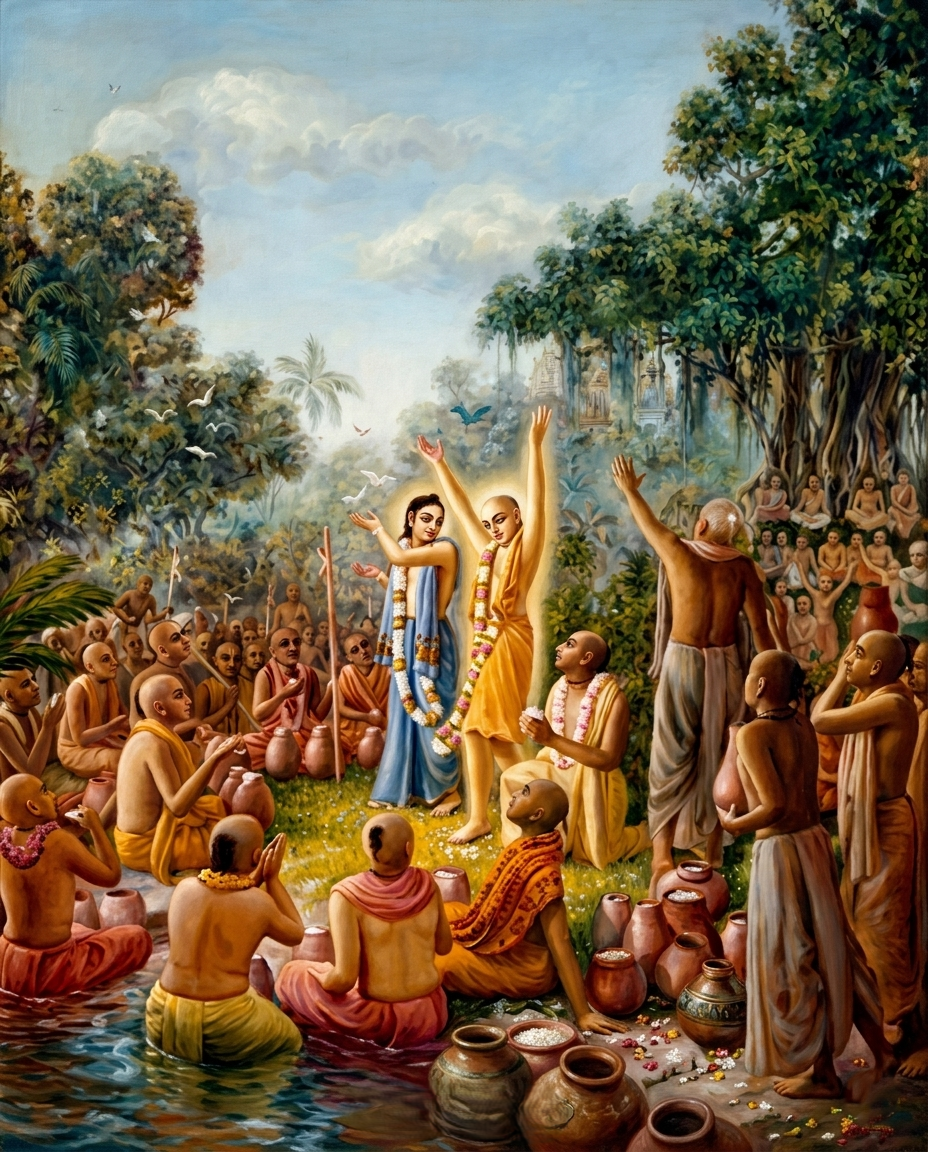 Lord Chaitanya Mahaprabhu and Lord Nityananda Prabhu joyfully participating in the Panihati Chida Dadhi Mahotsava — the transcendental festival of chipped rice and yogurt on the banks of the Ganges.
1. What Is the Panihati Chida Dadhi Mahotsava?
Every year, on the Ekadasi of the bright fortnight in the month of Jyestha (May–June), Vaishnavas across the world gather to celebrate the Panihati Chida Dadhi Mahotsava — a festival of pure joy, overflowing grace, and delicious prasadam. The name itself is a doorway into the pastime: Panihati is the village on the banks of the Ganges where the event took place; chida means flattened or chipped rice; dadhi means yogurt; and mahotsava means great festival.
At its heart, this is not merely a cultural event. It is the anniversary of a divine command — the day Lord Nityananda Prabhu, in His infinite mercy and characteristic playfulness, ordered Sri Raghunatha Dasa Goswami to feed all the Vaishnavas with chipped rice mixed with yogurt, condensed milk, bananas, and sugar. What began as a "punishment" became one of the most celebrated feasts in Gaudiya Vaishnava history.
Imagine a gathering where hundreds of people sit on the banks of a river, eating together in pure happiness, remembering God — and where God Himself joins in, invisibly but really. That is the Panihati Mahotsava.
2. Who Was Srila Raghunatha Dasa Goswami?
To understand the festival, we first need to understand the man at its centre — Sri Raghunatha Dasa Goswami, one of the Six Gosvamis of Vrindavana and among the most intimate associates of Sri Chaitanya Mahaprabhu.
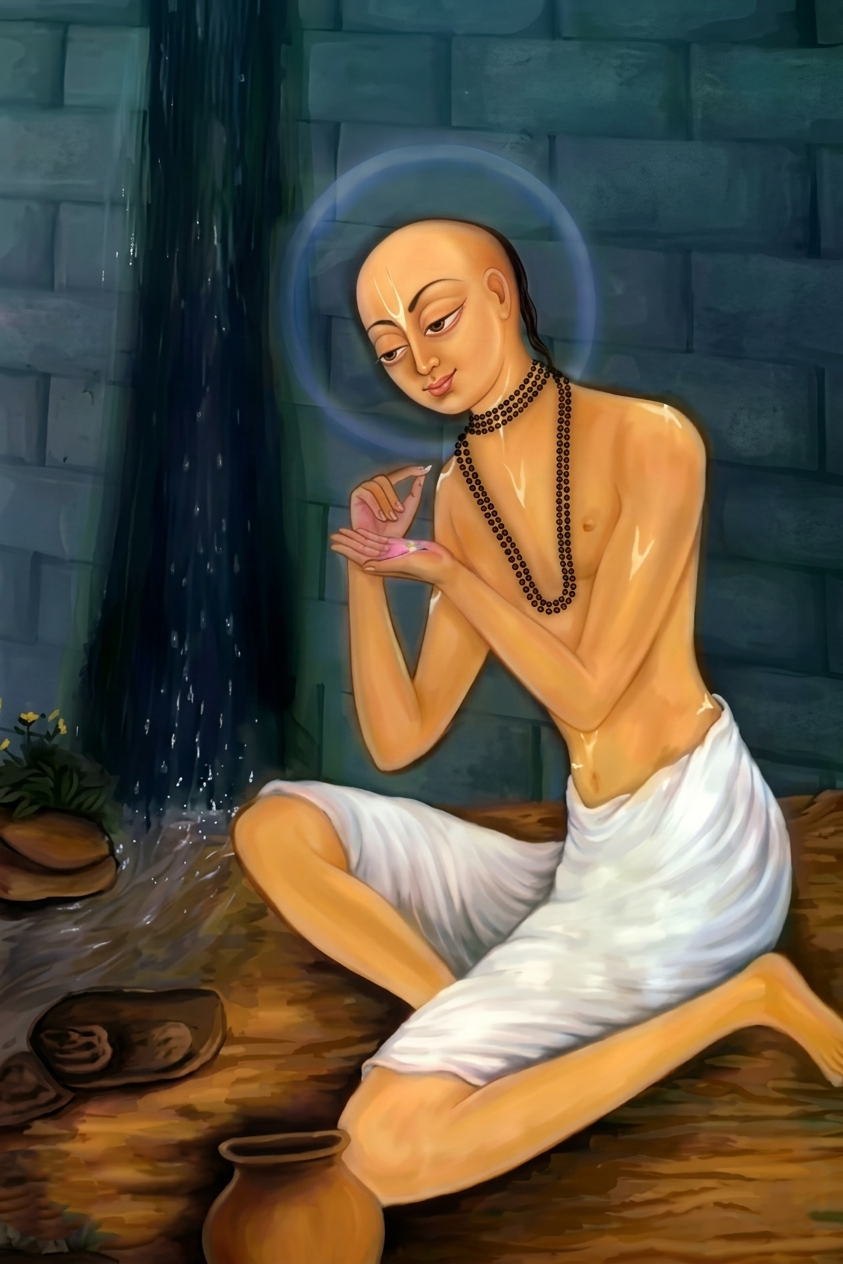 Srila Raghunatha Dasa Goswami — one of the Six Gosvamis of Vrindavana, whose intense renunciation and pure devotion remain an eternal inspiration for all Gaudiya Vaishnavas.
Raghunatha Dasa was born into immense wealth. His father, Govardhana, and uncle, Hiranya Dasa, were among the wealthiest landlords of Bengal. His wife was famously beautiful, his household well-ordered, and every material comfort was available without effort. To the world around him, he had everything.
Yet from a young age, Raghunatha Dasa burned with a single desire — to surrender completely at the lotus feet of Sri Chaitanya Mahaprabhu and live the life of a renounced devotee. The Chaitanya-charitamrita describes how he made repeated attempts to leave home. His mother once told his father despairingly: "Our son has become mad. Just keep him by binding him with ropes." His father replied with quiet wisdom:
"Raghunatha dasa, our son, has opulences like Indra, the heavenly king, and his wife is as beautiful as an angel. Yet all this could not tie down his mind. How then could we keep this boy home by binding him with ropes? It is not possible even for one's father to nullify the reactions of one's past activities."
— Sri Chaitanya-charitamrita, Antya-lila 6.39–40
This is the extraordinary quality of a soul touched by genuine bhakti — no amount of material comfort can substitute for the direct shelter of the Lord. Raghunatha Dasa eventually reached Jagannatha Puri and was placed under the care of Svarupa Damodara Goswami by Sri Chaitanya Mahaprabhu Himself. He later moved to Vrindavana, where he lived a life of extreme renunciation — living on a few morsels of rejected food, sleeping minimal hours, chanting constantly.
3. The Pastime: How the Festival Came to Be
The story unfolds in the village of Panihati. Lord Nityananda Prabhu — the embodiment of divine mercy and the elder brother of Sri Chaitanya Mahaprabhu — was sitting beneath a great tree on the bank of the Ganges, surrounded by hundreds of devotees. He was resplendent, His effulgence comparable to hundreds of thousands of rising suns (Antya-lila 6.44).
Raghunatha Dasa arrived and offered his prostrated obeisances from a distance. Lord Nityananda, who misses nothing, immediately called out to him — and with His characteristic mixture of affection and mischief, declared:
"You are a thief. Now you have come to see Me. Come here, come here. Today I shall punish you!"
— Lord Nityananda Prabhu, Chaitanya-charitamrita, Antya-lila 6.47
Before Raghunatha Dasa could approach, the Lord caught him and placed His lotus feet upon his head. Then came the "punishment": feed all My associates with yogurt and chipped rice.
What followed was extraordinary. Raghunatha Dasa immediately sent his men to purchase chipped rice, yogurt, milk, sugar, bananas, and various sweetmeats from surrounding villages. As word spread, learned scholars, brahmanas, priests, and devotees arrived by the hundreds — then thousands. Huge earthen pots were filled with chipped rice soaked in hot milk, then mixed with yogurt, sugar, and bananas. Another preparation was made with condensed milk, campa-kala bananas, clarified butter, and camphor. Two pots were offered to each person (Antya-lila 6.53–58).
Some sat on the raised platform, some on the riverbank, some waded into the Ganges itself and ate standing in the water, such was the overflow of the gathering.
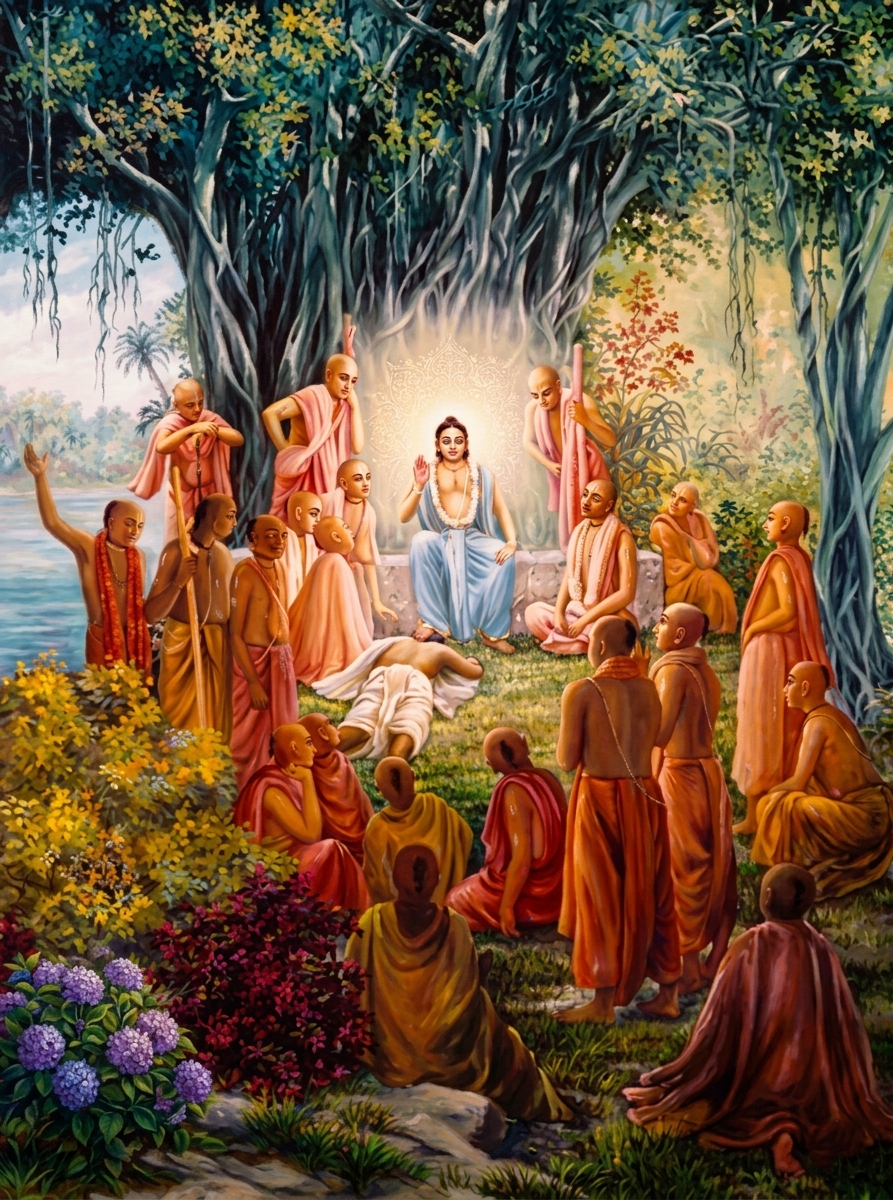 Lord Nityananda Prabhu bestowing His causeless mercy upon Raghunatha Dasa Goswami at Panihati — placing His lotus feet upon the devotee's head and ordering the great festival of chipped rice.
Then came the moment that transforms this story from a generous feast into a transcendental event. Lord Nityananda, in meditation, brought Sri Chaitanya Mahaprabhu to the site. As Nityananda walked through the groups of eating devotees, He playfully pushed a morsel of chipped rice into the mouth of Sri Chaitanya Mahaprabhu, who smiled and returned the gesture. Most could not see this exchange; only the most fortunate devotees, absorbed in ecstatic love, perceived that Sri Chaitanya Mahaprabhu was present (Antya-lila 6.77–82).
The following morning, Lord Nityananda placed His lotus feet upon Raghunatha Dasa's head and gave him the great benediction — Sri Chaitanya Mahaprabhu Himself had come to Panihati for his sake. Return home. Very soon, without any obstacles, you will attain His shelter. That promise was fulfilled within a short time, when Raghunatha Dasa finally reached Sri Chaitanya Mahaprabhu at Jagannatha Puri.
4. Panihati: The Sacred Festival Site
Panihati — located on the western bank of the Hooghly (Ganges) river, approximately 20 kilometres north of Kolkata in West Bengal — holds a place of great affection in Gaudiya Vaishnava geography. It was here that Lord Nityananda Prabhu regularly visited and stayed with His close associate Raghava Pandita, whose home became a place where both Lord Nityananda and Sri Chaitanya Mahaprabhu were said to partake of prasadam.
The kitchen of Raghava Pandita's house is described in the Chaitanya-charitamrita as one where Srimati Radharani Herself cooked, owing to a benediction received from Durvasa Muni that whatever She cooked would be sweeter than nectar (Antya-lila 6.115–116).
A temple at Panihati today marks the site of the festival — specifically the location of the great tree on the Ganges bank under which Lord Nityananda sat. The place breathes with the memory of that extraordinary afternoon when God and devotee sat together on a riverbank eating chipped rice.
5. How Panihati Reveals the Pastimes of Vrindavana
The Panihati festival is not simply a commemoration of a historical event. It is a re-enactment of something far more ancient — the simple, joyful meals that Krishna and Balarama shared with Their cowherd friends on the banks of the Yamuna in Vrindavana.
This parallel is stated directly in the Chaitanya-charitamrita. As Lord Nityananda walked among the groups of devotees eating their chida dadhi by the Ganges, the most fortunate among them were transported entirely:
"All the confidential devotees who were cowherd boys, headed by Sri Ramadasa, were absorbed in ecstatic love. They thought the bank of the Ganges to be the bank of the Yamuna."
— Sri Chaitanya-charitamrita, Antya-lila 6.90
"When all the Vaishnavas were chanting the holy names 'Hari, Hari' and eating, they remembered how Krishna and Balarama ate with Their companions the cowherd boys on the bank of the Yamuna."
— Sri Chaitanya-charitamrita, Antya-lila 6.87
Lord Nityananda Himself makes this connection explicit:
"I belong to a community of cowherd boys, and therefore I generally have many cowherd associates with Me. I am happy when we eat together in a picnic like this by the sandy bank of the river."
— Sri Chaitanya-charitamrita, Antya-lila 6.75
This is the inner meaning of the feast. Lord Nityananda is Balarama — Krishna's elder brother and eternal companion. When He sits with His associates on the riverbank and eats simple food, He is restoring, for those present, the atmosphere of Vrindavana itself. The Ganges becomes the Yamuna. The devotees become the cowherd boys. The chipped rice and yogurt become the simple forest picnic of the eternal pastimes.
When we participate in the Panihati Chida Dadhi Mahotsava — sitting together, chanting, eating prasadam by the grace of Lord Nityananda — we are, in the Vaishnava understanding, being given a taste of that same Vrindavana mood.
6. Srila Prabhupada on the Panihati Festival
His Divine Grace Vishwa Guru A.C. Bhaktivedanta Swami Prabhupada spoke about the Panihati pastime and its significance for practising devotees on several occasions. This festival offers the mercy of Lord Nityananda — the gateway through which the most conditioned souls can approach Sri Chaitanya Mahaprabhu.
"Just like Raghunatha dasa Goswami did. He came here, lived in Vrndavana. He was a very, very rich man's son. Five hundred years ago his father's income was twelve lakhs of rupees. And very beautiful wife. But he was not attracted. He was not even going inside the house. He was lying down outside the house, young man. He had no taste for visaya. Therefore later on he became Raghunatha dasa Goswami."
— Srila Prabhupada, Lecture on Srimad-Bhagavatam 6.2.14, Vrindavana, September 17, 1975
Srila Prabhupada also emphasised the significance of prasadam distribution as a core devotional activity, frequently citing the Panihati festival as a historical precedent. The principle of feeding everyone who arrives — invited or not, devotee or curious bystander — is the Vaishnava expression of universal compassion. This is the principle behind ISKCON's worldwide prasadam distribution programme and the Sunday feast tradition that Srila Prabhupada established from the very beginning of his preaching in the West.
7. How We Celebrate at Dakshina Dwaraka Dham, Chennai
At Dakshina Dwaraka Dham — Srila Prabhupada's ISKCON Thiruvanmiyur, Chennai — the Panihati Chida Dadhi Mahotsava is observed as a full evening of devotional celebration, open to all without any entry fee or prior registration.
All are cordially invited. There is no entry fee, no prior booking required, and no restriction based on background or faith. The festival is open to all who wish to come and participate in this beautiful Vaishnava tradition.
Frequently Asked Questions
What does 'Chida Dadhi' mean?▼
Is the festival only for ISKCON devotees?▼
Can children attend?▼
Is there an entry fee?▼
What is the significance of Lord Nityananda in this festival?▼
Where is Panihati, and can one visit?▼
How does observing this festival benefit the devotee?▼
✦ You Are Invited ✦
Come and Take Part
The Panihati Chida Dadhi Mahotsava at Dakshina Dwaraka Dham is one of the most joyful evenings in the temple calendar. Whether you are a practising devotee, a curious visitor, or someone who simply wants to experience something genuinely beautiful and spiritually nourishing — this festival is for you.
📍 Dakshina Dwaraka Dham
63, 1st Seaward Road, Valmiki Nagar
Thiruvanmiyur, Chennai — 600041
Hare Krishna Hare Krishna Krishna Krishna Hare Hare
Hare Rama Hare Rama Rama Rama Hare Hare
Connect with Hare Krishna Movement Chennai
Follow us across platforms for daily darshan, event updates, and spiritual content.