🛕 ISKCON Thiruvanmiyur
ISKCON Thiruvanmiyur (Hare Krishna Movement Chennai — Affiliated to ISKCON Bangalore Regn. S-49/78-79)
~ Sri Rama-Navami Special ~
Rama Navami:
The Appearance Day of Lord Ramacandra
and What It Means for Your Life
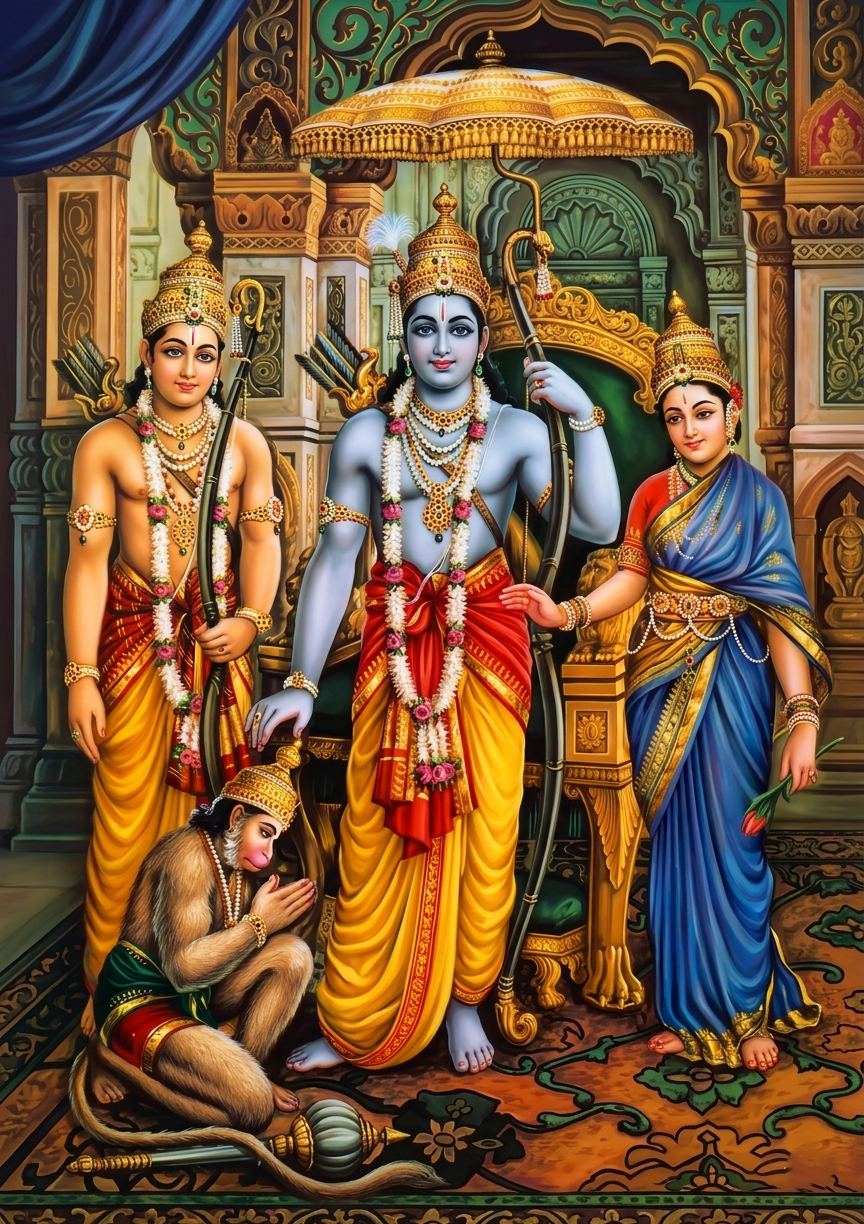
Every year, on the ninth day of the waxing moon in the month of Chaitra, millions of people across the world observe Rama Navami — the appearance day of Lord Ramacandra. Temples ring with kirtan. Devotees fast. The name of Rama fills the air.
But let us ask ourselves honestly: do we know why we celebrate? Do we understand who Lord Ramacandra truly is — not merely as a historical king, not merely as the hero of the Ramayana — but as the Supreme Personality of Godhead Himself, appearing on this earth to show us the perfect example of how a soul should live?
Today, on this most auspicious occasion, let us sit together — as Srila Prabhupada once sat with his students in Hawaii and Bombay — and hear the story of Lord Ramacandra. Because as Srila Prabhupada himself said: “If we hear His transcendental pastimes, that means we are associating with Ramacandra.”
1Who Is Lord Ramacandra? The Candle That Never Dims
Before we tell the story, we must understand the philosophy. Otherwise we will treat the Ramayana as mythology, as poetry, as entertainment — and miss the entire point.
In the Brahma-samhita, the great scripture of Brahma himself, it is declared:
rāmādi-mūrtiṣu kalā-niyamena tiṣṭhan
nānāvatāram akarod bhuvaneṣu kintu
kṛṣṇaḥ svayaṁ samabhavat paramaḥ pumān yo
govindam ādi-puruṣaṁ tam ahaṁ bhajāmi
“I worship Govinda, the primeval Lord, who is Kṛṣṇa Himself — the Supreme Person — who expands Himself as Lord Rāma and many other incarnations, according to the requirements of time and circumstance, and who appeared personally in this universe.” (Brahma-saṁhitā 5.39)
Srila Prabhupada explains this with a simple but perfect example. Think of a candle. You light one candle, and from that candle you light a second, a third, a fourth. Now — are all these candles of different power? No. Each candle burns with the same flame. The original candle and the tenth candle give the same light.
All the expansions of Krsna are of the same potency, same power. The difference is that one you can call the original candle and the others the second, the third. But so far the candle's power is concerned — there is no difference.
”— Srila Prabhupada, Bombay, 1974
Krsna is the original candle — the adi-purusa, the original person. Lord Ramacandra is His expansion — complete, perfect, fully divine. As the Srimad-Bhagavatam confirms:
ete cāṁśa-kalāḥ puṁsaḥ kṛṣṇas tu bhagavān svayam
“All these are either plenary portions or portions of the plenary portions of the Lord, but Kṛṣṇa is the Supreme Personality of Godhead Himself.” (Śrīmad-Bhāgavatam 1.3.28)
This is the correct understanding as given by the Vedic scriptures. We do not say Lord Rama is less than Krsna. We say Lord Rama is God — the same Supreme Lord, appearing in a different form, at a different time, for a different purpose. And that purpose was to show the world what a perfect king, a perfect husband, a perfect son, and a perfect soul looks like.
2When Did Lord Ramacandra Appear — and Where?
Lord Ramacandra appeared in Ayodhya — a city in northern India, approximately five hundred miles northeast of New Delhi. He appeared in the Treta-yuga, an age that ended more than two million years ago. His father was the great King Dasaratha, one of the most celebrated monarchs of the solar dynasty, tracing his lineage all the way back to Maharaja Iksvaku, the son of Manu.
Today — Rama Navami — marks the ninth day of the moon on which this extraordinary event took place. The Supreme Lord descended from the spiritual world and took birth as the son of Kausalya, the eldest queen of Dasaratha. He was named Ramacandra — Rama, the reservoir of all pleasure, and Candra, as brilliant and cooling as the moon.
And from the very first day of His life, He came to teach us something.
3What Does "Rama-Rajya" Mean — and Why Does the World Need It Today?
There is a phrase in India that has survived for thousands of years: Rama-rajya— the kingdom of Rama. Whenever people dream of a just society, a peaceful nation, a government that truly serves its people — they say: “We want Rama-rajya.”
Srila Prabhupada tells a remarkable story. Once, during the reign of Lord Ramacandra, a citizen came to the king’s open court and said: “My dear king, my son has died. How is it that in the presence of his father, a son can die? There must be something wrong in Your government.”
Let us pause and understand what is being said. This man was not complaining about taxes or roads. He was charging the king with responsibility for the untimely death of his child. And the king — Lord Ramacandra — took that complaint seriously.
The kings were so much responsible. They were always thinking of the happiness of the citizens — and the citizens were also so nice.
”— Srila Prabhupada, Hawaii, 1969
And the citizens? Srila Prabhupada tells us of a brahmana who would not eat a single morsel until he had taken darsana of Lord Ramacandra each morning. When the Lord went on a tour for a fortnight, this brahmana did not eat for the entire duration — not a drop of water — simply because he could not see his king, his God, his beloved Lord.
This is Rama-rajya. Not merely good administration — but a civilization where both the ruler and the ruled are God-conscious. Where every relationship — between king and subject, husband and wife, father and son, brother and brother — is rooted in dharma, in duty, in divine love. Is it any wonder the world still longs for this?
4The Test of a Great Soul — Renunciation and Obedience
Of all the stories in the Ramayana, none is more moving — and more instructive — than the story of Lord Ramacandra’s exile.
One day before His coronation as king of Ayodhya, His stepmother Kaikeyi reminded King Dasaratha of an old promise. Her demand was extraordinary: Lord Ramacandra must be exiled to the forest for fourteen years. Her own son Bharata must be crowned instead.
Dasaratha was shattered. But he was a ksatriya — a man of his word. So with a heart full of grief, he called his son. And what did Lord Ramacandra say?
“Yes, father. I am ready.”
No argument. No protest. No anger. The entire kingdom was waiting for His coronation — decorations had been hung, citizens had gathered — and He simply said: Yes, father. I am ready.
Srila Prabhupada identifies this as the display of one of the six great opulences of the Supreme Lord. In the Visnu Purana it is described:
aiśvaryasya samāgrasya vīryasya yaśasaḥ śriyaḥ
jñāna-vairāgyayoś caiva ṣaṇṇāṁ bhāgam itīṅganā
“Complete wealth, strength, fame, beauty, knowledge, and renunciation — these six are the opulences of the Supreme Lord.” (Viṣṇu Purāṇa 6.5.47)
Ramacandra exhibited the quality of renunciation — He renounced the whole kingdom simply on the order of His father. Out of the six opulences of God, this is one quality.
”— Srila Prabhupada, Hawaii, 1969
This is not the renunciation of a defeated man. This is the voluntary, joyful surrender of the Supreme Lord — demonstrating for all time that obedience, acceptance of God’s will, and detachment from material position are the highest qualities a soul can cultivate.
5Sita Devi — The Ideal of Devotion and Loyalty
When Lord Ramacandra prepared to leave for the forest, He turned to His young bride Sita Devi and said: “You cannot come. The forest is harsh. You are a king’s daughter, raised in comfort. Stay here.”
Sita’s reply has echoed through the ages:
“I am Your wife. I must go — even if You go to hell.”
And so she went. Into the forest. Into hardship. Into danger. Because she understood a truth our modern world has largely forgotten: devotion does not choose its circumstances.
And when Ravana — the demon king of Lanka — kidnapped Sita through deceit, Lord Ramacandra’s response was equally absolute. He was in exile — ordered to live in the forest — and He would not break that order. Instead, He built an alliance with the forest animals — the monkeys led by Hanuman and Sugriva. He constructed a bridge of floating stones across the ocean to Lanka. And He fought and defeated Ravana with an army of monkeys.
Why monkeys? Because the Lord does not depend on material power. He depends on devotion.
For Sita, Lord Ramacandra massacred the whole family of Ravana. The wife was so faithful she could not remain alone. And the husband was so faithful — He massacred the whole family of Ravana.
”— Srila Prabhupada, Hawaii, 1969
6How Do We Observe Rama Navami? The Power of Hearing and Chanting
We have now heard a portion of the story of Lord Ramacandra. But we must ask: what is the purpose of hearing it? Why do we fast? Why do we chant? Why do we come to the temple on this day?
Srila Prabhupada answers this with perfect clarity:
This is the unique gift of Vedic philosophy. God is absolute — meaning there is no difference between Him and His name, His form, His activities. When we chant Hare Rama, we are not merely repeating a word. We are touching the Supreme Lord. As the Srimad-Bhagavatam says:
śṛṇvatāṁ sva-kathāḥ kṛṣṇaḥ puṇya-śravaṇa-kīrtanaḥ
hṛdy antaḥ-stho hy abhadrāṇi vidhunoti suhṛt satām
“Lord Kṛṣṇa — who dwells in the heart of every living being as the Supersoul — cleanses the desire for material enjoyment from the heart of the devotee who relishes hearing His messages, which are in themselves virtuous when properly heard and chanted.” (Śrīmad-Bhāgavatam 1.2.17)
This is why we observe Rama Navami. Not as a ritual. Not as a cultural tradition. But as a direct opportunity to associate with the Supreme Lord. Every moment we spend hearing about Lord Ramacandra today, our heart becomes a little cleaner, our consciousness a little purer, our life a little more purposeful.
7What Can We Learn from Lord Rama for Our Daily Life?
The story of Lord Ramacandra is not an ancient tale for museum shelves. It is a living instruction manual for every soul who wishes to walk with dignity and purpose.
On duty: Lord Ramacandra accepted fourteen years of forest exile without a single word of protest. The Lord shows us that a noble soul accepts prescribed duty without complaint, performs it perfectly, and leaves the result in God’s hands.
On loyalty: Sītā Devī did not abandon her husband when life became difficult. Lakṣmaṇa did not stay behind in comfort. Hanūmān crossed an ocean out of pure devotion. In an age where relationships break at the first sign of inconvenience, Lord Rāma’s world shows us what real loyalty and real love look like.
On leadership: Lord Rāma held open court. Any citizen could approach the king directly. He took personal responsibility for the welfare of every soul in his kingdom. He is the eternal standard of a righteous ruler.
On God consciousness: The brāhmaṇa who would not eat until he had seen Lord Rāmacandra each morning — this is the level of God consciousness to which we are all being invited. Not fanaticism. Not superstition. But a deep, personal, daily relationship with the Supreme Lord.
How to Observe Rama Navami Today
We do not need to change our lives overnight. We simply need to take one step forward:
Chant: Today, add the Hare Rama maha-mantra to your chanting — Hare Krsna, Hare Krsna, Krsna Krsna, Hare Hare / Hare Rama, Hare Rama, Rama Rama, Hare Hare. There is no cost. There is no loss. Only purification.
Hear: Read or listen to the Ramayana — or simply sit with this article and let the story of Lord Ramacandra enter your heart. Hearing is direct association with God.
Fast: Observe a fast on Rama Navami — ideally till sunset. Even a partial fast is auspicious and pleasing to the Lord.
Visit: We warmly invite you to join us at ISKCON Thiruvanmiyur, Chennai for our Rama Navami celebrations.
Our daily program begins every morning at 4:30 AM with Mangala-arati. Come and take darsana of Lord Ramacandra, hear His glories in our Srimad-Bhagavatam class at 8:00 AM, and relish Krsna Prasadam — food offered with love and devotion to the Lord. Taste it once, and you will understand what no philosophy book can fully explain.
Conclusion: The King Who Came for All of Us
Lord Ramacandra did not appear on this earth for the people of Ayodhya alone. He appeared for every soul who has ever been confused, who has ever suffered, who has ever asked: “How should I live? What is the right thing to do? Where is God?”
He came to show us the answer — not in words, but in His own life. In every step He took toward the forest in exile. In every tear Sita shed in Ravana’s captivity. In every stone that floated on the ocean to build His bridge. In every moment of the Ramayana, the Supreme Lord is teaching us — patiently, lovingly, perfectly — what it means to live a life rooted in dharma, devotion, and divine love.
As Srila Prabhupada said: “Our process is purification. Krsna consciousness means simply we are purifying our consciousness.” And on this day of Rama Navami, the most powerful purification available to us is simply this — to hear His name, to tell His story, and to bow our heads before the Supreme Lord Ramacandra.
Sri Rama, Jaya Rama, Jaya Jaya Rama! 🙏
Hare Krsna!
Frequently Asked Questions
Q: What is Rāma Navāmī and why is it celebrated?
A: Rāma Navāmī is the appearance day of Lord Rāmacandra — the Supreme Personality of Godhead who descended to earth during the Tretā-yuga to demonstrate the perfect example of dharmic life. It falls on the ninth day of the waxing moon in the month of Chaitra (March–April). Devotees observe it through fasting till sunset, chanting, hearing the Rāmāyaṇa, and visiting temples to take darśana of Lord Rāmacandra.
Q: Is Lord Rāma the same as Lord Kṛṣṇa?
A: According to Vedic scripture — specifically the Brahma-saṃhitā (5.39) and Śrīmad-Bhāgavatam (1.3.28) — Lord Rāmacandra is an expansion of Lord Kṛṣṇa, the original Supreme Person. Just as one candle can light many others without losing its own flame, Kṛṣṇa expands into countless divine forms — all equally powerful, all equally divine. Lord Rāma is not a lesser God; He is God Himself in a different form, appearing for a specific purpose.
Q: Are there any Rāma Navāmī or Krishna consciousness programs near me in Chennai?
A: Yes — ISKCON Thiruvanmiyur celebrates Rāma Navāmī with special programs including kirtan, Bhāgavatam discourses, and prasādam distribution. Our daily program begins at 4:30 AM with Maṅgala-ārati, and our Śrīmad-Bhāgavatam class is held every morning at 8:00 AM. Sunday classes begin at 10:00 AM. All are welcome.
Q: How should I observe Rāma Navāmī at home?
A: The most powerful practice is to chant the Hare Kṛṣṇa mahā-mantra — which includes the holy name of Rāma — throughout the day. Observing a fast till sunset, reading or hearing the Rāmāyaṇa, and offering simple prayers to Lord Rāmacandra are all auspicious. If possible, visit a temple for darśana and hear the Lord’s glories in the association of devotees.
Q: Where can I learn more about Lord Rāmacandra and the Vedic scriptures?
A: You can visit our temple at ISKCON Thiruvanmiyur to attend daily classes and receive a copy of Śrīmad-Bhāgavatam or Bhagavad-gītā As It Is by Śrīla Prabhupāda. These editions provide the original Sanskrit, word-for-word meanings, and Śrīla Prabhupāda’s own purports that bring the scriptural message to life.
🌿 Connect With Us
We would love to welcome you to our growing community of seekers. Reach us through any of the platforms below or visit us in person.
ISKCON Thiruvanmiyur (Hare Krishna Movement Chennai — Affiliated to ISKCON Bangalore Regn. S-49/78-79)
🗺️ Open in Google Maps →