🛕 ISKCON Thiruvanmiyur
Hare Krishna Movement Chennai — Affiliated to ISKCON Bangalore · Reg. S-49/78-79
~ Sita Navami — The Appearance of Srimati Sita Devi ~
Srimati Sita Devi
Appearance Day
The Goddess Born of the Earth — Mother of the Three Worlds — Eternal Consort of Lord Ramacandra
Every year, on the auspicious Navami of Sukla Paksa in the month of Vaisakha, the Vaisnava world pauses to remember one of the most exalted personalities in all of creation: Srimati Sita Devi, the eternal consort of the Supreme Lord Ramacandra, the Mother of the Three Worlds, and the very embodiment of divine surrender.
On this sacred day of Sita Navami, while our temple at Dakshina Dwaraka Dham does not hold a formal celebration on this occasion, the day invites every devotee — in the quiet of their heart, before the Deities, or in the pages of Srila Prabhupada's books — to meditate on this incomparably glorious personality.
Who is Sita Devi, really? What does she represent in Vaisnava philosophy? What can the life of this eternally liberated goddess teach us as we struggle to purify our own lives? Let us explore these questions through the light of sastra and the unerring guidance of His Divine Grace Vishwa Guru A.C. Bhaktivedanta Swami Prabhupada.
Who Is Srimati Sita Devi?
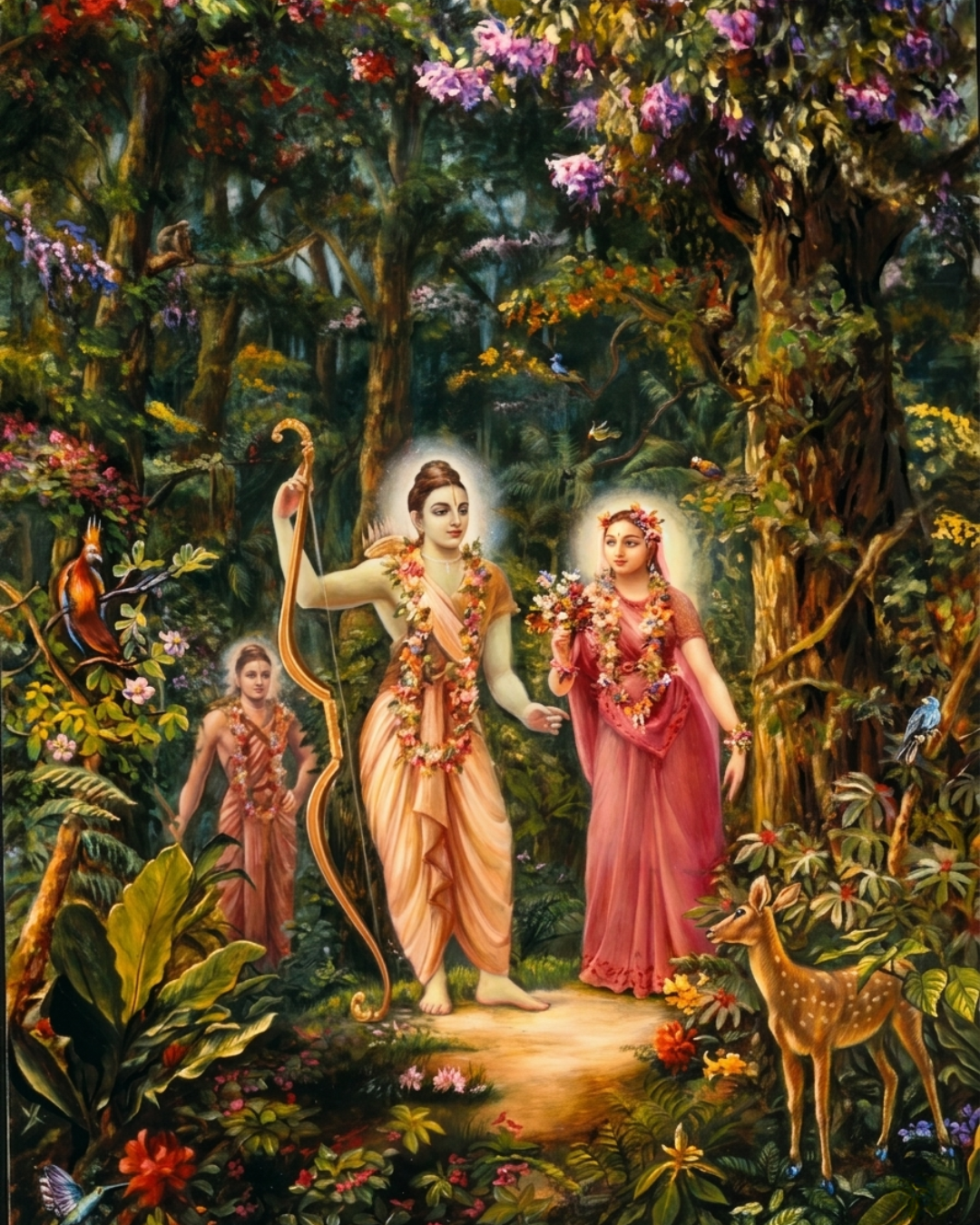
In popular understanding, Sita Devi is the devoted wife of Lord Ramacandra, kidnapped by the demon Ravana and eventually rescued in the great epic Ramayana. But this popular view captures only the surface of a bottomless ocean of transcendental reality.
Srimati Sita Devi is not an ordinary woman, not even an extraordinary one. She is the eternal, divine pleasure potency of the Supreme Lord — identical in quality with Laksmi Devi, the goddess of fortune, who eternally resides upon the chest of Lord Narayana. As Srila Prabhupada explains in the Srimad-Bhagavatam, she is non-different from the original source of all spiritual energy.
She is known by many sacred names. Each name reveals a different facet of her divine personality:
The Srimad-Bhagavatam (9.10.4) describes her as the very goddess of fortune who constantly rests on the chest of the Lord. This verse alone reveals her transcendental stature — she is not a historical queen, she is an eternal spiritual personality appearing in this world for the pleasure of the Lord and the instruction of all living beings.
The Miraculous Birth — Born of the Earth
Among all the divine births recorded in Vedic literature, few are as extraordinary as that of Sita Devi. She did not take birth through a human womb. She appeared miraculously from within the earth — a child discovered in a golden casket in a field being ploughed by King Janaka of Mithila, who was preparing the sacred ground for a great yajna (sacrifice).
The tradition records that the tip of a plough (sira) struck this hidden casket, and from it emerged a radiant infant girl of divine beauty. The word sira — the furrow made by a plough — gave the child her name: Sita. King Janaka, overwhelmed with wonder and devotion, accepted this miraculous child as his own beloved daughter.
That she is Bhumija — born of the earth — is deeply significant. Bhumi Devi (Mother Earth) is herself a form of Laksmi, the divine consort of Lord Visnu. The earth sustains all beings, nourishes all life, bears all burdens without complaint, and gives freely without expectation of return. That Sita Devi emerged from the earth is not coincidence — it reveals her very nature: infinite patience, silent endurance, and selfless nourishment.
sva-dharmam grha-medhiyam siksayan svayam acarat
This verse sets the stage for understanding Sita Devi's divine appearance: Lord Ramacandra came as the ideal husband and dharmic king, and Sita Devi appeared as the inseparable other half of his eternal identity — his hladini-sakti, his pleasure potency in the form of the ideal wife.
Sita as Hladini-Sakti — The Pleasure Potency of the Lord
To understand Sita Devi's position in Vaisnava philosophy, one must understand the nature of the Lord's potencies. Srila Prabhupada explains throughout his writings that the Supreme Lord has three principal internal potencies: sandhini (the potency of existence), samvit (the potency of knowledge), and hladini (the potency of bliss and pleasure).
The hladini-sakti is the pleasure potency — the energy by which the Lord enjoys supreme bliss. In the highest understanding of Vaisnava philosophy, Srimati Radharani is the full manifestation of this hladini-sakti. But as the Lord expands Himself into various forms — as Narayana in Vaikuntha, as Ramacandra in the Treta-yuga — his pleasure potency also correspondingly expands as Laksmi Devi, as Sita Devi.
“Sita-devi is the origin of all potencies of the Supreme Personality of Godhead. Cit-sakti. Parasya saktir vividhaiva sruyate. The Supreme Personality of Godhead has got many potencies, multipotencies, and one of the potency is hladini-sakti, pleasure potency. That pleasure potency is Sita, Radharani, Laksmi-devi. The Lord has got unlimited potencies, so one of the potency is Radharani or Laksmi or Sita. They are equal. There is no difference.”— His Divine Grace A.C. Bhaktivedanta Swami Prabhupada
Lecture on SB 7.9.26, Mayapur, 4 March 1976
This is a most remarkable teaching. Srila Prabhupada here states unequivocally: Sita, Radharani, and Laksmi — they are equal. They are all manifestations of the one divine pleasure potency. There is no difference in their transcendental quality, only in their relational context with the particular form of the Lord they serve.
The philosophical grounding comes from the verse of Svarupa Damodara Gosvami, quoted repeatedly by Srila Prabhupada:
ekatmanav api bhuvi pura deha-bhedam gatau tau
Just as Radha and Krsna are one yet appear as two for the sake of transcendental loving exchange, so too Sita and Rama are one transcendental reality appearing in two forms. Because the Lord is always worshipped together with his potency, we always chant: Sita-Rama, Laksmi-Narayana, Radha-Krsna.
“Hare Krsna means the Supreme Lord and His spiritual potency. Without energy, the Lord is incomplete. Radha-Krsna, Laksmi-Narayana, Sita-Rama. So God is always with energy. Without energy, He is incomplete.”— His Divine Grace A.C. Bhaktivedanta Swami Prabhupada
Room Conversation, 1966
The Ideal Wife — Prabhupada's Purport on SB 9.10.55
Of all the scriptural statements about Sita Devi, perhaps none is as concentrated and precise as the verse Srimad-Bhagavatam 9.10.55, where Sukadeva Gosvami glorifies her in a single verse that contains a universe of meaning.
bhiya hriya ca bhava-jna bhartuh sitaharan manah
Srila Prabhupada's purport to this verse:
“As Lord Ramacandra is the ideal husband (eka-patni-vrata), mother Sita is the ideal wife. Such a combination makes family life very happy. Yad yad acarati sresthas tat tad evetaro janah: whatever example a great man sets, common people follow. If the kings, the leaders, and the brahmanas, the teachers, would set forth the examples we receive from Vedic literature, the entire world would be heaven; indeed, there would no longer be hellish conditions within this material world.”— His Divine Grace A.C. Bhaktivedanta Swami Prabhupada
Purport to Srimad-Bhagavatam 9.10.55
The Sanskrit synonyms of this verse are worth meditating upon individually:
- premna anuvrttya — by service rendered to the husband with love and faith
- silena — by good character
- prasraya-avanata — always very submissive, ready to satisfy
- sati — chaste and pure
- bhiya — with reverential awe
- hriya — with shyness and modesty
- bhava-jna — understanding the innermost mood and intention of the Lord
Each of these qualities is a spiritual virtue, not a social convention. Sita Devi does not serve Rama out of societal compulsion — she serves him because she is his pleasure potency. Her service is the expression of her spiritual identity, as natural to her as the warmth that radiates naturally from fire.
“Just as Lord Ramacandra is the ideal husband (eka-patni-vrata), mother Sita is the ideal wife. Such a combination makes family life very happy.”
“There are many stories — Nala-Damayanti, then Parvati, Sita — five chaste women in the history. They should read their life.”— His Divine Grace A.C. Bhaktivedanta Swami Prabhupada
Morning Walk Conversation, Dallas, 1973
The Cosmic Message of Ravana's Abduction
The most dramatic episode in Sita Devi's pastimes is her abduction by the demon Ravana. Superficially, this reads as a tragedy — the virtuous queen taken by a powerful and lustful demon. But Srila Prabhupada reveals the cosmic significance of this event in a conversation that is both striking and profound.
“Materialists are like Ravana — they have kidnapped Sita, or Laksmi. And we, as devotees, act as Hanuman to get Laksmi back from Ravana and return her to Rama, or Narayana, by engaging the materialists' money in the service of the Lord.”— His Divine Grace A.C. Bhaktivedanta Swami Prabhupada
(As recalled by Giriraj Swami in conversation with Prabhupada)
This teaching turns the Ramayana into a living, present-day reality. The maya of this world — the false notion that we can possess, control, and enjoy the Lord's energy for our own pleasure — is precisely the Ravana-tendency. Ravana did not want Sita to return to Rama. He wanted to enjoy Sita for himself. This is the very definition of material consciousness.
Sita is Laksmi — the energy, the wealth, the beauty, the fertility of this world. All of it belongs to the Lord. When we try to exploit it for ourselves, separated from the Lord, we become Ravana. When we, like Hanuman, carry the Lord's message and reunite the energy with the energetic — we serve our highest calling.
svar-yositam nalina-gandha-rucam kuto 'nyah
rasotsave 'sya bhuja-danda-grhita-kantha-
labdhasisam ya udagad vraja-vallabhinam
The Secret Sri Caitanya Revealed — Ravana Never Touched the Real Sita
Here is a teaching so profound that Sri Caitanya Mahaprabhu himself was described as becoming deeply satisfied upon reading it. It is recorded in the Kurma Purana and cited by Srila Prabhupada in both Sri Caitanya-caritamrta (Madhya-lila 9.201–206 and 9.211–212) and the purport to Srimad-Bhagavatam 9.10.11. It answers the question that has troubled thoughtful readers of the Ramayana for centuries:
How could the chaste Sita Devi, the goddess of fortune herself, have been touched by a demon like Ravana?
The answer, as revealed by the Kurma Purana and confirmed by Lord Caitanya himself: She was not.
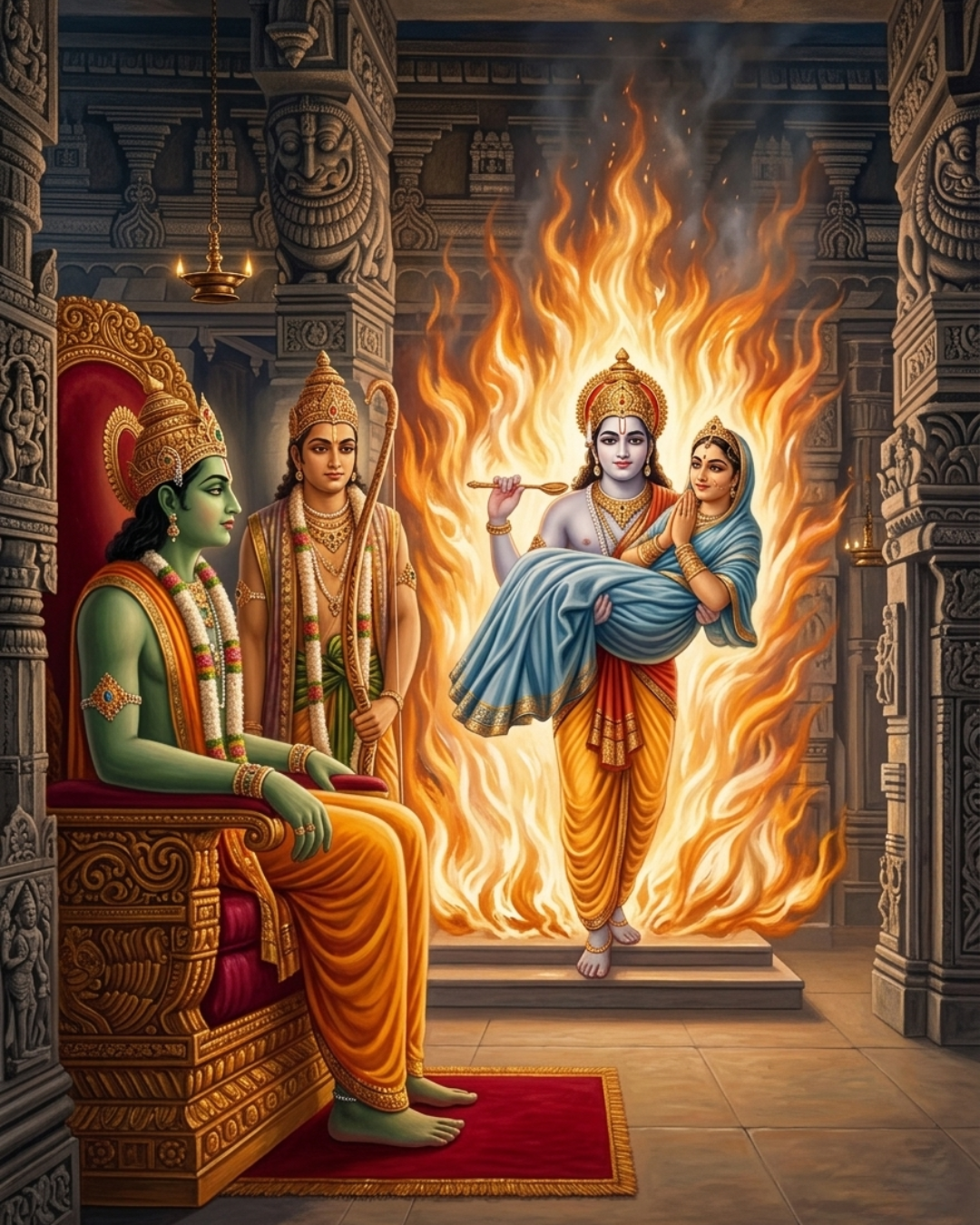
When Ravana arrived at the hermitage in the forest, the moment Sita Devi saw him — she immediately took shelter of Agni, the fire-god. The fire-god covered her, protected her, and produced an illusory shadow form — maya-sita — in her place. It was this shadow Sita that Ravana kidnapped. The real Sita Devi, hidden and protected, was brought by Agni to the care of goddess Parvati. The real Sita never entered Lanka. The real Sita was never in Ravana's captivity for a single moment.
ravana haite agni kaila sitake avarana
‘maya-sita’ diya agni vancila ravane
tam jahara dasa-grivah sita vahni-puram gata
pariksa-samaye vahnim chaya-sita vivesa sa
vahnih sitam samaniya tat-purastad aninayat
(Srila Prabhupada's purport: “These two verses are taken from the Kurma Purana.”)
“Upon hearing from the Kurma Purana how Ravana had kidnapped a false form of mother Sita, Sri Caitanya Mahaprabhu became very much satisfied.”— Sri Caitanya-caritamrta, Madhya-lila 9.203
Translation by His Divine Grace A.C. Bhaktivedanta Swami Prabhupada
“It was actually impossible for Ravana to take away Sita. The form of Sita taken by Ravana was an illusory representation of mother Sita — maya-sita. When Sita was tested in the fire, this maya-sita was burnt, and the real Sita came out of the fire.”— His Divine Grace A.C. Bhaktivedanta Swami Prabhupada
Purport to Srimad-Bhagavatam 9.10.11
Why Does This Matter So Deeply?
🔑 Three Profound Implications
- Sita Devi is eternally untouchable by material forces. She is the hladini-sakti, the internal potency of the Supreme Lord. She cannot be possessed, enjoyed, or defiled by any conditioned soul — not even Ravana.
- The agni-pariksa was never a test of Sita's purity. Her purity was never in question. The fire test was the arrangement by which the real Sita was ceremonially returned to Lord Ramacandra — the maya-sita dissolved, and the real Sita stepped forward. It was a divine reunion, not an ordeal.
- Ravana never won anything. He thought he had captured Laksmi — the greatest prize in the universe. But he had captured only a shadow. This is the perfect metaphor for all material enjoyment: the materialist captures what he thinks is happiness — but it is always maya-sita, a false form. The real Sita belongs only to the Lord and returns only to the Lord.
This is why Sri Caitanya Mahaprabhu was “very much satisfied” upon reading this account. It vindicates the absolute purity of Sita Devi beyond any doubt, and reveals the deeper spiritual truth: the Lord's energy is eternally protected, eternally pure, and eternally inseparable from the Lord — no matter how it may appear to the external eye.
The Supernatural Power of Chastity
One of the most important teachings embedded in the story of Sita Devi is the extraordinary spiritual power that flows from chastity and one-pointed devotion. Srila Prabhupada is explicit on this point:
tejo 'nubhavam sitaya yena nito dasam imam
Srila Prabhupada's purport to this verse states:
“Not only was mother Sita powerful, but any woman who follows in the footsteps of mother Sita can also become similarly powerful. There are many instances of this in the history of Vedic literature. Whenever we find a description of ideal chaste women, mother Sita is among them. Mandodari, the wife of Ravana, was also very chaste. Similarly, Draupadi was one of five exalted chaste women. As a man must follow great personalities like Brahma and Narada, a woman must follow the path of such ideal women as Sita, Mandodari and Draupadi. By staying chaste and faithful to her husband, a woman enriches herself with supernatural power.”— His Divine Grace A.C. Bhaktivedanta Swami Prabhupada
Purport to Srimad-Bhagavatam 9.10.27
When Ravana kidnapped the maya-sita and held her captive in Lanka, he could not touch her. He offered every material inducement — yet Sita remained immovable. She held a blade of grass between herself and Ravana and kept her mind fixed entirely on Lord Rama. Mandodari, Ravana's own wife, understood this perfectly. Because she herself was a chaste woman, she could perceive the power of another chaste woman. Ravana did not listen — and was destroyed.
🪷 Timeless Lessons from Sita Devi's Life
- Purity is power: Sita's chastity was her invincible armour. Inner strength rooted in devotion surpasses any material force.
- Surrender is not weakness: Sita's surrender to Lord Rama was the surrender of energy to the energetic — a divine reality, not a social submission.
- Patience in adversity: Whether in the forest or in Lanka, Sita Devi never lost faith. Her equanimity is a model for every sadhaka.
- Renunciation without bitterness: Even when Lord Rama sent her to the forest, Sita accepted this without rancour, continuing to worship him.
- Service as spiritual identity: Her service to Rama was not a duty imposed from outside — it was the expression of who she is, eternally.
Sita Devi and Sri Caitanya Mahaprabhu
It is recorded in the writings of the Vaisnava tradition that when Lord Ramacandra, Sita Devi, and Laksmana passed through the land of Navadvipa during the Treta-yuga, Lord Rama revealed to Sita Devi:
“O Devi, this Navadvipa is very dear to Me. In the beginning of the upcoming Kali-yuga, I will come here in the form of Sri Caitanya Mahaprabhu, and You, Sita, will come here as Srimati Visnupriya.”— Navadvipa-dhama Mahatmya (as recorded in the Vaisnava tradition)
As Visnupriya Devi, she appeared once more as the devoted wife of the Lord, accepting the profound separation of Lord Caitanya's sannyasa — perhaps the most poignant expression of her eternal nature as the potency that accepts even the greatest separation in perfect love.
jagatera mata sita — ramera grhini
How to Honour This Sacred Day
At Dakshina Dwaraka Dham, we do not hold a formal observance on Sita Navami. Yet every devotee can personally observe this day in a meaningful way. Srila Prabhupada's recommendation is always the same: use every auspicious day to deepen one's devotional practice.
🌸 Personal Observance — Simple and Powerful
- Chant extra rounds of the Hare Krsna maha-mantra with the mood of Sita Devi — complete surrender, one-pointed devotion.
- Read Srimad-Bhagavatam Canto 9, Chapter 10 — Sukadeva Gosvami's account of Lord Ramacandra's pastimes with Sita Devi.
- Chant or hear the Rama-nama: Rama Rama Hare Rama, Hare Hare, Hare Krsna Hare Krsna, Krsna Krsna Hare Hare.
- Offer a simple flower at the altar with the prayer: Srimati Sita Devi, mother of the three worlds, please bless me with one drop of your surrender and chastity of heart.
- Observe a partial fast until noon, as many Vaisnavas traditionally do on this day.
- Share the glories of Sita Devi — with family, with friends, with whoever will listen. The sravanam-kirtanam of the Lord and his devotees is the very process of this age.
Whatever form our remembrance takes, the important thing is smaranam — remembrance. Srila Prabhupada repeatedly taught that hearing and chanting about the Lord's devotees purifies the heart just as hearing about the Lord himself does. And what greater devotee is there than Sita Devi — the very embodiment of devotion in its most exalted form?
Frequently Asked Questions
Common questions about Srimati Sita Devi, Sita Navami, and Dakshina Dwaraka Dham — answered through the Vaisnava lens.
According to Srila Prabhupada's purport to Srimad-Bhagavatam 9.10.4, Srimati Sita Devi is the goddess of fortune who resides on the chest of the Lord — non-different from Laksmi Devi and the eternal consort of Lord Ramacandra. She is the internal pleasure energy (hladini-sakti) of the Supreme Lord, not an ordinary woman but an eternally liberated divine personality. The Kurma Purana (quoted in Sri Caitanya-caritamrta, Madhya-lila 9.201) further declares her the mother of the three worlds and the supreme among all chaste women.
Sita Navami — also known as Janaki Navami or Srimati Sita Devi's Appearance Day — is observed annually on Vaisakha Sukla Navami, the ninth day of the bright fortnight in the month of Vaisakha.
Sita Navami commemorates the divine appearance of Srimati Sita Devi, who emerged from the earth as King Janaka ploughed a field in preparation for a yajna. Devotees observe this day by chanting the Hare Krsna maha-mantra with the mood of complete surrender, reading Srimad-Bhagavatam Canto 9 Chapter 10, offering flowers at the altar, and observing a partial fast until noon.
According to Srila Prabhupada's purport to Srimad-Bhagavatam 10.47.60, both Srimati Sita Devi and Srimati Radharani are expansions of the Lord's pleasure potency (hladini-sakti). Sita Devi is the eternal consort of Lord Ramacandra in the Vaikuntha mood of aisvarya (divine opulence). Radharani is the consort of Lord Krsna in the Vraja mood of madhurya (sweet intimacy). Even Laksmi Devi — of whom Sita is an expansion — yearns for the platform of the Vraja gopis, as Sukadeva Gosvami explains in that same verse.
According to the Navadvipa-dhama Mahatmya, when Lord Ramacandra passed through Navadvipa in Treta-yuga, He revealed to Sita Devi that He would return in Kali-yuga as Sri Caitanya Mahaprabhu, and that She would appear as Srimati Visnupriya Devi — Mahaprabhu's devoted wife who accepted the profound separation of His sannyasa with perfect, unbroken surrender.
Srila Prabhupada describes Sita Devi as the personification of the Lord's hladini-sakti — the divine pleasure potency. He explains that her pativratya-dharma (complete fidelity to Lord Rama) gave her supernatural protection even against the powerful demon Ravana, and cites Srimad-Bhagavatam 9.10.27 to illustrate how chastity and devotion become the greatest spiritual armour.
Connect With Us
Follow Hare Krishna Movement Chennai across all platforms for daily darsan, spiritual insights, event updates, and seva opportunities.
📍 Dakshina Dwaraka Dham — Find Us
🗺️ Get DirectionsAll Glories to Srimati Sita Devi!
On this most auspicious day of Vaisakha Sukla Navami, we bow at the lotus feet of the Mother of the Three Worlds. May her example of surrender, patience, and one-pointed love inspire every heart that seeks the Supreme.
Jaya Sita-Rama!
Jaya Jaya Sita-Rama!