Appearance & Disappearance Day Special
Sri Madhavendra Puri Gosvami
The Root from Which the Tree of Pure Devotion Grew
The grand-spiritual-master of the Golden Avatara — the acarya who first planted the seed of love of Godhead in this world, in the disciplic succession of Sri Madhva-Gaudiya-sampradaya.
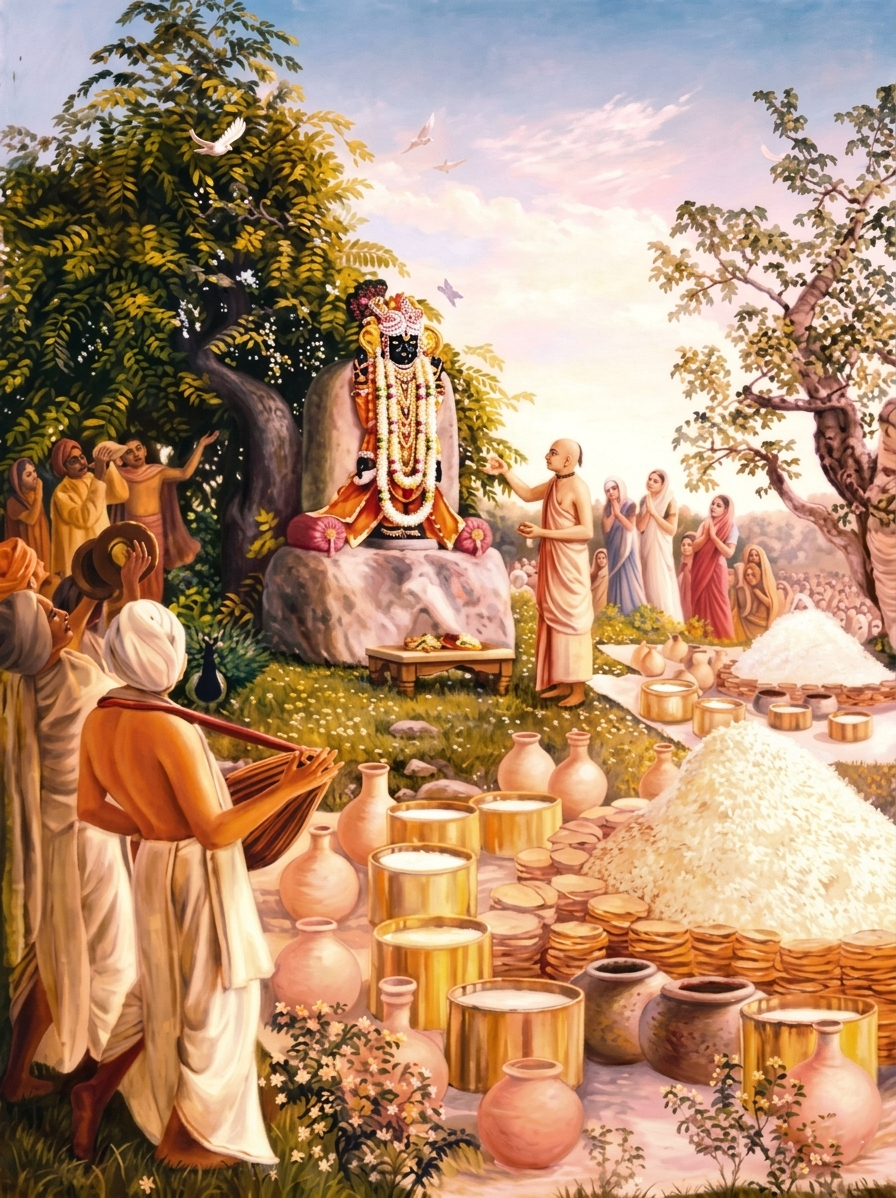 Sri Madhavendra Puri Gosvami worshipping Sri Gopala at Govardhana Hill
In the vast garden of Gaudiya Vaisnava tradition, there is one great soul whose very name moves Lord Caitanya Mahaprabhu to spontaneous tears. He is Sri Madhavendra Puri Gosvami — the grand-spiritual-master of the Golden Avatara Himself, the acarya who first planted the seed of pure love of Godhead in this world.
Whether we honour the anniversary of his divine appearance or his departure from this world, the devotional community of the Gaudiya-Madhva-sampradaya pauses to remember and glorify this extraordinary personality. Everything here is drawn entirely from the Caitanya-caritamrta, Madhya-lila Chapter 4 and Antya-lila Chapter 8 — the complete account of Sri Madhavendra Puri's life and service, as narrated by Lord Caitanya Mahaprabhu Himself.
Who Is Sri Madhavendra Puri?
Sri Madhavendra Puri was a great Vaisnava sannyasi in the disciplic succession coming from Madhvacarya, initiated by Sri Laksmipati Tirtha. Krsnadasa Kaviraja Gosvami, in Antya-lila Chapter 8, gives him the title that sums up his position in one phrase: "the spiritual master of the entire world." He stands at the most important junction in the entire history of the Gaudiya-Vaisnava movement.
The disciplic succession runs precisely: from Krsna to Brahma, to Narada, to Vyasa, to Madhvacarya — through a chain of great acaryas down to Laksmipati Tirtha, then to Madhavendra Puri, then to Isvara Puri, and then to Lord Caitanya Mahaprabhu Himself.
"Our sampradaya belongs to the disciplic succession of Madhavendra Puri, who belonged to the Madhva-sampradaya. We are in the disciplic succession of Sri Caitanya Mahaprabhu, who was initiated by Sri Isvara Puri, a disciple of Madhavendra Puri's. Our sampradaya is therefore called the Madhva-Gaudiya-sampradaya."
— Cc. Madhya 4, purport by Srila PrabhupadaWithout Madhavendra Puri there is no Isvara Puri; without Isvara Puri there is no Caitanya Mahaprabhu's great movement of sankirtana; without that — no worldwide chanting of the Holy Names. His position in the parampara is that essential.
The First Seed of Love of Godhead
Before Sri Madhavendra Puri, the Madhvacarya-sampradaya was followed with great strictness — correct philosophy, careful study of scripture, formal worship. But the intense, melting love of God known as madhurya-bhava — the ecstasy of the gopis, the love of Vrajabhumi — had not yet appeared in that line.
Sri Madhavendra Puri was the first person in that disciplic succession to exhibit the symptoms of love of Godhead. As stated in the purport to Cc. Madhya 4.197:
"Śrī Mādhavendra Purī was the first person in that disciplic succession to exhibit the symptoms of love of Godhead and the first to write a poem beginning with the words ayi dīna-dayārdra nātha… In that poem is the seed of Caitanya Mahāprabhu's cultivation of love of Godhead."
— Cc. Madhya 4.197, purportKrsnadasa Kaviraja Gosvami in Antya-lila 8.36 puts it simply and powerfully:
"Madhavendra Puri sowed the seed of ecstatic love for Krsna within this material world and then departed. That seed later became a great tree in the form of Sri Caitanya Mahaprabhu."
— Cc. Antya 8.36Madhavendra Puri is thus the kalpa-vrksa — the wish-fulfilling tree of devotional service — in whom the seed of prema first took root. Isvara Puri is the sprouting. Lord Caitanya Mahaprabhu is the great tree. And the fruit — love of Godhead freely distributed to all fallen souls — is what we taste today through the chanting of the Hare Krsna maha-mantra.
The Renunciation of Madhavendra Puri
Madhavendra Puri's own celebrated verse, cited in the purport to Srimad-Bhagavatam 2.4.3–4, shows the state of a devotee who has gone completely beyond all ritualistic duties out of pure love:
bho devāḥ pitarāśca tarpaṇa-vidhau nāhaṃ kṣamaḥ kṣamyatām
yatra kvāpi niṣadya yādava-kulottaṃsasya kaṃsa-dviṣaḥ
smāraṃ smāram aghaṃ harāmi tad alaṃ manye kim anyena me
"O my evening prayer, all good unto you. O my morning bath, I bid you good-bye. O demigods and forefathers, please excuse me. I am unable to perform any more offerings for your pleasure. Now I have decided to free myself from all reactions to sins simply by remembering anywhere and everywhere the great descendant of Yadu and the great enemy of Kaṃsa [Lord Kṛṣṇa]. I think that this is sufficient for me. So what is the use of further endeavours?"
— SB 2.4.3–4 purportThis is not carelessness. This is the voice of a soul completely absorbed in love of Krsna — the highest stage of bhakti. Lord Caitanya Mahaprabhu Himself describes Madhavendra Puri's daily character:
"Madhavendra Puri used to remain alone. He was completely renounced and always very silent. He was uninterested in everything material, and for fear of talking about mundane things, he always lived without a companion."
— Cc. Madhya 4.179His renunciation was not performance. He avoided begging entirely (Cc. Madhya 4.123): if, without his begging, someone offered food, he would eat; otherwise he would fast. Material hunger and thirst simply could not impede his activities. As the Caitanya-caritamrta states (Text 124): "A paramahamsa like Madhavendra Puri is always satisfied in the loving service of the Lord."
Three Dreams, Three Commands: The Gopala Pastime
The greatest pastimes of Sri Madhavendra Puri unfold across three separate dream-instructions from the Lord — each one deeper in surrender than the last. This full account is found in Caitanya-caritamrta, Madhya-lila Chapter 4, narrated by Lord Caitanya Mahaprabhu Himself to Nityananda Prabhu at the temple of Ksira-cora Gopinatha in Remuna, Orissa.
Dream One — Gopala Reveals Himself
Madhavendra Puri arrived at Govinda-kunda near Govardhana Hill in a state of ecstatic love (Cc. Madhya 4.22): "Madhavendra Puri was almost mad in his ecstasy of love of Godhead, and he did not know whether it was day or night. Sometimes he stood up, and sometimes he fell to the ground." He simply sat down in meditation.
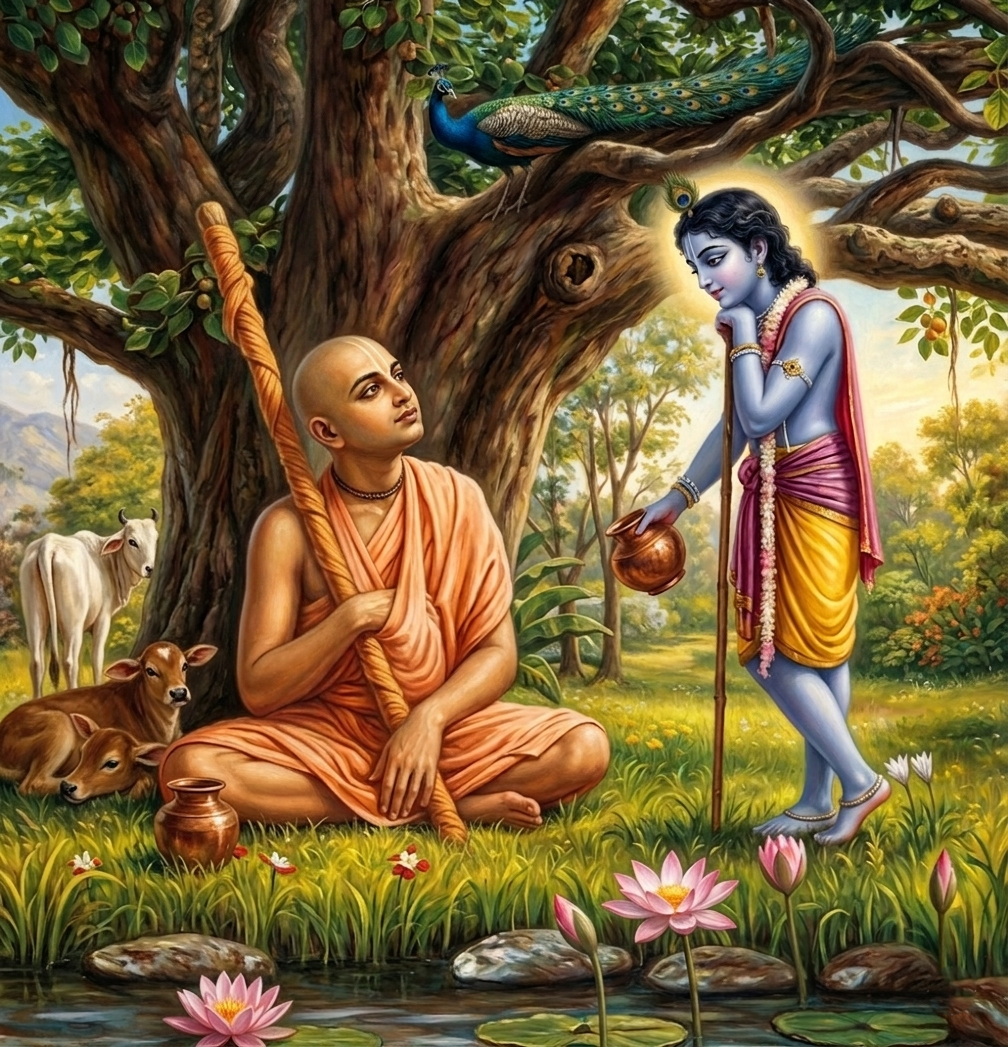 The Lord appears as a beautiful cowherd boy and offers milk to Madhavendra Puri
While sitting, a young and beautiful smiling cowherd boy approached with a pot of milk (Madhya 4.25):
"O Madhavendra Puri, please drink the milk I have brought. Why don't you beg some food to eat? What kind of meditation are you undergoing?"
— Cc. Madhya 4.25When Madhavendra Puri saw the beauty of that boy, he became very satisfied. Hearing His sweet words, he forgot all hunger and thirst (Madhya 4.26). The boy said He was a cowherd from the village, that He must go very soon to milk the cows, and that He would return to take back the milk pot (Madhya 4.28–31). Saying this, the boy left — and suddenly could be seen no more (Madhya 4.32).
Madhavendra Puri could not sleep. He sat and chanted the Hare Krsna maha-mantra, and only at the end of the night did he doze a little (Madhya 4.34). In that sleep, the same boy appeared in dream, took him by the hand, led him to a bush in the jungle, and spoke:
"For many days I have been observing you, and I have been wondering, 'When will Madhavendra Puri come here to serve Me?' I have accepted your service due to your ecstatic love for Me. Thus I shall appear, and by My audience all fallen souls will be delivered. My name is Gopala. I am the lifter of Govardhana Hill. I was installed by Vajra, and here I am the authority. When the Muslims attacked, the priest who was serving Me hid Me in this bush. Since the priest went away, I have been staying here. Now just remove Me with care."
— Cc. Madhya 4.39–43When Madhavendra Puri woke, he lamented bitterly (Madhya 4.45): "I saw Lord Krsna directly, but I could not recognize Him!" And he fell to the ground in ecstatic love.
He then assembled the villagers, cleared the jungle, and the Deity was placed on a stone throne atop Govardhana Hill. A full abhiseka was performed with nine hundred pots of water from Govinda-kunda, panca-gavya, pancamrta, and maha-snana. The Annakuta festival was then arranged in one day: mountains of rice, dhal, vegetables, chapatis covered in ghee, pots of yogurt, sweet rice, cream, and buttermilk — and Gopala ate everything offered.
Madhavendra Puri initiated all the brahmanas present into the Vaisnava cult and engaged them in Deity service. Each family in Vrajabhumi contributed one cow — and in this way thousands of cows became the property of Gopala (Madhya 4.102). This Annakuta festival continued village after village for two full years (Madhya 4.105). The standard of Deity worship established here — six aratrikas from mangala-aratrika to sayana-aratrika — is the same standard followed in ISKCON temples worldwide today.
"Being obliged because of the loving affairs of Mādhavendra Purī, Lord Kṛṣṇa Himself appeared as the Gopāla Deity, and, accepting his service, He liberated the whole world."
— Lord Caitanya Mahāprabhu, Cc. Madhya 4.173Dream Two — Fetch Sandalwood from Jagannatha Puri
After two years of gorgeous Deity worship, Gopala appeared again in Madhavendra Puri's dream with a new instruction (Madhya 4.106–107):
"My bodily temperature still has not decreased. Please bring sandalwood from the Malaya province and smear the pulp over My body to cool Me. Bring sandalwood pulp from Jagannatha Puri. Kindly go quickly. Since no one else can do it, you must."
— Cc. Madhya 4.106–107Madhavendra Puri immediately made arrangements for the Deity's continued worship and departed. He stopped at Santipura where Advaita Acarya, so moved by the ecstatic love of Godhead he witnessed in Madhavendra Puri, begged to be initiated and received that blessing (Madhya 4.110–111).
Passing through Orissa, he arrived at Remuna and entered the Gopinatha temple. He danced and chanted in ecstasy. Then he asked the priest about the Deity's food offerings — so that by making arrangements in their kitchen, similar foods could be offered to Sri Gopala (Madhya 4.115). The priest described the famous amrta-keli — sweet rice offered in twelve earthen pots every evening.
Madhavendra Puri privately thought: "If, without my asking, a little sweet rice is given to me, I can taste it and make a similar preparation to offer my Lord Gopala." He was immediately overcome with shame for even this thought — considering he had committed an offense by desiring to eat what was being offered to the Deity (Madhya 4.124) — and without a word to anyone, left the temple and sat alone in the vacant marketplace, chanting (Madhya 4.125).
That night, Gopinatha appeared in the dream of the head priest (Madhya 4.127–129):
"O priest, please get up and open the door of the temple. I have kept one pot of sweet rice for the sannyasi Madhavendra Puri… A sannyasi named Madhavendra Puri is sitting in the vacant marketplace. Please take this pot and deliver it to him."
— Cc. Madhya 4.127–129The priest found the pot exactly as described, went to the marketplace and called out: "Will he whose name is Madhavendra Puri please come and take this pot! Gopinatha has stolen this pot of sweet rice for you! You are the most fortunate person within these three worlds!" (Madhya 4.133–134). Thus the Deity of Remuna received forever the name Ksira-cora Gopinatha — the Gopinatha who stole the pot of sweet rice.
Madhavendra Puri ate the sweet rice in ecstatic love, broke the pot into pieces, bound them in his cloth, and every day thereafter ate one piece — overwhelmed with ecstasy at each remembrance of the Lord's mercy (Madhya 4.139–140). Being afraid of his reputation, he quietly slipped away from Remuna before morning. Yet even in flight his greatness pursued him (Madhya 4.147): "The reputation brought by love of Godhead is so sublime that it goes along with the devotee, as if following him."
Reaching Jagannatha Puri, he saw Lord Jagannatha and was overwhelmed — sometimes falling, sometimes dancing, sometimes laughing, sometimes crying (Madhya 4.144). The devotees there enthusiastically collected one maund — approximately eighty-two pounds — of sandalwood, and twenty tolas of camphor, along with two assistants and official release papers to pass the Muslim toll collectors of Orissa (Madhya 4.151–153, 182–183).
Dream Three — Gopala's Final Merciful Order
Carrying his eighty-two-pound load back toward Vrndavana, Madhavendra Puri set out through provinces governed by Muslims. Lord Caitanya Mahaprabhu describes the journey (Madhya 4.181–185):
"Although Madhavendra Puri was hungry, he would not beg food to eat. This renounced person carried a load of sandalwood for the sake of Sri Gopala… Madhavendra Puri was not at all anxious during the long journey through the provinces governed by the Muslims. Although Madhavendra Puri did not have a farthing with him, he was not afraid to pass by the toll officers. His only enjoyment was in carrying the load of sandalwood to Vrndavana for Gopala."
— Cc. Madhya 4.181–185When he reached Remuna again, the priest joyfully gave him the sweet rice prasadam. That night, Gopala appeared in the third and final dream:
"O Madhavendra Puri, I have already received all the sandalwood and camphor. Now just grind all the sandalwood together with the camphor and smear the pulp on the body of Gopinatha daily until it is finished. There is no difference between My body and Gopinatha's body. They are one and the same."
— Cc. Madhya 4.158–160Lord Caitanya Mahaprabhu Himself reveals the real purpose of the entire journey (Madhya 4.187–190):
"Śrī Gopāla wanted to show how intensely Mādhavendra Purī loved Kṛṣṇa; therefore He asked him to go to Nīlācala to fetch sandalwood and camphor. To test the intense love of Mādhavendra Purī, Gopāla, the Supreme Personality of Godhead, ordered him to bring sandalwood, and when Mādhavendra Purī passed this examination, the Lord became very merciful to him."
— Cc. Madhya 4.187–190Madhavendra Puri carried out the third order without hesitation: he had the sandalwood ground with camphor and smeared on Gopinatha daily until the entire stock was finished, then returned peacefully to Jagannatha Puri for Caturmasya (Madhya 4.168–169). Lord Caitanya's verdict (Madhya 4.186): "This is the natural result of intense love of Godhead. The devotee does not consider personal inconveniences or impediments. In all circumstances he wants to serve the Supreme Personality of Godhead."
Lord Caitanya Glorifies Madhavendra Puri at Remuna
When Lord Caitanya Mahaprabhu visited the Ksira-cora Gopinatha temple at Remuna, He offered His obeisances with great devotion. At that moment the flower helmet on Gopinatha's head fell directly onto the head of Caitanya Mahaprabhu (Madhya 4.14). He became very pleased and began to chant and dance in ecstasy.
He then narrated the entire story of Madhavendra Puri to Nityananda Prabhu and asked (Madhya 4.171): "Please judge whether there was anyone within this world as fortunate as Madhavendra Puri." Then He declared (Madhya 4.191): "That verse is just like the moon. It has spread illumination all over the world."
Then He recited the verse. Immediately He fell to the ground unconscious (Madhya 4.198). Nityananda Prabhu quickly placed Him on His lap. When He came to His senses He ran here and there, laughed, cried, danced and sang. He could not even recite the whole verse — He only cried again and again (Madhya 4.201): "Ayi dina! Ayi dina! — He simply said these words repeatedly." All twelve ecstatic symptoms appeared in His body simultaneously.
"In this way, Lord Śrī Caitanya Mahāprabhu personally tasted with His own mouth the transcendental qualities of Gopālajī, Gopīnātha and Śrī Mādhavendra Purī."
— Kṛṣṇadāsa Kavirāja Gosvāmī, Cc. Madhya 4.210Ayi Dina-Dayardra Natha: The Most Precious Verse
At the end of his time in this world, Sri Madhavendra Puri — the spiritual master of the entire world (Cc. Antya 8.33) — repeated one verse again and again until he left his body:
mathurā-nātha kadāvalokyase
hṛdayaṃ tvad-aloka-kātaraṃ
dayita bhrāmyati kiṃ karomy aham
"O My Lord! O most merciful master! O master of Mathurā! When shall I see You again? Because of My not seeing You, My agitated heart has become unsteady. O most beloved one, what shall I do now?"
— Cc. Madhya 4.197 / Cc. Antya 8.34Krsnadasa Kaviraja Gosvami declares in Cc. Madhya 4.193: as the Kaustubha-mani is the most precious of all valuable stones, this verse is similarly the most precious of all poems in devotional service. It is "just like the moon — it has spread illumination all over the world" (Madhya 4.191). And the more one considers it, the more its fragrance increases — like Malaya sandalwood whose aroma grows the more it is rubbed (Madhya 4.192).
Cc. Madhya 4.195 makes clear that only three personalities have fully understood this verse: Srimati Radharani, Sri Madhavendra Puri, and Sri Caitanya Mahaprabhu. And the reason:
"Actually this verse was spoken by Srimati Radharani Herself, and by Her mercy only was it manifest in the words of Madhavendra Puri."
— Cc. Madhya 4.194This verse is Radharani's lament when Krsna left Vrndavana for Mathura and She was left behind, burning in the fire of separation. That divine agony was transmitted by Her mercy alone into the heart and words of Madhavendra Puri. Worship in separation [vipralambha-seva] is the topmost level of devotional service. In this mood the devotee does not demand the Lord's presence — he simply feels his own poverty, his own inability to reach the Lord, and he cries.
"Mādhavendra Purī recited this verse again and again at the end of his material existence. Thus uttering this verse, he attained the ultimate goal of life."
— Cc. Madhya 4.196The Two Disciples: An Instruction to the Whole World
In the final days of Madhavendra Puri's life, he lay completely invalid, absorbed in the agony of separation, crying: "O my Lord, I did not get shelter at Mathura" (Antya 8.19). Two disciples came to attend him. Their contrasting responses became, as Krsnadasa Kaviraja Gosvami declares, an instruction by Madhavendra Puri to the entire world (Antya 8.32).
Isvara Puri — The Ocean of Ecstatic Love
Isvara Puri, the future spiritual master of Sri Caitanya Mahaprabhu, served Madhavendra Puri at his deathbed with complete selflessness — personally cleaning his stool and urine with his own hands, constantly chanting the holy name and narrating the pastimes of Lord Krsna for Madhavendra Puri to hear. In this way he helped his spiritual master remember the holy name at the time of death.
"Pleased with Isvara Puri, Madhavendra Puri embraced him and gave him the benediction that he would be a great devotee and lover of Krsna."
— Cc. Antya 8.28–30That single blessing turned Isvara Puri into an ocean of love of Godhead (Antya 8.31) — which later engulfed Lord Caitanya Himself. This is the power of sincere, selfless service to the spiritual master.
Ramacandra Puri — A Warning for All Disciples
Ramacandra Puri came to Madhavendra Puri's deathbed and, seeing his spiritual master crying in separation from Krsna, presumed to instruct him (Antya 8.20–21): "If you are in full transcendental bliss, you should now remember only Brahman. Why are you crying?"
Madhavendra Puri was greatly angered and rebuked him sharply (Antya 8.22–25): "Get out, you sinful rascal! I am dying without achieving the shelter of Krsna, and this condemned rascal has come to instruct me about Brahman."
Due to this offense, Ramacandra Puri fell into dry speculation and fault-finding (Antya 8.26–27). He later stayed at Jagannatha Puri where he would first induce someone to eat more than necessary, then criticise them; he gathered information about how everyone was eating and conducting their affairs; he could find no fault in Caitanya Mahaprabhu but invented one — finding ants in the Lord's room and accusing Him of keeping sweets. Because of his criticism, Caitanya Mahaprabhu reduced His own eating by half, and all the devotees became miserable (Antya 8.56–57).
"Īśvara Purī received the blessing of Mādhavendra Purī, whereas Rāmacandra Purī received a rebuke from him. Therefore these two persons are examples of the objects of a great personality's benediction and punishment. Mādhavendra Purī instructed the entire world by presenting these two examples."
— Cc. Antya 8.32Conclusion — The Root of All That We Have
Sri Madhavendra Puri Gosvami stands at the very root of the Gaudiya Vaisnava tradition — the acarya without whom the great tree of Lord Caitanya's movement could never have grown. He was not a loud preacher or a prolific writer. He did not build institutions or gather large communities around himself. He was a solitary, silent, wandering sannyasi — absolutely merged in love of Krsna, dependent on no one, afraid of nothing, motivated only by the Lord's pleasure.
Yet from this one soul's pure love, an entire spiritual revolution was born. The Gopala Deity at Govardhana was revealed through him. The standard of Deity worship that fills ISKCON temples worldwide today was established by him. The ecstatic seed of madhurya-bhava that Lord Caitanya Mahaprabhu later distributed to the whole world was first planted by him. Even the verse that moves the Golden Avatara to unconscious ecstasy —ayi dina-dayardra natha — was uttered first by Madhavendra Puri, by the mercy of Srimati Radharani Herself.
His life teaches us three great lessons. First, that Krsna is not indifferent to the love of His devotees — He personally comes to serve those who serve Him with a pure heart. Second, that true renunciation is not dry or mechanical, but is the natural flowering of love: a soul so absorbed in Krsna that hunger, reputation, hardship and comfort simply cease to matter. Third, that the quality of our relationship with the spiritual master determines everything — as Isvara Puri and Ramacandra Puri demonstrate so powerfully, humility and selfless service open the gates of divine grace, while arrogance and presumption close them.
On this sacred day of his appearance / disappearance, we bow our heads at the lotus feet of Sri Madhavendra Puri Gosvami and pray that even a single drop of his love for Krsna may touch our hearts. We are the inheritors of the tradition he planted. The maha-mantra we chant, the Deities we worship, the books we study, the sampradaya we belong to — all of it flows from the root of his pure devotion.
"He reasons ill who says that Vaiṣṇavas die, when thou art living still in sound! The Vaiṣṇavas die to live, and living try, to spread the holy name around."
— Śrīla Bhaktivinoda ṬhākuraSri Madhavendra Puri Gosvami ki — Jaya!
Frequently Asked Questions — Sri Madhavendra Puri
Who was Sri Madhavendra Puri and why is he important in the Gaudiya Vaisnava tradition?
Sri Madhavendra Puri was a great Vaisnava sannyasi in the Madhva-sampradaya, initiated by Sri Laksmipati Tirtha. Krsnadasa Kaviraja Gosvami calls him 'the spiritual master of the entire world' (Cc. Antya 8.33). He was the first person in that disciplic succession to exhibit the symptoms of love of Godhead, and he planted the seed of pure devotion that Lord Caitanya Mahaprabhu later distributed to the entire world. Without him there is no Isvara Puri; without Isvara Puri there is no Lord Caitanya's movement of sankirtana.
What is the significance of the Gopala Deity at Govardhana and Madhavendra Puri's connection to Him?
The Gopala Deity at Govardhana Hill was originally installed by Vajra, the great-grandson of Lord Krsna, but was hidden in the jungle when Muslim invaders attacked. Lord Krsna personally appeared to Madhavendra Puri in a dream, revealed the Deity's location, and said: 'For many days I have been observing you, wondering when will Madhavendra Puri come here to serve Me?' Madhavendra Puri organised the installation, the Annakuta festival, and established the full Deity worship standard still followed in ISKCON temples today. This original Gopala Deity is now worshipped at Nathdvara, Rajasthan, and is known as Sri Nathaji.
Why is the Deity at Remuna called Ksira-cora Gopinatha?
Ksira-cora means 'the one who stole the sweet rice.' When Madhavendra Puri stopped at Remuna en route to Jagannatha Puri, he privately desired to taste the famous amrta-keli sweet rice — not for himself, but to learn how to prepare a similar offering for Gopala. He immediately felt ashamed and left the temple without asking for anything. That night, Gopinatha appeared in the head priest's dream and said He had hidden a pot of sweet rice behind His cloth curtain for the sannyasi in the marketplace. The priest found it exactly as described and called out: 'Gopinatha has stolen this pot of sweet rice for you! You are the most fortunate person within these three worlds!' From that day the Deity has been known as Ksira-cora Gopinatha.
What is the verse 'ayi dina-dayardra natha' and why is it so important in our sampradaya?
This verse composed by Madhavendra Puri is the one he repeated constantly until the moment of his departure, and by uttering it he attained the ultimate goal of life (Cc. Madhya 4.196). It was actually spoken originally by Srimati Radharani Herself, and by Her mercy alone it appeared in the words of Madhavendra Puri (Cc. Madhya 4.194). Krsnadasa Kaviraja Gosvami says it is the most precious of all devotional verses — like the Kaustubha gem — and like the moon it has spread illumination all over the world (Madhya 4.191–193). Only three persons have fully understood it: Srimati Radharani, Sri Madhavendra Puri, and Sri Caitanya Mahaprabhu.
What can we learn from the contrast between Isvara Puri and Ramacandra Puri?
Both were disciples of Madhavendra Puri, but their service was completely different. Isvara Puri served his spiritual master at the end of his life with total selflessness — personally cleaning his stool and urine, constantly chanting the Holy Name for his hearing, and reminding him of Krsna's pastimes. Pleased with this service, Madhavendra Puri gave Isvara Puri his full blessing, and Isvara Puri became an ocean of love of Godhead — through whom Lord Caitanya Himself was initiated. Ramacandra Puri, on the other hand, presumed to instruct his own spiritual master at his deathbed, and due to this offense fell into dry speculation and fault-finding. Krsnadasa Kaviraja Gosvami says: 'Madhavendra Puri instructed the entire world by presenting these two examples' (Cc. Antya 8.32).
🌿 Connect With Us
We would love to welcome you to our growing community of seekers. Reach us through any of the platforms below or visit us in person.
ISKCON Thiruvanmiyur (Hare Krishna Movement Chennai — Affiliated to ISKCON Bangalore Regn. S-49/78-79)
🗺️ Open in Google Maps →