Eternal Associates of Lord Chaitanya
Sri Vakreshvara Pandita:
The One Wing of Lord Chaitanya
Glorifying the ecstatic devotee-dancer who danced for seventy-two hours in the sankirtana of Sri Chaitanya Mahaprabhu
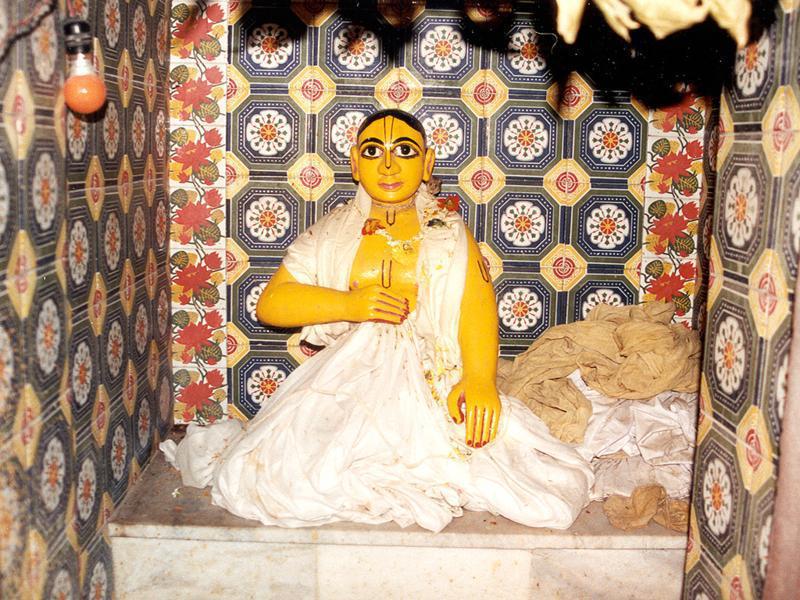 Vakreshvara Pandita absorbed in the ecstasy of harinama sankirtana.
Quick Facts (at a glance)
It is well past midnight in Srivasa Pandita's courtyard. Lord Chaitanya is singing. Vakreshvara Pandita has been dancing, without pause, for two full days and nights. When he finally falls at the Lord's feet, breathless, he does not ask to rest — he begs for ten thousand celestial Gandharvas to sing so that he can keep dancing. Mahaprabhu's reply becomes one of the most tender lines in all of Vaishnava literature: "I have only one wing like you, but if I had another, certainly I would fly in the sky."
That single exchange tells you almost everything about who Vakreshvara Pandita was.
Table of Contents
- 01Quick Facts
- 02Birth and Early Life in Guptipara
- 03An Eternal Associate: Aniruddha Incarnate
- 04Glorified Among the Learned Devotees
- 05The Seventy-Two Hour Dance and the "Wing" Pastime
- 06The Deliverance of Devananda Pandita
- 07Life in Jagannatha Puri
- 08Seva at the House of Kashi Mishra
- 09Disciplic Legacy
- 10Lila Sthali: Places to Remember
- 11What Vakreshvara Pandita Teaches Us
- 12Frequently Asked Questions
Quick Facts (At a Glance)
Among the eternal associates of Sri Chaitanya Mahaprabhu, there is one devotee whose very body became an instrument of Krishna's ecstasy — Vakreshvara Pandita. Srila Prabhupada describes him as "the fifth branch of the tree" of Lord Chaitanya's associates (Chaitanya-charitamrita, Adi 10.17), so dear to the Lord that Mahaprabhu Himself compared Vakreshvara Pandita to His own missing wing.
What follows is his story — from his birth in a Bengal town already steeped in Vaishnava culture, to his identity as an eternal Vrindavan gopi, to the pastimes and places that keep his memory alive today.
Birth and Early Life in Guptipara
Sri Vakreshvara Pandita took birth in the village of Guptipara, near Triveni, in Bengal. From his youth he was expert in singing and dancing — gifts that were not mere artistic talent but instruments of pure devotional ecstasy, later to be fully revealed in the presence of Lord Chaitanya.
Guptipara itself has long been a stronghold of Vaishnava culture on the banks of the Hooghly River. The town is home to the historic Brindaban Chandra Math, a walled quadrangle of four terracotta temples — dedicated to Chaitanya-Nityananda, Radha-Krishna-Jagannath (Brindabanchandra), Rama-Sita-Lakshmana-Hanuman, and Radha-Krishna (Krishnachandra) — and to one of Bengal's oldest and tallest ratha-yatra chariots, second in length only to the Ratha-yatra of Puri. The area was historically known as a center of Sanskrit scholarship and Vaishnava devotion, a fitting birthplace for a devotee whose own learning would later be overshadowed only by his ecstatic love for Krishna.
An Eternal Associate: Aniruddha Incarnate
Srila Prabhupada explains the transcendental identity of this great devotee in his purport to Chaitanya-charitamrita Adi 10.17:
"In the Gaura-ganoddesa-dipika (71) it is stated that Vakresvara Pandita was an incarnation of Aniruddha, one of the quadruple expansions of Visnu (Vasudeva, Sankarsana, Aniruddha and Pradyumna)."
— Srila PrabhupadaIn the Dhyana-chandra-paddhati, written by Dhyanachandra Goswami — the disciple of Vakreshvara Pandita's own disciple, Gopal Guru Goswami — it is revealed that in Krishna's eternal pastimes of Vrindavan, Vakreshvara Pandita was the gopi Tungavidya, celebrated among the ashta-sakhis for her expertise in music and dance. That same eternal associate of Radha and Krishna appeared in Gaura-lila as Vakreshvara Pandita, to relish and distribute the ecstasy of the sankirtana movement.
The Dhyana-chandra-paddhati also records his appearance and disappearance tithis: he appeared on Krishna Panchami (the fifth day of the waning moon) of the month of Ashadha, and concluded his earthly pastimes on Shukla Shashthi (the sixth day of the waxing moon), also in Ashadha — dates that, following the lunar calendar, shift each year in the Gregorian reckoning.
Glorified Among the Learned Devotees
Sri Chaitanya-charitamrita records Vakreshvara Pandita among the most exalted and learned devotees of the Lord. As Srila Prabhupada translates in Adi 6.49–50:
"Srivasa, Haridasa, Ramadasa, Gadadhara, Murari, Mukunda, Candrasekhara and Vakresvara are all glorious and are all learned scholars, but the sentiment of servitude to Lord Caitanya makes them mad in ecstasy."
— Sri Chaitanya-charitamrita, Adi-lila 6.49-50Great scholarship bowed before pure devotional madness — and Vakreshvara Pandita embodied this madness of love more visibly than almost any other associate.
The Seventy-Two Hour Dance and the 'Wing' Pastime
The most celebrated pastime of Vakreshvara Pandita's life took place in the house of Srivasa Pandita, where Lord Chaitanya engaged in dramatic performances of sankirtana. Srila Prabhupada narrates this pastime in Chaitanya-charitamrita:
"Vakresvara Pandita, the fifth branch of the tree, was a very dear servant of Lord Caitanya's. He could dance with constant ecstasy for seventy-two hours."
— Sri Chaitanya-charitamrita, Adi 10.17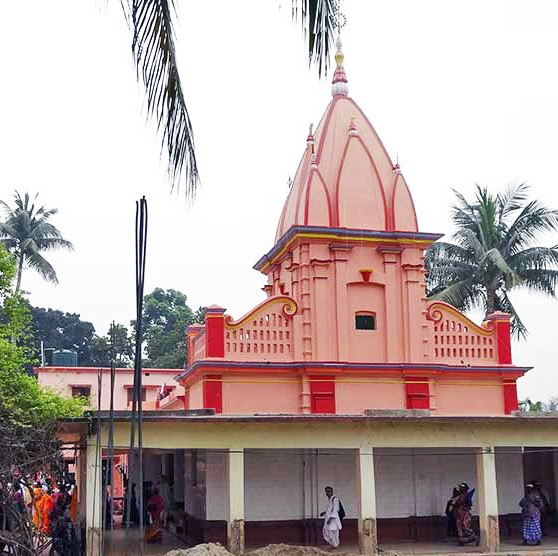 Srivasa Angan in Sri Mayapur, the site of the 72-Hour Dance and the 'Wing' Pastime.
Sri Chaitanya Mahaprabhu Himself sang while Vakreshvara Pandita danced without cessation. Overwhelmed, Vakreshvara Pandita fell at the lotus feet of the Lord and made a bold and loving request:
"O Candramukha! Please give me ten thousand Gandharvas. Let them sing as I dance, and then I will be greatly happy."
— Sri Chaitanya-charitamrita, Adi 10.19Srila Prabhupada explains in his purport that the Gandharvas are the celestial singers of Gandharvaloka, capable of singing continuously for days — and so Vakreshvara Pandita, in his insatiable hunger to dance in the Lord's service, wished for their unending song. (Adi 10.19, purport)
Lord Chaitanya's reply is among the most tender exchanges recorded between the Lord and His devotee:
"I have only one wing like you, but if I had another, certainly I would fly in the sky!"
— Sri Chaitanya-charitamrita, Adi 10.20Mahaprabhu compared Himself to a bird with only one wing — Vakreshvara Pandita being that wing — unable to fly without his ecstatic dancing to carry Him aloft in sankirtana bliss.
The Deliverance of Devananda Pandita
Vakreshvara Pandita's mercy was not confined to dancing before the Lord; it extended to the deliverance of fallen souls. Devananda Pandita, a renowned scholar of Srimad-Bhagavatam residing in Kuliya (present-day Navadvipa), had committed a grave offense: when Srivasa Thakura wept in ecstasy while hearing his Bhagavatam recital, Devananda's own disciples drove Srivasa Thakura away, and Devananda made no protest.
When Lord Chaitanya later passed through Kuliya, He chastised Devananda severely for his Mayavadi interpretation of the Bhagavatam. At that time, Devananda had little faith in Sri Chaitanya Mahaprabhu as an incarnation of Krishna. But providence brought Vakreshvara Pandita as a guest to a devotee's house in Kuliya, across the Ganges from Nadia. One evening Vakreshvara Pandita performed kirtana and dance there for two praharas — some six hours — and Devananda, hearing the news, came to witness it.
Seeing the visible symptoms of divine love manifest in Vakreshvara Pandita's dancing body, Devananda himself took up a cane to keep the gathering crowd from obstructing the ecstatic performance. When the dancing ended, Devananda offered dandavat pranams at Vakreshvara Pandita's feet, who blessed him simply: "May you attain devotion to Sri Krishna."
As Srila Prabhupada writes in Adi 10.77:
"Devananda Pandita was a professional reciter of Srimad-Bhagavatam, but by the mercy of Vakresvara Pandita and the grace of the Lord he understood the devotional interpretation of the Bhagavatam."
— Sri Chaitanya-charitamrita, Adi 10.77Later, when Lord Chaitanya returned to Nadia to see His mother and the Ganges, He personally told Devananda Pandita: "Because you have rendered service to Vakreshvara Pandita I consider you to be one of my own. Vakreshvara Pandita is completely empowered by the Lord." (Chaitanya-charitamrita, Adi 10.77 and purport)
This pastime teaches a central truth of Gaudiya Vaishnava philosophy — that service to a pure Vaishnava is the direct means of attaining the mercy of Krishna Himself.
Life in Jagannatha Puri
When Sri Chaitanya Mahaprabhu accepted sannyasa and took up residence in Jagannatha Puri, Vakreshvara Pandita was counted among His most intimate and permanent associates there. Srila Prabhupada writes that among these devotees, Paramananda Puri and Svarupa Damodara were the heart and soul of the Lord, and among the others were Gadadhara, Jagadananda, Sankara, Vakreshvara, Damodara Pandita, Thakura Haridasa, Raghunatha Vaidya, and Raghunatha dasa. (Chaitanya-charitamrita, Adi 10.124–126)
Chief Dancer in Sankirtana
During the annual Ratha-yatra festival, Sri Chaitanya Mahaprabhu personally ordered Nityananda Prabhu, Advaita Acharya, Thakura Haridasa, and Vakreshvara Pandita to each dance in one of four kirtana parties. (Chaitanya-charitamrita, Madhya-lila 13.35) Two brothers, Madhava Ghosha and Vasudeva Ghosha, joined Vakreshvara Pandita's party as responsive singers, with Vakreshvara Pandita as the dancer. (Chaitanya-charitamrita, Madhya-lila 13.43)
In the Gundicha Temple Courtyard
Srila Prabhupada records that Sri Chaitanya Mahaprabhu would sometimes engage Vakreshvara Pandita and other devotees in chanting and dancing, performing sankirtana three times daily — morning, noon, and evening — in the yard of the Gundicha temple. (Chaitanya-charitamrita, Madhya-lila 14.72)
In the Water Pastimes
In the gardens near the Gundicha temple, during the Vrindavana pastimes re-enacted there, a duel of throwing water took place between Raghava Pandita and Vakreshvara Pandita, one among several such playful exchanges among the devotees. (Chaitanya-charitamrita, Madhya-lila 14.82) On another occasion, the Lord personally ordered Vakreshvara Pandita to dance, and as he began, the Lord Himself began to sing. (Chaitanya-charitamrita, Madhya-lila 14.101)
Every Day of Mahaprabhu's Puri Pastimes
Vakreshvara Pandita is named among the devotees to whom Sri Chaitanya Mahaprabhu introduced Sanatana Gosvami (Chaitanya-charitamrita, Antya-lila 4.108–110), among those who danced with the Lord in the great sankirtana processions where he was again named chief dancer (Antya-lila 11.48, 11.64), and among those who danced in jubilation around the Lord's body as He passed in ecstasy (Antya-lila 11.67).
Seva at the House of Kashi Mishra
In Jagannatha Puri, Lord Chaitanya resided at the house of Kashi Mishra, the priest of the King. Srila Prabhupada notes in his purport to Adi 10.131 that this sacred house was later inherited by Vakreshvara Pandita himself, and thereafter by his disciple, Gopal Guru Goswami, who established there the worship of Sri Sri Radha-Kanta — a seva that continues to this day.
Kashi Mishra served as rajguru to King Prataparudra, who gifted him a house with a large garden near the Jagannatha temple. Within it was a small, secluded room called the Gambhira — meaning "deep" or "hidden" — where Mahaprabhu spent the final twelve years of His manifest pastimes, absorbed in intense feelings of separation from Krishna.
After Mahaprabhu's disappearance, Vakreshvara Pandita took up residence in the Gambhira and continued the seva of Sri Radha-Kanta received from Kashi Mishra, before entrusting it to Gopal Guru Goswami. Between 1538 and 1548, Gopal Guru renovated and expanded the temple, installing additional Deities of Radharani, Lalita Devi, and dancing Gauranga-Nityananda alongside Radha-Kanta — the same Deities worshiped there today at what is now known as Radhakanta Math.
Disciplic Legacy
Vakreshvara Pandita's foremost disciple was Gopal Guru Goswami, who inherited both his spiritual mood and his seva at Kashi Mishra's house. Gopal Guru Goswami's own disciple, Dhyanachandra Goswami, authored the Dhyana-chandra-paddhati — a Gaudiya Vaishnava meditational text distinct from Chaitanya-charitamrita — through which the identity of Vakreshvara Pandita as Tungavidya gopi has been preserved for devotees.
Many disciples of Vakreshvara Pandita took root in Orissa, where they are honored as Gaudiya Vaishnavas though they are Oriyas by birth. (Gaudiya History)
Lila Sthali: Places to Remember Vakreshvara Pandita
- Guptipara, West Bengal — Birthplace
Guptipara lies on the eastern bank of the Hooghly River in the Hooghly district, roughly 60–80 km north of Kolkata. Long a center of Sanskrit learning and Vaishnava devotion, the town today is known for the Brindaban Chandra Math temple complex, its terracotta shrines, and one of Bengal's grandest Ratha-yatra festivals. - Srivasa Angan, Sri Mayapur — Site of the 72-Hour Dance
Srivasa Angan, the former homestead of Srivasa Thakura, stands close to the Yogapitha in present-day Sri Mayapur. It was here, at the nightly closed-door sankirtana gatherings of Mahaprabhu's inner circle, that Vakreshvara Pandita's celebrated seventy-two-hour dance and the "one wing" exchange took place. - Gambhira (Radhakanta Math), Jagannatha Puri — Residence & Seva
Located in Bali Sahi, southeast of the Jagannatha temple, this site was Kashi Mishra's residence and the place where Mahaprabhu spent His last twelve years in a small room called the Gambhira. After Vakreshvara Pandita inherited the seva here, he passed it to his disciple Gopal Guru Goswami. It remains an active place of worship and darshan for pilgrims visiting Puri.
What Vakreshvara Pandita Teaches Us
Srila Prabhupada's presentation of Vakreshvara Pandita's life offers devotees several enduring lessons:
- Devotion beyond scholarship. Though counted among the most learned associates of the Lord, it was not his scholarship but his ecstatic servitude that made him dear to Mahaprabhu.
- The body as an instrument of bhakti. His dancing was not artistic performance but the direct manifestation of Krishna's presence within his heart — a living example that devotional service engages the whole being.
- The power of Vaishnava association. The transformation of Devananda Pandita, a proud and offensive scholar, into a genuine devotee came about not through argument but through simple, humble association with a pure Vaishnava.
- Humility despite empowerment. Though declared an incarnation of Aniruddha and completely empowered by Krishna, Vakreshvara Pandita remained a servant, dancing at the Lord's pleasure rather than seeking recognition.
Frequently Asked Questions
Connect with Us
Follow Hare Krsna Movement Chennai across all platforms for daily darsana and event updates.