What Srila Prabhupada Teaches on Varnasrama
Caste System Truth
Corruption by Birthright, and the Real Path of Human Civilization
Based exclusively on the teachings of His Divine Grace Vishwa Guru A.C. Bhaktivedanta Swami Prabhupada.
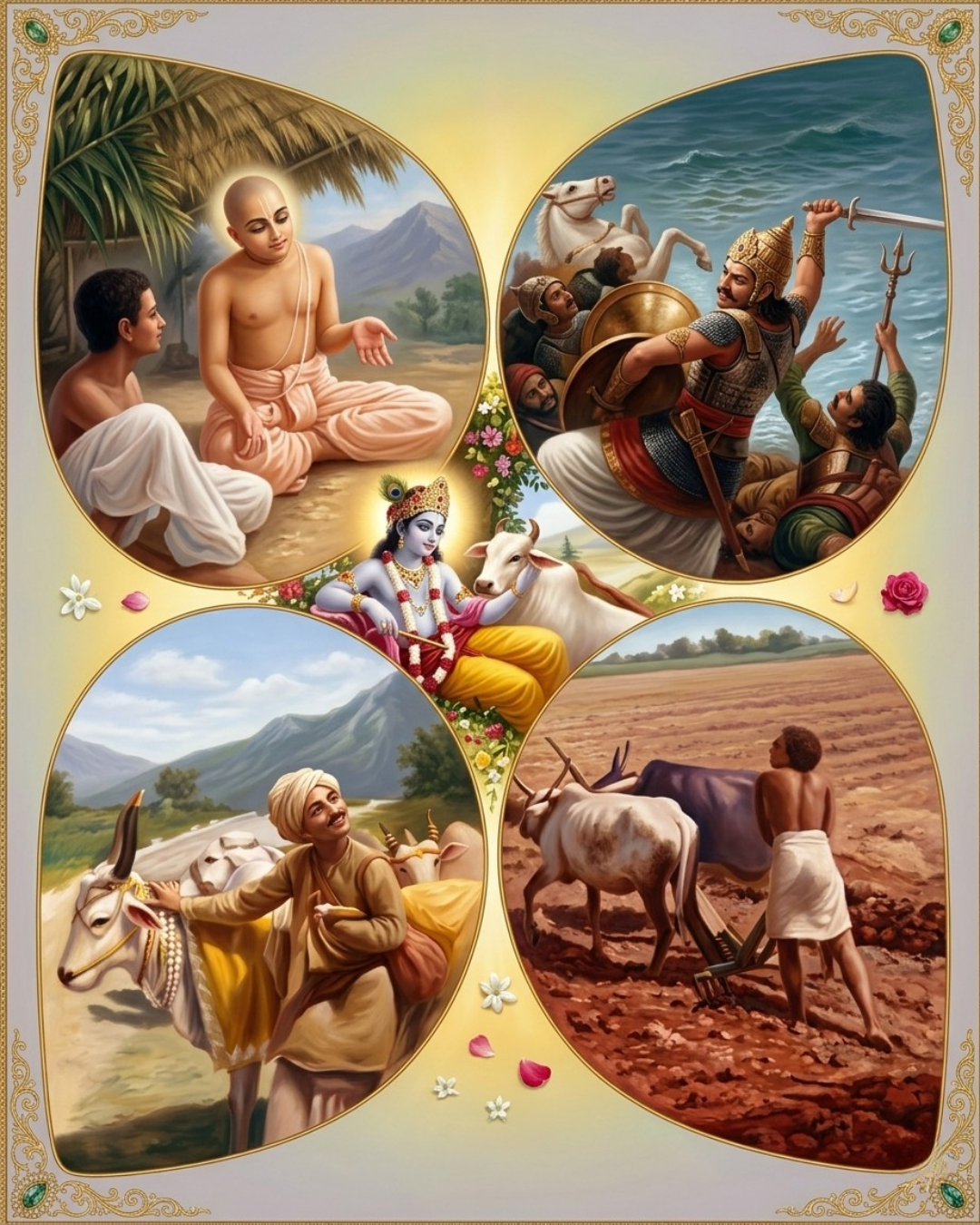 The divine varnashrama system — the natural division of human society into four orders based on quality and work (guna-karma).
Table of Contents
- ❖ 1. Introduction: The Most Misunderstood Question in Indian Civilization
- ❖ 2. What Lord Krishna Actually Established: Guna and Karma, Never Birth
- ❖ 3. How and When the Divine System Was Corrupted
- ❖ 4. The Real Qualifications: What Makes a Brahmana, Ksatriya, Vaisya, and Sudra
- ❖ 5. The Vaishnava Is Transcendental to All Caste Distinctions
- ❖ 6. The Great Devotees Who Transcended Caste: Historical Evidence
- ❖ 7. "They Accuse Me of Ruining Hinduism" — Srila Prabhupada's Own Declaration
- ❖ 8. Gandhi's Harijan Movement and Ambedkar's Reservations: Why Political Solutions Fail
- ❖ 9. Krishna Consciousness: The Only Real Solution
- ❖ 10. Summary: Srila Prabhupada's Complete Teaching in Eleven Points
- ❖ 11. Frequently Asked Questions
- ❖ Conclusion: The Call of Srila Prabhupada
1. Introduction: The Most Misunderstood Question in Indian Civilization
Few topics generate more confusion, anger, and social division in India today than the question of caste. On one side stand those who insist that birth-based caste hierarchy is an eternal Vedic injunction. On the other stand those who want to abolish all caste distinctions entirely and establish a so-called casteless society. Both sides, says His Divine Grace Vishwa Guru A.C. Bhaktivedanta Swami Prabhupada, have fundamentally misunderstood the sastric position.
Srila Prabhupada addressed this question hundreds of times — in purports, lectures, room conversations, letters, and essays — with extraordinary clarity and consistency. His teaching is this: the birth-based caste system as it currently operates in India is not Vedic, not sanctioned by Krishna, and not acceptable. But the divine system of varnasrama-dharma — classification of society based on quality (guna) and work (karma) — is eternal, universal, and the only real solution to human social chaos.
This blog presents Srila Prabhupada's complete teaching on this subject directly in his own words — from Bhagavad-gita purports, Srimad-Bhagavatam purports, Caitanya-caritamrita purports, lectures, letters, and conversations.
"It is this divine varṇāśrama-dharma that Kṛṣṇa recommends, not the caste system as it is understood today. This modern caste system is now condemned in India also, and it should be condemned, for the classification of different types of men according to birth is not the Vedic or divine caste system."
— The Science of Self-Realization, Chapter 32. What Lord Krishna Actually Established: Guna and Karma, Never Birth
The foundational verse on this matter is Bhagavad-gita 4.13. Srila Prabhupada returns to it again and again across thousands of pages. Let us hear it directly:
cātur-varṇyaṁ mayā sṛṣṭaṁ guṇa-karma-vibhāgaśaḥ
"According to the three modes of material nature and the work ascribed to them, the four divisions of human society were created by Me." (Bhagavad-gita 4.13)"
"The Lord says, 'This division, the social division — brāhmaṇa, kṣatriya, vaiśya, śūdra — is made by Me according to quality and work.' Not that simply work or simply quality. You must have the quality and work, both. Means you must be a bona fide candidate to work for something. If you want to work as a brāhmaṇa, then you must possess all the bona fide qualities of a brāhmaṇa."
— Lecture on Bhagavad-gita 16.8, Hyderabad, December 16, 1976The critical word in Krishna's declaration is guna-karma-vibhagasah — "according to quality and work." Nowhere does Krishna say janma-vibhagasah — "according to birth." Srila Prabhupada was absolutely explicit about this:
"Herein it is clearly stated by Nārada Muni that one should not be accepted as a brāhmaṇa, kṣatriya, vaiśya or śūdra according to birth, for although this is going on now, it is not accepted by the śāstras. As stated in Bhagavad-gītā (4.13), cātur-varṇyaṁ mayā sṛṣṭaṁ guṇa-karma-vibhāgaśaḥ. Thus the four divisions of society — brāhmaṇa, kṣatriya, vaiśya and śūdra — are to be ascertained according to qualities and activities."
— Srimad-Bhagavatam 7.11.35 PurportThis is not an isolated statement. Across his entire body of work, Srila Prabhupada consistently teaches that the criterion for classification in the divine system is qualification — not the accident of birth:
"The conception of the caste system is always based on quality and not on the qualification of birth. Birth is an extraneous consideration; it is not the main feature of the orders and divisions. In Bhagavad-gītā (18.41–44) the qualifications of the brāhmaṇas, kṣatriyas, vaiśyas and śūdras are specifically mentioned, and it is understood that all such qualifications are needed before one can be designated as belonging to a particular group."
— Srimad-Bhagavatam 3.6.31 PurportSrila Prabhupada uses the analogy of professional qualification to make this unmistakably clear to modern people:
"Where does the Bhagavad-gītā mention the caste system? Kṛṣṇa says, cātur-varṇyaṁ mayā sṛṣṭaṁ guṇa-karma-vibhāgaśaḥ: 'I created four divisions of men according to their quality and work.' For instance, you can understand that there are engineers as well as medical practitioners in society. Do you say they belong to different castes — that one is in the engineer caste and the other is in the medical caste? No. If a man has qualified himself in medical school, you accept him as a doctor; and if another man has a degree in engineering, you accept him as an engineer. Similarly, the Bhagavad-gītā defines four classes of men in society: a class of highly intelligent men, a class of administrators, a class of productive men, and ordinary workers."
— The Science of Self-Realization, Chapter 1 (Interview with Sandy Nixon)He repeats this example from multiple angles and in multiple contexts — to Western journalists, to Indian audiences, in academic forums — always driving home the same point: quality and training, never birth.
"It is not that this system refers to the perverted caste system in India. Śrī Kṛṣṇa specifically states: guṇa-karma-vibhāgaśaḥ: men are classified according to the guṇa or the mode under which they are operating, and this applies to men all over the universe. When Kṛṣṇa speaks, we must understand that whatever He says is not limited but is universally true."
— On the Way to Krishna, Chapter 43. How and When the Divine System Was Corrupted
If the Vedic system is so clearly based on quality and not birth, how did the hereditary, oppressive caste system arise? Srila Prabhupada explains this deterioration with great precision, tracing it to the influence of Kali-yuga and to the failure of brahmanas who held power by birth rather than by qualification.
3.1 The Original System Was Scientific and Functional
"The whole system of society was so well planned that all the members of society in their different positions as brāhmaṇas, kṣatriyas, vaiśyas, and śūdras had no difficulty in earning their livelihood. There was no competition among the divisions of society. The original conception of the caste system was so planned that one group of men engaged in a particular type of occupation would not compete with another group of men engaged in a different occupation."
— Krishna: The Supreme Personality of Godhead, Chapter 35"Human society all over the world is divided into four castes and four orders of life. The four castes are the intelligent caste, the martial caste, the productive caste and the laborer caste. These castes are classified in terms of one's work and qualification and not by birth."
— Srimad-Bhagavatam 1.2.13 Purport3.2 The Downfall: Brahmanas Who Claimed Status Without Qualification
The rot began when those born in brahmana families claimed all the privileges of brahmanas without possessing brahmana qualities. Srila Prabhupada describes this collapse:
"The downfall of the brāhmaṇa caste began in the age of Kali. And since brāhmaṇas are the heads of the social order, all other orders of society also began to deteriorate."
— Srimad-Bhagavatam 1.18.33 Purport"Naturally, the son of a brāhmaṇa has a good chance to become a brāhmaṇa by the direction of his qualified father, as a son of a medical practitioner has a very good chance to become a qualified medical practitioner. So the caste system is quite scientific. The son must take advantage of the father's qualification and thus become a brāhmaṇa or medical practitioner, and not otherwise. Without being qualified, one cannot become a brāhmaṇa or medical practitioner, and that is the verdict of all scriptures and social orders."
— Srimad-Bhagavatam 1.18.33 PurportThis is the subtle but critical distinction Srila Prabhupada draws. The original system allowed for a son of a brahmana to become a brahmana — but only by actually being trained and qualified, not merely by birth. When this training requirement was abandoned and birth alone became the criterion, the system degenerated.
3.3 The Dvija-bandhu — Friend of a Brahmana, Not a Brahmana
Srila Prabhupada employs the sastric term dvija-bandhu ("friend of a twice-born") to describe those who claim brahmana status by birth without possessing brahmana qualification. This is not his own invention — it is the verdict of Srimad-Bhagavatam:
"The dvija-bandhu, or the less intelligent, uncultured men born of higher castes, put forward many arguments against the lower caste men becoming brāhmaṇas in this life."
— Srimad-Bhagavatam 1.18.19 Purport"Formerly, according to varṇāśrama-dharma, it is not that 'Because I am a brāhmaṇa's son, therefore I am a brāhmaṇa,' just as the practice is going on now in India, caste system. Oh, that was not the system... 'Because my father is high-court judge, therefore I am also high-court judge.' So that consideration is there. You must be qualified to become a high-court judge. Simply because you are the son does not make you so."
— Lecture on Bhagavad-gita 2.13, New York, March 11, 19663.4 Kali-Yuga: The Age of Universal Sudra-hood
In the present age of Kali, says Srila Prabhupada, the degradation is near-universal. The garbhadhana-samskara — the purificatory rite performed before conception that marks the beginning of brahminical culture — is not observed anywhere. Therefore:
"As it is stated in the scriptures, kalau śūdra-sambhava: 'In this age of Kali, everyone is a śūdra.' This is because there is no performance of the purificatory processes known as saṁskāras, which begin from the time of the mother's pregnancy and continue up to the point of the individual's death. No one can be classified as a member of a particular caste, especially of a higher caste — brāhmaṇa, kṣatriya or vaiśya — simply by birthright."
— Krishna: The Supreme Personality of Godhead, Chapters 2 and 31"In Kali-yuga, caste brāhmaṇas are accepted as brāhmaṇas. Vipratve sūtram eva hi (Bhāg. 12.2.3): in Kali-yuga, simply by putting on a thread worth two paise, one becomes a brāhmaṇa. Such brāhmaṇas were not called for by Nanda Mahārāja... There may be caste brāhmaṇas, and we have all respect for them, but their birth in brāhmaṇa families does not mean that they are qualified to bestow blessings upon the other members of human society. This is the verdict of the śāstras."
— Srimad-Bhagavatam 10.7.13–15 Purport3.5 Raksasas in Brahmana Families
Perhaps the most striking statement Srila Prabhupada makes about the current state of caste-brahmanas is drawn directly from the Varaha Purana:
"The difficulty, according to the Varāha Purāṇa, is that demons, taking advantage of Kali-yuga, have taken birth in brāhmaṇa families. Rākṣasāḥ kalim āśritya jāyante brahma-yoniṣu (Varāha Purāṇa). In other words, in this age there are many so-called caste brāhmaṇas and caste Gosvāmīs who, taking advantage of the śāstra and of the innocence of people in general, claim to be brāhmaṇas and Vaiṣṇavas by hereditary right. One will not derive any benefit by rendering service to such false brāhmaṇa-kulas."
— Srimad-Bhagavatam 4.21.40 PurportThese are strong words. Srila Prabhupada is not simply saying the caste system is imperfect. He is stating unambiguously that in Kali-yuga, demonic persons have exploited the hereditary system to masquerade as spiritual authorities, and that following such people leads nowhere.
3.6 The Historical Consequences: India's Division and Decline
Srila Prabhupada connects the degeneration of the caste system directly to some of the greatest tragedies of Indian history:
"The Pakistan is also due to this hereditary brahmanism. You see? They hated so much the Muhammadans and the śūdras. First of all they hated the śūdras, and then, when the śūdras they became Muhammadans, they hated the Muhammadans... And gradually it developed that the so-called śūdras and Muhammadans, politically the Britishers took advantage, agitated them. They cut up India into Pakistan and Hindustan. So there are many histories."
— Lecture on Srila Bhaktisiddhanta Sarasvati Thakura Appearance Day, Los Angeles, February 7, 1969"Nobody cared. So many Muslims, they converted, but the higher caste, they did not care. 'Oh, they have become Muslims. Reject them.' Why reject? Kṛṣṇa says, māṁ hi pārtha vyapāśritya ye 'pi syuḥ pāpa-yonayaḥ... Why these Muslims were neglected? Why they were not turned into Vaiṣṇavas, just like we are doing? This is the fault of the leaders. Therefore India is now divided, Pakistan and Hindustan."
— Lecture on Srimad-Bhagavatam 1.2.16, Vrindavana, October 27, 19724. The Real Qualifications: What Makes a Brahmana, Ksatriya, Vaisya, and Sudra
If birth is not the criterion, what is? Srila Prabhupada answers this with great specificity, citing the qualities described in Bhagavad-gita 18.41–44:
4.1 The Brahmana: Brain of Society
"śamo damas tapaḥ śaucaṁ kṣāntir ārjavam eva ca — jñānaṁ vijñānam āstikyaṁ brahma-karma svabhāva-jam (Bg. 18.42). Peacefulness, self-control, austerity, purity, tolerance, honesty, knowledge, wisdom and religiousness — these are the natural qualities by which the brāhmaṇas work."
— Bhagavad-gita 18.42 (quoted in Room Conversation with Yogi Bhajan, Honolulu, June 7, 1975)"brahma jānātīti brāhmaṇaḥ — brāhmaṇa means one who knows Brahman, the Absolute Truth. He is the brāhmaṇa. And there is no restriction. Don't think that because you are born in America, you cannot become a brāhmaṇa. No, you can become a brāhmaṇa. There is no restriction."
— Lecture on Bhagavad-gita 2.48–49, New York, April 1, 19664.2 The Ksatriya: Arms of Society
"śauryaṁ tejo dhṛtir dākṣyaṁ yuddhe cāpy apalāyanam / dānam īśvara-bhāvaś ca kṣātraṁ karma svabhāva-jam (Bg. 18.43). Heroism, power, determination, resourcefulness, courage in battle, generosity and leadership are the natural qualities of work for the kṣatriyas."
— Bhagavad-gita 18.43 (quoted in Essays and Articles: Concept of Gita-nagari)4.3 The Vaisya: Belly of Society
"kṛṣi-go-rakṣya-vāṇijyaṁ vaiśya-karma svabhāva-jam (Bg. 18.44). Farming, cow protection and business are the natural work for the vaiśyas."
— Bhagavad-gita 18.444.4 The Sudra: Legs of Society
"paricaryātmakaṁ karma śūdrasyāpi svabhāva-jam (Bg. 18.44). For the śūdras there is labor and service to others."
— Bhagavad-gita 18.44Srila Prabhupada regularly employs the analogy of the human body to explain the necessity and dignity of all four divisions:
"In terms of the four orders, therefore, no caste is to be considered degraded because of being situated on a particular part of the body. In our own bodies we do not show any actual difference in our treatment towards the hands or legs. Each and every part of the body is important."
— Srimad-Bhagavatam 2.9.3 Purport4.5 Janmana Jayate Sudrah — Everyone Is Born a Sudra
One of the most important principles in Srila Prabhupada's teaching is the verse janmana jayate sudrah samskarad bhaved dvijah — "By birth everyone is a sudra; by reformation one becomes twice-born." He quotes this repeatedly to dismantle the myth of birth-based superiority:
"By birth, everyone is born a śūdra, a fourth-class man. It is to be accepted, and actually so. Just like a child, innocent child, what does he know? He has to be trained. Either you train him as a brāhmaṇa or train him as a kṣatriya or train him as a vaiśya. Or otherwise, he is śūdra already, born śūdra. So everyone is born śūdra. That is accepted. Now, if you train him, never mind in which family he is born, you have to train him."
— Lecture on Rama Navami, Hawaii, March 27, 1969"The second birth means by the spiritual master and Vedic knowledge. At that time, the second birth means mother is the Vedic knowledge and father is the spiritual master."
— Lecture on Srimad-Bhagavatam 7.9.10, Montreal, July 10, 19685. The Vaishnava Is Transcendental to All Caste Distinctions
Srila Prabhupada's teaching goes even beyond the reformed varnasrama system. He teaches that a Vaishnava — a devotee of the Lord — is completely transcendental to caste. This is the testimony not of Srila Prabhupada alone but of Lord Sri Caitanya Mahaprabhu, of Narada Muni, and of multiple Puranic authorities:
5.1 The Padma Purana: Seeing a Vaishnava by Caste Leads to Hell
"One who thinks the Deity in the temple to be made of wood or stone, who thinks of the spiritual master in the disciplic succession as an ordinary man, who thinks the Vaiṣṇava in the Acyuta-gotra to belong to a certain caste or creed or who thinks of caraṇāmṛta or Ganges water as ordinary water is taken to be a resident of hell." (Padma Purāṇa)"
— Srimad-Bhagavatam 4.21.12 Purport"śūdraṁ vā bhagavad-bhaktaṁ niṣādaṁ śva-pacaṁ tathā / vīkṣate jāti-sāmānyāt sa yāti narakaṁ dhruvam. 'One who considers a devotee of the Supreme Personality of Godhead who was born in a family of śūdras, niṣādas or caṇḍālas to belong to that particular caste certainly goes to hell.'" (Padma Purāṇa)"
— Caitanya-caritamrita, Antya-lila 16.295.2 Lord Caitanya Mahaprabhu's Revolutionary Principle
Sri Caitanya Mahaprabhu, whose movement Srila Prabhupada carried to the world, made this teaching His central social declaration:
"kibā vipra, kibā nyāsī, śūdra kene naya / yei kṛṣṇa-tattva-vettā, sei 'guru' haya. 'It does not matter whether a person is a vipra [learned scholar in Vedic wisdom] or is born in a lower family, or is in the renounced order of life — if he is master in the science of Kṛṣṇa, he is the perfect and bona fide spiritual master.'" (Caitanya-caritāmṛta, Madhya 8.127)"
— Bhagavad-gita 2.8 Purport; Caitanya-caritamrita, Madhya 8.128 Purport"Śrī Caitanya Mahāprabhu never acknowledged the stereotyped caste system by birthright; rather, He strictly followed the verdict of the śāstras in the matter of one's svarūpa, or real identity."
— Srimad-Bhagavatam, Canto 1 Introduction5.3 Narada Muni's Definitive Verdict
Narada Muni's statement in Srimad-Bhagavatam 7.11.35 — quoted by Srila Prabhupada more than almost any other verse on this topic — settles the question definitively:
yasya yal-lakṣaṇaṁ proktaṁ puṁso varṇābhivyañjakam | yad anyatrāpi dṛśyeta tat tenaiva vinirdiśet
"If the qualities of one group are found in the men of another, those men should be recognized by their qualities, by their symptoms, not by the caste of the family in which they were born. Birth is not at all important; it is one's qualities that are stressed in all Vedic literature." (SB 7.11.35)"
"This is a statement by Nārada Muni to Mahārāja Yudhiṣṭhira, wherein Nārada says that the symptoms of a brāhmaṇa, kṣatriya and vaiśya are all described in śāstra. Therefore, if one is found exhibiting the symptoms and qualities of a brāhmaṇa and serving in a brahminical occupation, even if he is not born a brāhmaṇa or kṣatriya, he should be considered according to his qualifications and occupation."
— Caitanya-caritamrita, Antya-lila 16.295.4 Initiation Transforms the Soul
Srila Prabhupada explains that Vaishnava initiation by a bona fide spiritual master is itself the transforming process that makes a person genuinely twice-born, regardless of family:
"yathā kāñcanatāṁ yāti kāṁsyaṁ rasa-vidhānataḥ / tathā dīkṣā-vidhānena dvijatvaṁ jāyate nṛṇām. 'As bell metal is turned to gold when mixed with mercury in an alchemical process, so one who is properly trained and initiated by a bona fide spiritual master becomes a brāhmaṇa immediately.'"
— Caitanya-caritamrita, Antya-lila 16.29 (quoting Tattva-sagara)"In the Hari-bhakti-vilāsa, Śrī Sanātana Gosvāmī states that one who is initiated by a bona fide spiritual master immediately becomes a brāhmaṇa. A pseudo spiritual master cannot transform a person into a brāhmaṇa, but an authorized spiritual master can do so. This is the verdict of śāstra, Śrī Caitanya Mahāprabhu and all the Gosvāmīs."
— Caitanya-caritamrita, Madhya-lila 10.139 Purport6. The Great Devotees Who Transcended Caste: Historical Evidence
Srila Prabhupada does not merely argue philosophically. He points to a long, unbroken line of great Vaishnavas from so-called low-birth backgrounds — proof that the divine system has always worked this way:
6.1 Srila Haridasa Thakura — Namacarya from a Muslim Family
"Lord Śrī Caitanya Mahāprabhu accepted him [Śrīla Haridāsa Ṭhākura, a veteran devotee of the Lord coming from a Mohammedan family]... The Lord's only criterion was the standard of devotional service of the particular person. He was not concerned with the outward dress of a man; He was concerned only with the inner soul and its activities."
— Srimad-Bhagavatam, Canto 1 Introduction6.2 Srila Ramananda Raya — A Sudra Who Taught a Sannyasi
"Śrī Rāmānanda Rāya was a self-realized soul, although outwardly he belonged to a caste lower than the brāhmaṇa in social status... Still, Śrī Caitanya Mahāprabhu accepted him as a liberated soul on the strength of the high order of his realization of transcendental knowledge."
— Srimad-Bhagavatam, Canto 1 Introduction"This verse is very important to the Kṛṣṇa consciousness movement. One should not think that because Śrī Caitanya Mahāprabhu was born a brāhmaṇa and was situated in the topmost spiritual order as a sannyāsī, it was improper for Him to receive instructions from Śrīla Rāmānanda Rāya, who belonged to the śūdra caste. To clarify this matter, Śrī Caitanya Mahāprabhu informed Rāmānanda Rāya that knowledge of Kṛṣṇa consciousness is more important than caste."
— Caitanya-caritamrita, Madhya-lila 8.128 Purport6.3 Suta Gosvami — From Mixed Caste to Reciter of Bhagavatam
"Sūta Gosvāmī did not take his birth in a brāhmaṇa family. He was born in a family of mixed caste, or an uncultured low family. But because of higher association, like Śrī Śukadeva Gosvāmī and the great ṛṣis of Naimiṣāraṇya, certainly the disqualification of inferior birth was washed off... This verse definitely proves that Śrīla Śukadeva Gosvāmī did not refuse to teach Sūta Gosvāmī about the transcendental science nor did the sages of Naimiṣāraṇya refuse to hear lessons from him because of his inferior birth."
— Srimad-Bhagavatam 1.18.18 Purport6.4 Govinda — Sudra by Birth, Made Brahmana by Initiation
"Govinda came from a śūdra family, but because he was initiated by Īśvara Purī, he was certainly a brāhmaṇa... When Govinda was initiated, he became a brāhmaṇa and was accepted as Īśvara Purī's personal servant."
— Caitanya-caritamrita, Madhya-lila 10.136–139 Purport6.5 Jhadu Thakura and Raghunatha dasa Gosvami
"Jhaḍu Ṭhākura presents himself as being born in a low-caste family and not having the qualifications of a bona fide devotee of Lord Kṛṣṇa. He accepts the statements declaring a lowborn person highly exalted if he is a Vaiṣṇava. However, he feels that these descriptions from Śrīmad-Bhāgavatam appropriately describe others, but not himself. Jhaḍu Ṭhākura's attitude is quite befitting a real Vaiṣṇava, for a Vaiṣṇava never considers himself exalted, even if he factually is."
— Caitanya-caritamrita, Antya-lila 16.296.6 Srila Bhaktisiddhanta Sarasvati — The Modern Reformer
"In the Middle Ages, after the disappearance of Lord Caitanya's great associate Lord Nityānanda, a class of priestly persons claimed to be the descendants of Nityānanda, calling themselves the gosvāmī caste... In this way, they exercised their artificial power for some time, until Śrīla Bhaktisiddhānta Sarasvatī Ṭhākura, the powerful ācārya of the Gauḍīya Vaiṣṇava sampradāya, completely smashed their idea. There was a great hard struggle for some time, but it has turned out successfully, and it is now correctly and practically established that devotional service is not restricted to a particular class of men."
— Nectar of Devotion, Chapter 57. "They Accuse Me of Ruining Hinduism" — Srila Prabhupada's Own Declaration
Srila Prabhupada did not merely teach theory. He acted on his teaching. He initiated Americans, Europeans, Africans, and people of every background as brahmanas, awarded them the sacred thread, and declared them fully qualified Vaishnavas. This sparked fierce opposition from caste-conscious brahmanas in India:
"In India the caste brāhmaṇas have become enemies of the Kṛṣṇa consciousness movement because we elevate foreigners, who are supposed to be mlecchas and yavanas, to the position of brāhmaṇas. We train them in austerities and penances and recognize them as brāhmaṇas by awarding them sacred threads. Thus the caste brāhmaṇas of India are very displeased by our activities in the Western world."
— Srimad-Bhagavatam 6.5.39 Purport"Sometimes I am very much criticized that I am making foreigners a brāhmaṇa. The caste brāhmaṇas in India, they are very much against me. But this is not fact. When Caitanya Mahāprabhu said that all over the world His message will be broadcast, does it mean that it will be simply a cinema show? No. He wanted that everyone should become perfect Vaiṣṇava. That is His purpose."
— Lecture on Srila Bhaktisiddhanta Sarasvati Thakura Appearance Day, Atlanta, March 2, 1975"We are not introducing the caste system, in which any rascal born in a brāhmaṇa family is automatically a brāhmaṇa. He may have the habits of a fifth-class man, but he is accepted as first class because of his birth in a brāhmaṇa family. We don't accept that. We recognize a man as first class who is trained as a brāhmaṇa. It doesn't matter whether he is Indian, European, or American; lowborn or highborn — it doesn't matter. Any intelligent man can be trained to adopt first-class habits."
— The Science of Self-Realization, Chapter 1"In India, which was one day the land of religion and Brahminical culture, things have deteriorated to such an extent that a man in a higher caste is recognized simply by putting a piece of thread on the body as a sign of sanctity. The so-called Swamis are cheating the public because the public also want to be cheated by cheap method of self-realization."
— Letter to Pope Paul VI, Montreal, August 3, 1968"The Kṛṣṇa consciousness movement is not based upon bodily designations. It is a transcendental movement on the platform of spiritual understanding... These boys are not Americans or Europeans. Once they take to Kṛṣṇa consciousness they are no longer under those designations."
— General Lecture, Los Angeles, December 4, 19688. Gandhi's Harijan Movement and Ambedkar's Reservations: Why Political Solutions Fail
Srila Prabhupada directly addresses both Mahatma Gandhi's harijan movement and the broader political project of abolishing caste by legislation. His assessment is both compassionate and clear: political means cannot solve what is fundamentally a spiritual problem.
"Mahatma Gandhi started the hari-jana movement to purify the untouchables, but he was a failure because he thought that one could become a hari-jana, a personal associate of the Lord, through some kind of material adjustment. That is not possible. Unless one fully realizes that he is not the body but a spiritual soul, there is no question of his becoming a hari-jana."
— Caitanya-caritamrita, Adi-lila 17.44 Purport"Gandhi wanted to establish a greater human society. His idea of a casteless society could only be given a shape under the guidance of the principles of Bhagavad-gītā... These natural modes work everywhere in the world and different propensities develop by the psychological modes of nature. The caste system is nothing but a classification of men according to such modes of nature. It is not therefore bound up within the walls of India but this is current all over the world may be under different names."
— Letter to Gandhi Memorial Fund, Calcutta, July 5, 1949"Without going the pāñcarātrikī-vidhī, they remain the same unclean drunkard and the all nonsense habits. And simply by stamping rubber-stamping, Harijana? No. Here what we are doing, it is not rubberstamping. It is actually training according to the pāñcarātrikī-vidhī. We are training our boys to become brāhmaṇas, to refrain from four kinds of sinful activities."
— Lecture on Sri Sri Rukmini Dvarakanatha Deity Installation, Los Angeles, July 16, 1969On the question of abolishing the caste system entirely — as championed by Dr. Ambedkar and later by India's constitution — Srila Prabhupada gives a remarkably nuanced answer:
"Caste system should not be abolished, but it must be properly established. That is wanted. If you have got any defect in the eye, not that the eye should be plucked out. But it should be treated and brought into the normal condition. That is wanted."
— Room Conversation about Harijans, Bombay, April 10, 1977"Nationalistic division of human races is artificial but scientific division of the caste system as envisaged in the Bhagavad-gītā is natural... Destruction of the caste system as contemplated by some exponents, is therefore out of question. By the modes of nature different persons are imbued with different qualities and the scientific way of division of human society, from the qualitative aspect, by the caste system is quite natural."
— Letter to Sardar Patel, Calcutta, February 28, 19499. Krishna Consciousness: The Only Real Solution
Having described both the original divine system and its corruption, Srila Prabhupada points to the one path that actually works: Krishna consciousness. This is not a new religion but a return to the actual purpose of all social and spiritual organization — pleasing the Supreme Lord:
9.1 The Highest Purpose of All Social Division
"The varṇāśrama institution is constructed to enable one to realize the Absolute Truth. It is not for artificial domination of one division over another. When the aim of life, i.e., realization of the Absolute Truth, is missed by too much attachment for indriya-prīti, or sense gratification, as already discussed hereinbefore, the institution of the varṇāśrama is utilized by selfish men to pose an artificial predominance over the weaker section."
— Srimad-Bhagavatam 1.2.13 Purport"ataḥ pumbhir dvija-śreṣṭhā varṇāśrama-vibhāgaśaḥ / svanuṣṭhitasya dharmasya saṁsiddhir hari-toṣaṇam. 'O best among the twice-born, it is therefore concluded that the highest perfection one can achieve, by discharging his prescribed duties according to caste divisions and orders of life, is to please the Lord Hari.'"
— Srimad-Bhagavatam 1.2.13 Purport9.2 Krishna Consciousness Elevates All Regardless of Background
"māṁ hi pārtha vyapāśritya ye 'pi syuḥ pāpa-yonayaḥ / striyo vaiśyās tathā śūdrās te 'pi yānti parāṁ gatim (Bg. 9.32). 'O son of Pṛthā, those who take shelter in Me, though they be of lower birth — women, vaiśyas [merchants] and śūdras [workers] — can attain the supreme destination.'"
— Bhagavad-gita 9.32 (quoted throughout Prabhupada's works)"caṇḍālo 'pi dvija-śreṣṭho hari-bhakti-parāyaṇaḥ — Even if a caṇḍāla is trained up as a devotee, he can be better than a qualified brāhmaṇa. These are the śāstric injunctions."
— Lecture on Srimad-Bhagavatam 1.9.49, Mayapur, June 15, 19739.3 The Hare Krishna Maha-mantra: The Great Equalizer
"Just always chant Hare Kṛṣṇa. Never mind whether you are in a factory or in a hell, in a shack or in a skyscraper — it doesn't matter. Just go on chanting Hare Kṛṣṇa. There is no expense, there is no impediment, there is no caste, there is no creed, there is no color — anyone can do it. Just chant and hear."
— On the Way to Krishna, Chapter 5"By chanting this Hare Kṛṣṇa mantra, any part of the world, although they do not know the meaning, they chant and they join and they become rectified, and they become bright-faced. That is the verdict. So therefore we appeal to everyone, irrespective of any caste-creed consideration, please come, join this movement, and be happy."
— Lecture on Srimad-Bhagavatam 6.1.8, New York, July 22, 19719.4 ISKCON — The Living Proof
"We have already started the International Society for Krishna Consciousness, and many thousands of Europeans and Americans have joined this movement. Indeed, it is spreading like wildfire. The cult of Kṛṣṇa consciousness, based on the nine principles of devotional service, will never be stopped. It will go on without distinction of caste, creed, color or country."
— Srimad-Bhagavatam 4.28.31 Purport"We have had actual experience of how Americans and Europeans, because of their full Kṛṣṇa consciousness, have purified their whole families, so much so that a mother of a devotee, at the time of her death, inquired about Kṛṣṇa with her last breath. Therefore it is theoretically true and has been practically proven that a devotee can give the best service to his family, his community, his society and his nation."
— Srimad-Bhagavatam 7.9.10 Purport9.5 The Need of the Hour: Real Brahmanas for the World
"Because at the present moment there is a scarcity of brāhmaṇas, spiritual guides, and kṣatriyas, administrative men, and because the entire world is being ruled by śūdras, or men of the manual laborer class, there are many discrepancies in society. It is to mitigate all these discrepancies that we have taken to this Kṛṣṇa consciousness movement. If the brāhmaṇa class is actually reestablished, the other orders of social well-being will automatically follow, just as when the brain is perfectly in order, the other parts of the body, such as the arms, the belly, and the legs, all act very nicely."
— The Science of Self-Realization, Chapter 3"Human society is naturally grouped into four divisions... But if this system is neglected and the qualities and divisions of society are not considered, the result will be: the so-called caste system of brāhmaṇa, kṣatriya, vaiśya and śūdra will be meaningless. As a result, whoever somehow or other becomes powerful will be the king or president, and thus the prajās, or citizens, will be so harassed that they will give up hearth and home."
— Srimad-Bhagavatam 9.15.15 Purport10. Summary: Srila Prabhupada's Complete Teaching in Eleven Points
Across thousands of pages, Srila Prabhupada's position on the caste system is entirely consistent. Here is his complete teaching summarized in twelve essential points, each in his own words:
1. Krishna's varnasrama system is based on quality and work, never birth
"The four divisions of human society — brāhmaṇa, kṣatriya, vaiśya and śūdra — are to be ascertained according to qualities and activities." (SB 7.11.35 Purport)"
2. Birth-based caste is un-Vedic and must be condemned
"This modern caste system is now condemned in India also, and it should be condemned, for the classification of different types of men according to birth is not the Vedic or divine caste system." (Science of Self-Realization, Ch. 3)"
3. Everyone is born a sudra; brahminical status comes through training
"Janmanā jāyate śūdraḥ — by birth everyone is a śūdra. Then saṁskārād bhaved dvijaḥ — by reformation and training, one becomes twice-born."
4. In Kali-yuga, everyone is effectively a sudra by default
"Kalau śūdra-sambhavaḥ — in this age of Kali, everyone should be accepted as born-śūdra. Because the garbhādhāna-saṁskāra is not observed, the claim of brahminism by birthright is a false display." (Letter to Acyutānanda, 1970)"
6. A Vaishnava is transcendental to all caste — seeing him by birth leads to hell
"One who considers a devotee... to belong to that particular caste certainly goes to hell." (Padma Purāṇa, quoted in CC Antya 16.29)"
7. Initiation by a bona fide guru transforms anyone into a brahmana
"As bell metal is turned to gold when mixed with mercury... so one who is properly trained and initiated by a bona fide spiritual master becomes a brāhmaṇa immediately." (CC Antya 16.29)"
8. Caitanya Mahaprabhu's principle: knowledge of Krishna, not caste, makes a guru
"Kibā vipra, kibā nyāsī, śūdra kene naya / yei kṛṣṇa-tattva-vettā, sei 'guru' haya." (CC Madhya 8.127)"
9. Political abolition of caste without spiritual training cannot work
"The caste system should not be abolished, but it must be properly established. Without training, simply by rubber-stamping 'harijan', nothing changes." (Conversation, Bombay, April 10, 1977)"
10. The social division exists universally, not only in India
"People misunderstand that Indians have created a caste system. No. That caste system is everywhere... Even here also [in America], you have got that caste system." (Lecture, New York, October 2, 1966)"
10. The highest purpose of all social organization is to please the Supreme Lord
"The highest perfection one can achieve by discharging his prescribed duties according to caste divisions and orders of life is to please the Lord Hari." (SB 1.2.13)"
11. Krishna consciousness is open to all, regardless of caste, creed, color or country
"In this Kṛṣṇa consciousness movement a chance is given to everyone without discrimination of caste, creed or color. Everyone is invited to join this movement, sit with us, take prasāda and hear about Kṛṣṇa." (Nectar of Instruction 5 Purport)"
Frequently Asked Questions
Q: Does the Bhagavad-gita support the caste-by-birth system?
A: No. Srila Prabhupada's commentary on Bhagavad-gita 4.13 is unambiguous: Krishna says catur-varnyam maya sristam guna-karma-vibhagasah — the four-fold division is created by quality (guna) and work (karma), not by birth. Nowhere in the Bhagavad-gita does Krishna say "birth in a brahmana family makes one a brahmana." The current birth-based caste system is a corruption of the Vedic arrangement.
Q: Is Srila Prabhupada against having any social divisions?
A: No. Srila Prabhupada teaches that social division by quality is natural, universal, and necessary. Just as the human body requires head, arms, belly, and legs, a healthy society requires intellectuals, administrators, producers, and laborers. What he opposes is the hereditary, birth-based version that denies qualified people their proper position and grants unqualified people social status they do not deserve.
Q: Can a person from any background become a brahmana?
A: Yes. Srila Prabhupada teaches this explicitly. Any person — regardless of nationality, family, or birth — who receives proper initiation from a bona fide spiritual master, follows the regulative principles (no illicit sex, no intoxication, no meat-eating, no gambling), and chants the Hare Krishna maha-mantra, is to be accepted as a qualified brahmana. This is the pancaratrika system authorized by sastra.
Q: What does Srila Prabhupada say about the so-called caste gosvamis who claim hereditary spiritual authority?
A: Srila Prabhupada is clear: "Gosvami is not a caste title." Real Gosvami means one who has mastered the influence of the senses. The hereditary caste-Gosvamis who claim authority by family descent rather than spiritual qualification are described by Srila Bhaktisiddhanta Sarasvati Thakura (Srila Prabhupada's guru) as engaged in a "society of cheaters and cheated."
Q: Is the Krishna consciousness movement a Hindu movement?
A: No. Srila Prabhupada repeatedly states: "The Krishna consciousness movement has nothing to do with the Hindu religion or any system of religion. No Christian gentleman will be interested in changing his faith from Christian to Hindu... We are giving a spiritual culture that can solve all the problems of life, and therefore it is being accepted all over the world." (The Science of Self-Realization, Ch. 3)
Q: What is the position of Srila Prabhupada's ISKCON Thiruvanmiyur on the caste question?
A: Srila Prabhupada's ISKCON Thiruvanmiyur, following Srila Prabhupada's instructions and in affiliation with ISKCON Bangalore, welcomes all sincere seekers regardless of caste, community, nationality, or background. The temple's programs — Annadanam, Gita Life Foundation Course, bhakti festivals, and daily darshan — are open to all. We follow Sri Caitanya Mahaprabhu's principle: yei krisna-tattva-vetta, sei 'guru' haya — anyone genuinely advanced in Krishna consciousness is a qualified guide, regardless of birth.
Conclusion: The Call of Srila Prabhupada
The teaching of His Divine Grace Vishwa Guru A.C. Bhaktivedanta Swami Prabhupada on the caste system is not a compromise between reformers and traditionalists. It is something far more radical and far more compassionate than either. It says: the birth-based caste system you see today is not Vedic — it is a degeneration, a tool of oppression, and in many cases the work of raksasas who have taken birth in brahmana families. But the divine varnasrama system — classification by quality and work, with the ultimate purpose of pleasing Krishna — is eternal, scientific, and the only real foundation for peaceful human society.
Most significantly, Srila Prabhupada shows that the Vaishnava path — Krishna consciousness — dissolves all material designations entirely. In the International Society for Krishna Consciousness, Americans, Europeans, Africans, Indians from every community, Muslims, and Christians all sit together and take prasada. They chant the same names of the Lord. They worship the same Deities. They are, in Srila Prabhupada's words, members of the Acyuta-gotra — the family of the infallible Lord — which is the only lineage that ultimately matters.
"From early histories it appears that the entire earth was under one culture, Vedic culture, but gradually, due to religious and cultural divisions, the rule fragmented into many subdivisions. Now the earth is divided into many countries, religions and political parties. Despite these political and religious divisions, we advocate that everyone should unite again under one culture — Kṛṣṇa consciousness. People should accept one God, Kṛṣṇa; one scripture, Bhagavad-gītā; and one activity, devotional service to the Lord. Thus people may live happily upon this earth and combine to produce sufficient food. In such a society, there would be no question of scarcity, famine, or cultural or religious degradation."
— Caitanya-caritamrita, Madhya-lila 25.193 PurportThis is the vision of Dakshina Dwaraka Dham — the temple of Srila Prabhupada's ISKCON Thiruvanmiyur at Thiruvanmiyur, on the shores of the Bay of Bengal. It stands as a place where all are welcome, where Krishna's mercy is distributed freely, and where the pure teaching of Srila Prabhupada continues to transform lives — regardless of caste, creed, or country.
🌿 Connect With Us
We would love to welcome you to our growing community of seekers. Reach us through any of the platforms below or visit us in person.
ISKCON Thiruvanmiyur (Hare Krishna Movement Chennai — Affiliated to ISKCON Bangalore Regn. S-49/78-79)
🗺️ Open in Google Maps →