Gaudiya Vaisnava — Vaisnava Saints
Sri Madhu Pandita Gosvami:
The Devoted Servant of Gopinatha
Disciple of Sri Gadadhara Pandita · Founder of the ancient Gopinatha Temple in Vrndavana · Associate in the Caitanya-parampara
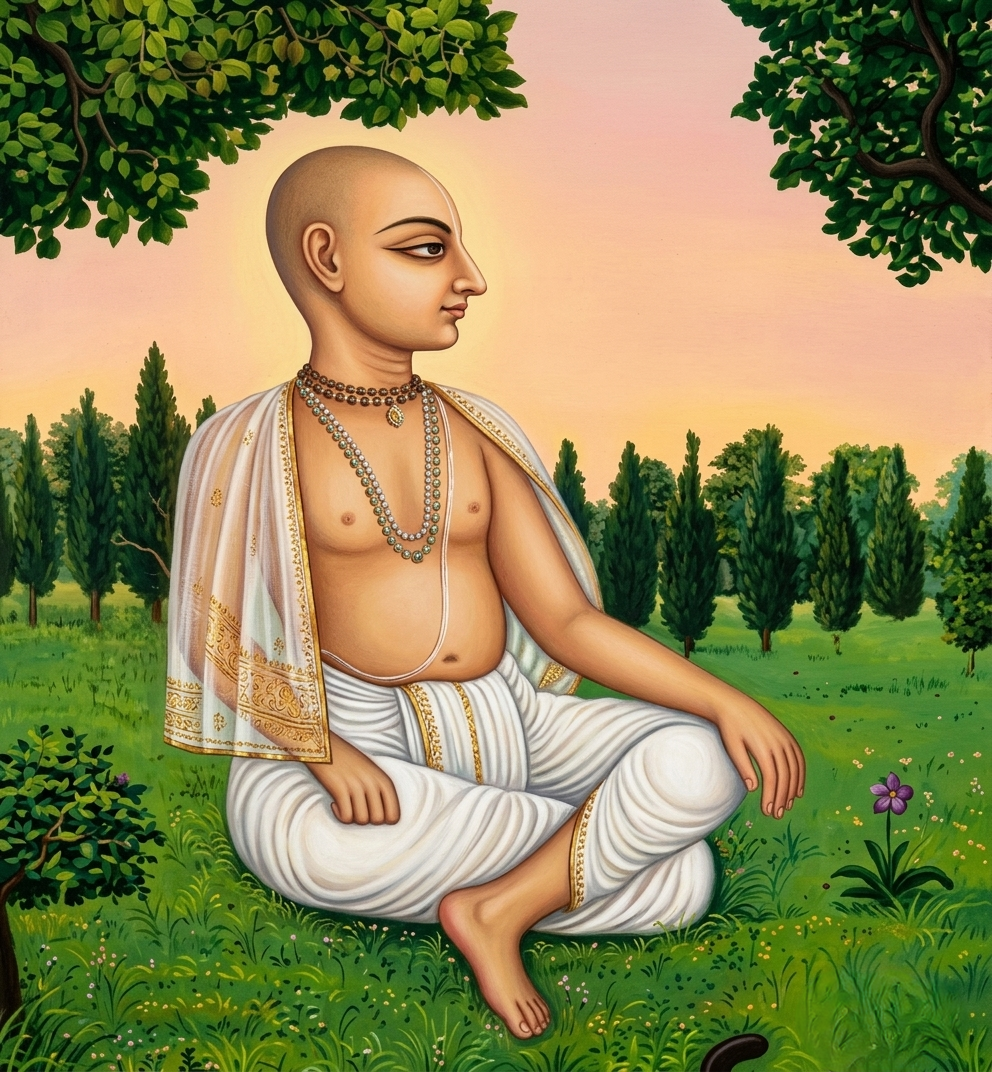 Sri Madhu Pandita Gosvami — devoted servant of Sri Gopinatha
In this article
Who Was Sri Madhu Pandita Gosvami?
In the vast and luminous galaxy of devotees who orbited Sri Caitanya Mahaprabhu — the Supreme Lord who descended in this age to distribute the treasure of pure love of Godhead — there are some souls whose contribution remains etched in the very stones and soil of Vrndavana. Sri Madhu Pandita Gosvami is one such exalted personality.
His Divine Grace Vishwa Guru A.C. Bhaktivedanta Swami Prabhupada, in his commentary on Sri Caitanya-caritamrta (Adi-lila 12.88), specifically lists Madhu Pandita Gosvami among the notable disciples of Sri Gadadhara Pandita, noting that he “lived near Khadadaha in the village known as Sanibona-grama, about two miles east of the Khadadaha station, and constructed the temple of Gopinathaji in Vrndavana.”
This single line from Srila Prabhupada opens a door into an extraordinary life — a life of complete surrender, unbroken Deity worship, and selfless service to the Vaisnava community. To observe his Tirobhava (Disappearance Day) or Avirbhava (Appearance Day) is to remember a soul who literally built one of the seven most sacred temples on the face of the earth and spent forty years in devoted service before the lotus feet of Lord Gopinatha.
“A devotee should be fixed in the conclusion that the Lord's holy name is identical with the Lord Himself and should chant the holy name with complete conviction.”
— Srimad-Bhagavatam 11.2.40, as explained by Srila Prabhupada
Such was the conclusion in which Madhu Pandita Gosvami was firmly established. Every day of his life in Vrndavana was an expression of this principle — that devotional service, when rendered with purity and steadiness, becomes the highest gift one can offer both to the Lord and to future generations.
The Lineage: A Disciple of Sri Gadadhara Pandita
To understand Madhu Pandita Gosvami, we must first understand his spiritual master, Sri Gadadhara Pandita Gosvami — for the quality of a disciple is illuminated by the greatness of his guru.
Sri Gadadhara Pandita is one of the panca-tattva — the five-fold form of the Absolute Truth that descended with Sri Caitanya Mahaprabhu. The Gaura-ganoddesa-dipika, the authoritative text that identifies the roles of Mahaprabhu's associates, declares that Gadadhara Pandita is none other than Srimati Radharani herself — the hladini-sakti (the pleasure potency) of the Lord — who appeared in Gaura-lila to accompany the Lord in His pastimes of distributing prema-bhakti.
Madhu Pandita Gosvami received diksa (spiritual initiation) from this ocean of divine love. Having come from the village of Sanibona-grama near Khadadaha in Bengal, he eventually made his way to Vrndavana — the eternal abode of Lord Krsna — in search of the Supreme Lord and in the spirit of his master's teachings. There, he came under the guidance of Sri Paramananda Bhattacarya, another disciple of Gadadhara Pandita, who would play a pivotal role in one of the most remarkable events of that era.
The Disciplic Connection
🌸
Sri Caitanya Mahaprabhu
The Supreme Lord in Gaura-lila
🌺
Sri Gadadhara Pandita
Panca-tattva · Guru of Madhu Pandita Gosvami
🌼
Sri Madhu Pandita Gosvami
Founder of Gopinatha Temple · Vrndavana
The Sakha-nirnaya of Yadunandana Dasa, cited by Srila Prabhupada, lists Madhu Pandita Gosvami as one of the significant branches of the Gadadhara Pandita disciplic tree — a tree whose roots were nourished by the most intimate love of Sri Caitanya Mahaprabhu Himself.
The Rediscovery of Lord Gopinatha
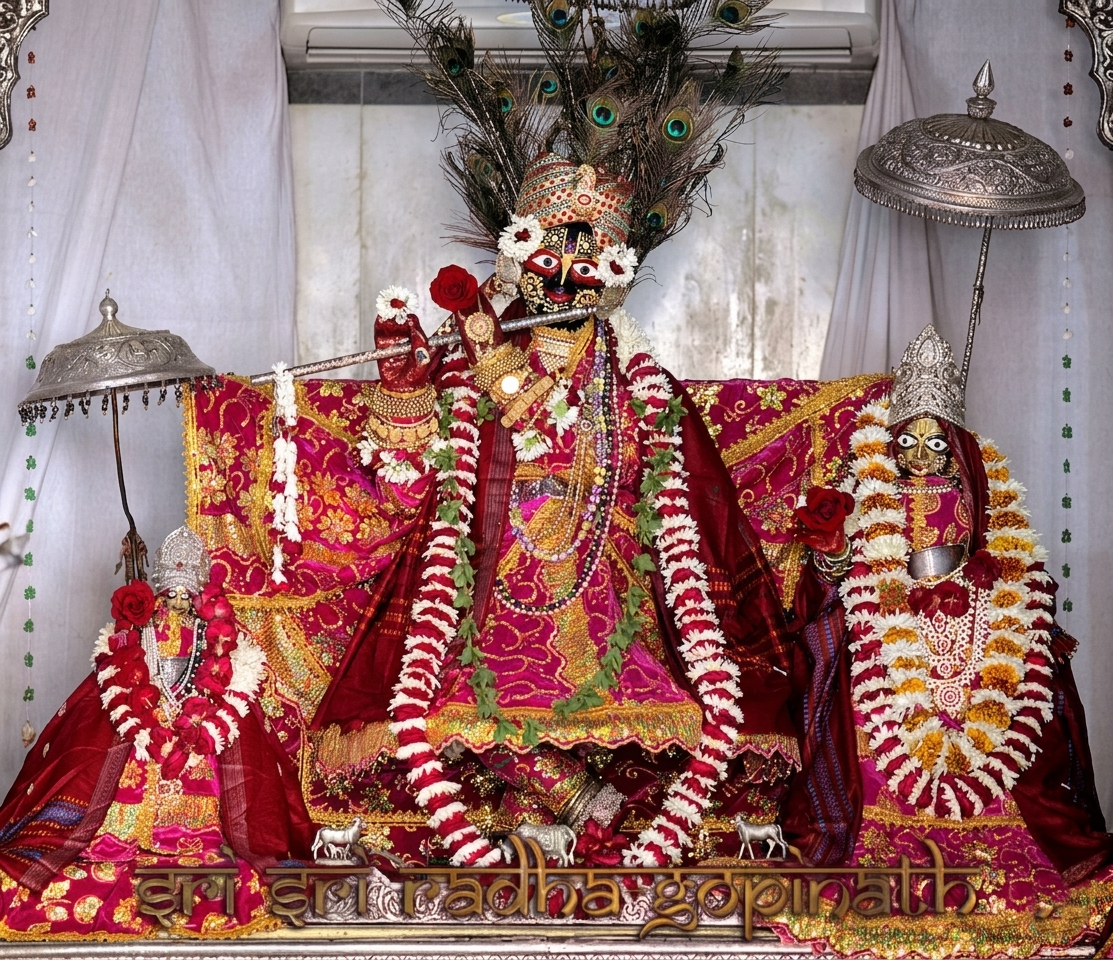
Sri Sri Radha-Gopinatha — worshipped in the Gopinatha tradition established by Madhu Pandita Gosvami
The story of how Lord Gopinatha was rediscovered in Vrndavana is one of the most touching episodes in the history of Gaudiya Vaisnavism — and Madhu Pandita Gosvami stands at its very heart.
Lord Gopinatha — meaning “the Master of the Gopis” — is one of the three principal Deities of Vrndavana, the others being Sri Madana-Mohana and Sri Govinda Deva. Together, these three Deities represent the three great principles of spiritual life described in the Bhagavad-gita and Srimad-Bhagavatam: sambandha (our relationship with the Lord), abhidheya (our activities in that relationship), and prayojana (the ultimate goal — pure love of Godhead). Lord Gopinatha embodies prayojana — He is the Lord of the highest love.
The original Deity of Gopinatha had been installed approximately 5,000 years ago by Vajranabha, the great-grandson of Lord Krsna, who had several Deities carved based on the descriptions of Krsna's divine form given by Uttara, the mother of Maharaja Pariksit. As narrated in the Srimad-Bhagavatam, Pariksit was the last royal descendent of the Pandavas who heard the Bhagavatam from Sukadeva Gosvami on the banks of the Ganga before leaving his body — an event that is the very foundation of the Bhagavata tradition.
Over millennia, this ancient Deity became lost. During the time of the Gosvamis — the period following Sri Caitanya Mahaprabhu's earthly pastimes — Madhu Pandita Gosvami came to Vrndavana with a burning longing in his heart for Lord Gopinatha. He searched everywhere. Not finding the Deity, and feeling a grief that only a pure devotee can know, he gave up eating and sat at Vamsivata — the sacred place where Lord Krsna had performed His rasa-lila — weeping in constant streams of tears and calling out to the Lord.
“sriman rasa-rasarambhi vamsivata-tata-sthitau karman venu-svanair gopir gopi-nathau sriye 'stu nau”
— Sri Caitanya-caritamrta, Madhya 1.5 · The verse glorifying Lord GopinathaTranslation: Let the merciful blessings of Lord Gopinatha — who commences the enchanting rasa dance on the banks of the Yamuna at Vamsivata and enthralls the gopis with the sweet melodies of His flute — be upon us.
As fate — or rather, the Lord's own mercy — would have it, the monsoon that season brought extraordinary floods. The Yamuna overflowed her banks with tremendous force, uprooting an ancient banyan tree at Vamsivata. When the waters finally receded, Madhu Pandita Gosvami's close companion, Sri Paramananda Bhattacarya, saw a Deity half-buried in the earth at the very spot where the great banyan tree had once stood — Lord Gopinatha, resting where He had been for thousands of years, awaiting the arrival of His devoted servants.
Paramananda immediately called Madhu Pandita Gosvami, who retrieved the Deity with tears of joy. The Lord who had been searched for with such longing and grief was now found — and the great chapter of Gopinatha's worship in Vrndavana had truly begun.
Forty Years of Unbroken Devotional Service
After the discovery of Lord Gopinatha, the Deity was moved to the spot where the present Gopinatha Temple now stands. The seva (worship) of the Deity was entrusted to Madhu Pandita Gosvami — and for the next forty years, he served Lord Gopinatha with absolute steadiness, devotion, and love.
This is not a small or incidental detail. The Srimad-Bhagavatam repeatedly glorifies the power of steadfast, uninterrupted devotional service. As Srila Prabhupada explains in his purports, the highest standard of bhakti is naisthiki — unswerving, unbroken, lifelong devotion. Madhu Pandita Gosvami embodied this. Every day, for four decades, he rose before dawn, performed the full srngara (dressing and ornamentation) of the Deity, offered bhoga (food), performed arati, and read the Srimad-Bhagavatam — the scripture that Sri Caitanya Mahaprabhu declared to be the commentary on the Vedanta-sutra and the essence of all spiritual knowledge.
The Bhakti-ratnakara — the authoritative text of Narahari Cakravarti that records the lives of the Vaisnavas after the disappearance of Sri Caitanya Mahaprabhu — glorifies the extraordinary service of Madhu Pandita Gosvami. It is the very text that the Six Gosvamis of Vrndavana, Srinivasa Acarya, and Narottama Dasa Thakura honoured and propagated.
The Teaching of Steady Devotion
Srila Prabhupada writes in his purport to Srimad-Bhagavatam 1.2.6:
“The highest perfection of human life is to have one's complete absorption in pure devotional service of the Lord without any cause or impediment.”
— His Divine Grace A.C. Bhaktivedanta Swami Prabhupada, Srimad-Bhagavatam 1.2.6, PurportThis is precisely what Madhu Pandita Gosvami demonstrated — not for a year, not for a decade, but for forty continuous years. His life is a living commentary on this verse. When we observe his Appearance or Disappearance Day, we celebrate not just a historical personality but an eternal principle: that a human life fully dedicated to Deity worship and the service of the Lord is the highest achievement possible in this world.
The Gopinatha Temple — One of the Saptadevalyas
The Gopinatha Temple that Madhu Pandita Gosvami established is one of the Saptadevalyas — the seven principal and most ancient Vaisnava temples of Vrndavana. These seven temples are the beating heart of the dhama, each one associated with a great Gosvami or saint of the Caitanya tradition, and each one housing a Deity whose history connects us to the very earliest days of Krsna's appearance on this earth.
The seven Gosvami temples of Vrndavana are: Sri Madan-Mohan (established by Sri Sanatana Gosvami), Sri Govinda Deva (established by Sri Rupa Gosvami), Sri Gopinatha (established by Sri Madhu Pandita Gosvami), Sri Radha Damodara (established by Sri Jiva Gosvami), Sri Radha Syamasundara (established by Srinivasa Acarya), Sri Radha Ramana (established by Sri Gopala Bhatta Gosvami), and Sri Radha Gokulananda (associated with Sri Lokanatha Gosvami).
There is a profound Vaisnava tradition that states: if a pilgrim is fortunate enough to have darsana of the three principal Deities — Sri Madana-Mohana, Sri Gopinatha, and Sri Govinda Deva — within a single day, before sunset, they receive a blessing equivalent to the direct darsana of Lord Krsna Himself. These three Deities represent the complete spiritual journey — from first awakening our love for God, to deepening our service, to attaining the supreme goal.
Sri Madana-Mohana
Sambandha Tattva
Establishing our relationship with the Lord — the beginning of the path
Sri Govinda Deva
Abhidheya Tattva
Our activities and service in that relationship — the practice
Sri Gopinatha
Prayojana Tattva
The supreme goal — pure love of Godhead in the footsteps of the gopis
That Madhu Pandita Gosvami was chosen by the Lord to establish and serve the Deity representing the highest goal — prayojana — says everything about his spiritual stature. He was not merely a temple builder. He was a devotee who had achieved the very purpose of life and was thus fit to serve the Deity who embodies it.
The Blessing of Srinivasa Acarya
Among the most heartwarming episodes involving Madhu Pandita Gosvami is his role in blessing Srinivasa Acarya — one of the three most celebrated acaryas of the post-Caitanya era, alongside Narottama Dasa Thakura and Syamananda Pandita — who were entrusted with carrying the precious writings of the Six Gosvamis from Vrndavana to Bengal.
This was a monumental mission. The Six Gosvamis — Sri Rupa, Sri Sanatana, Sri Jiva, Sri Gopala Bhatta, Sri Raghunatha Bhatta, and Sri Raghunatha Dasa — had produced an ocean of Vaisnava theology, philosophy, and devotional poetry during their years in Vrndavana. These writings needed to be brought to Bengal and distributed, so that the people of India — and ultimately the world — could receive the gift of bhakti that Sri Caitanya Mahaprabhu had come to give.
As Srinivasa Acarya prepared to depart on this great service mission, Madhu Pandita Gosvami came forward and garlanded him with a flower garland that had been worn by Lord Gopinatha Himself. In Vaisnava tradition, the honour of receiving the Lord's own garland is among the most sacred blessings one can receive — it signifies the Lord's personal acceptance and blessing of the recipient's service. That Madhu Pandita Gosvami, as the pujari of Gopinatha, was the instrument through which this divine blessing was transmitted to Srinivasa Acarya shows his position of trust and intimacy in the community of the Vrndavana Gosvamis.
“The garland that had graced the Lord was placed by Madhu Pandita Gosvami around the neck of Srinivasa — and with it, the Lord's own blessing for the great preaching mission that was about to unfold.”
— From the Bhakti-ratnakara of Narahari Cakravarti
The Bhakti-ratnakara also records that when Sri Biracandra Prabhu (the son of Sri Nityananda) visited Vrndavana, Madhu Pandita Gosvami was among the great devotees who came out to receive him — along with Sri Jiva Gosvami, Krsnadasa Kaviraja Gosvami, and other exalted personalities. This confirms that Madhu Pandita Gosvami was an integral and respected figure in the full community of the Vrndavana Vaisnavas during this golden era of the Caitanya tradition.
Gopinatha and the Principle of Prayojana Tattva
The Deity that Madhu Pandita Gosvami served — Lord Gopinatha — is not merely a beautiful murti (Deity form). In the Gaudiya Vaisnava theological tradition, each of the three principal Deities of Vrndavana represents a complete philosophical principle, and together they reveal the entire path of devotional life as taught by Sri Caitanya Mahaprabhu.
Lord Gopinatha — “the Master of the Gopis” — represents prayojana tattva: the ultimate purpose and goal of existence. The gopis of Vrndavana are the supreme exemplars of loving devotion. Their love for Krsna — spontaneous, unconditional, selfless, and all-consuming — is what the Srimad-Bhagavatam describes as the highest form of bhakti. The Tenth Canto of the Srimad-Bhagavatam — which Srila Prabhupada has described as the ripened fruit of the Vedic tree of knowledge — is largely dedicated to the narration of Lord Krsna's pastimes with the gopis, culminating in the rasa-lila at Vamsivata — the very spot where Lord Gopinatha was rediscovered.
Srila Prabhupada explains in his purport to Srimad-Bhagavatam 10.33.39:
“The highest perfection of love of Godhead is exhibited by the gopis of Vrndavana. Their love is categorized as kama, meaning it appears to resemble lusty desires, but in fact it is the highest platform of prema, or pure love.”
— Srila Prabhupada, Srimad-Bhagavatam 10.33.39, Purport
By serving Lord Gopinatha — the Lord of this highest prema — every day for forty years, Madhu Pandita Gosvami was himself absorbed in the contemplation of the highest goal of Vaisnava life. His service was not mechanical ritual. It was the outpouring of a heart that had been trained by his spiritual master — who was himself the embodiment of Srimati Radharani — to love the Lord without reservation. There is a profound continuity in this: the sakti (divine energy) of Gadadhara Pandita — who is Radharani in Gaura-lila — flowed through to the worship of Gopinatha — the Lord of Radharani's gopis — through the devotion of Madhu Pandita Gosvami.
Srila Prabhupada and the Gopinatha Lineage
His Divine Grace Vishwa Guru A.C. Bhaktivedanta Swami Prabhupada — the founder-acarya of the International Society for Krishna Consciousness (ISKCON) and the spiritual parent of Srila Prabhupada's ISKCON Thiruvanmiyur — had a deep personal connection with the legacy of the Vrndavana Gosvamis and the temples they established.
Before founding ISKCON, Srila Prabhupada lived for years in Vrndavana, meditating on the Lord's pastimes and translating the Srimad-Bhagavatam. He walked the same lanes and courtyards where Madhu Pandita Gosvami once served. He had darsana of Lord Gopinatha in the very temple that Madhu Pandita Gosvami established. The deep reverence Srila Prabhupada carried for the Six Gosvamis and their associates — including personalities like Madhu Pandita Gosvami — permeates every page of his translations and purports.
When Srila Prabhupada wrote his commentary on the Caitanya-caritamrta verse that mentions Madhu Pandita Gosvami (Adi 12.88), he was not merely providing a historical footnote. He was drawing our attention to a living example of the principles he spent his entire life teaching:
- That the highest occupation is service to the Lord's Deity
- That a pure disciple inherits the spiritual potency of a pure guru
- That the Vaisnava community functions as a family — each member blessed and blessing others
- That the dhama (holy place) is eternally alive because pure devotees have served there
When we at Srila Prabhupada's ISKCON Thiruvanmiyur observe the Tirobhava of Madhu Pandita Gosvami, we do so in the spirit of Srila Prabhupada's teaching — that remembering the great Vaisnavas purifies us and connects us to an unbroken chain of devotion that stretches from the present moment back to Lord Krsna Himself.
As the Srimad-Bhagavatam declares (3.25.25): “In the association of pure devotees, discussion of the pastimes and activities of the Supreme Personality of Godhead is very pleasing and satisfying to the ear and the heart. By cultivating such knowledge one gradually becomes advanced on the path of liberation, and thereafter he is freed, and his attraction becomes fixed. Then real devotion and devotional service begin.”
How to Observe This Sacred Day
In the Gaudiya Vaisnava tradition, both the Avirbhava (Appearance Day) and Tirobhava (Disappearance Day) of great Vaisnavas are observed with equal reverence and devotion. The Disappearance Day is not a day of mourning — it is a day of glorification and celebration, for the pure devotee never truly disappears. As the Bhagavad-gita teaches, the soul is eternal, and the great Vaisnavas continue their service to the Lord in the spiritual world, ever accessible to sincere devotees through their teachings and the mercy they bestow.
Read About His Life
Study the Bhakti-ratnakara and the relevant sections of Caitanya-caritamrta that mention Madhu Pandita Gosvami and his service.
Perform Kirtana
Chant the Hare Krsna maha-mantra and sing the songs of the Vaisnava acaryas — especially those composed by Narottama Dasa Thakura who was blessed by Madhu Pandita Gosvami's tradition.
Offer Prayers
Offer a flower at your home altar or the temple Deity, remembering Madhu Pandita Gosvami's forty years of Deity worship and his unbroken devotion to Lord Gopinatha.
Chant Extra Rounds
On the Tirobhava of a great Vaisnava, devotees traditionally chant extra rounds of japa to deepen their own practice of the holy name.
Visit the Temple
Visit Srila Prabhupada's ISKCON Thiruvanmiyur — Dakshina Dvaraka Dhama at Thiruvanmiyur for special observances, Srimad-Bhagavatam class, and darsana of Sri Sri Nitai Gauranga.
Share the Glories
Share this article with devotees and seekers, so that more souls may hear about this great personality and receive the purifying benefit of such glorification.
The Samadhi of Madhu Pandita Gosvami
In the Vaisnava tradition, the samadhi — the memorial tomb of a great saint — is not merely a monument. It is a place of ongoing spiritual presence. The Gaudiya Vaisnavas believe that a pure devotee is nirguna — transcendental to the material energy — and that his or her samadhi retains the spiritual potency of that personality. To visit the samadhi of a Vaisnava and offer pranamas (obeisances) is to receive their mercy directly.
The samadhi of Sri Madhu Pandita Gosvami stands on the eastern side of the Gopinatha Temple premises in Vrndavana — within the very courtyard of the temple he built and the Deity he served for forty years. Even today, pilgrims who visit the Gopinatha Temple can offer their respects at this samadhi and meditate on the extraordinary life of devotion it represents.
For devotees who cannot make the pilgrimage to Vrndavana, the samadhi can be visited in spirit through prayer, reading, and remembrance. The Srimad-Bhagavatam (7.14.30-33) confirms that even the homes of devotees become places of pilgrimage, because the devotee carries the Lord with them always. In the same spirit, whenever we remember Madhu Pandita Gosvami — wherever we are — we make contact with his mercy.
“I offer my respectful obeisances unto the feet of Sri Madhu Pandita Gosvami — the devoted disciple of Sri Gadadhara Pandita, the great servant of Lord Gopinatha, the blessed associate of the Vrndavana Gosvamis, and the eternal recipient of the Lord's own mercy.”
— A prayer of remembranceFrequently Asked Questions
Who was Sri Madhu Pandita Gosvami?
What is the significance of the Gopinatha Temple founded by Madhu Pandita Gosvami?
Who was Madhu Pandita Gosvami's spiritual master?
What is the connection between Madhu Pandita Gosvami and Srinivasa Acarya?
When is the Disappearance Day of Sri Madhu Pandita Gosvami observed?
Where is the samadhi of Madhu Pandita Gosvami located?
What can we learn from the life of Madhu Pandita Gosvami?
How can I observe the Appearance or Disappearance Day of Sri Madhu Pandita Gosvami at Srila Prabhupada's ISKCON Thiruvanmiyur?
Continue reading
Connect With Us
Follow Hare Krishna Movement Chennai across all platforms for daily darsan, spiritual insights, event updates, and seva opportunities.
Dakshina Dwaraka Dham — Find us