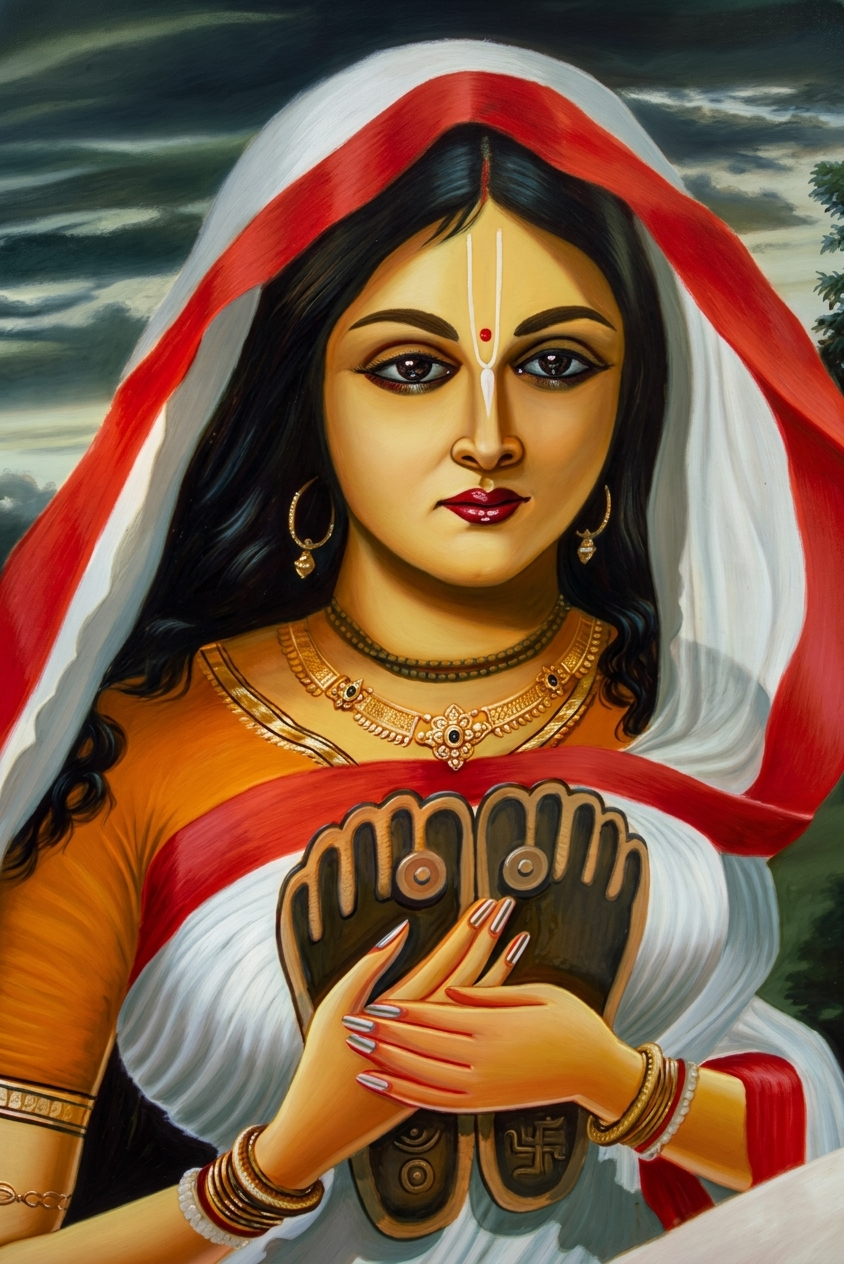
Introduction — Who Is Śrīmatī Jāhnavā Devī?
On this most auspicious tithi — whether the āvirbhāva (divine appearance) or the tirobhāva (divine disappearance) of Śrīmatī Jāhnavā Devī — we gather to meditate with devotion and gratitude upon the glories of one of the most luminous personalities in all of Gauḍīya Vaiṣṇava history.
She is the eternal consort of Śrī Nityānanda Prabhu. To understand her greatness, we must first understand who Nityānanda Prabhu is. Śrīla Prabhupāda writes:
“Lord Nityānanda Prabhu is the original Saṅkarṣaṇa, Śeṣa and Balrāma. He is the principal expansion of Kṛṣṇa.” — Śrī Caitanya-caritāmṛta, Ādi-līlā 5.120–121, Purport
Lord Nityānanda is Baladeva — the second body of the Supreme Lord, the first and original expansion, the ādi-guru of all. Jāhnavā Devī is His eternal śakti, His pleasure potency — a fact Prabhupāda states in his very own words, as we shall see.
I. “The Pleasure Potency of Śrī Nityānanda Prabhu”
The most exalted and theologically precise identification of Śrīmatī Jāhnavā Devī in all of Śrīla Prabhupāda’s writings appears in the purport to Śrī Caitanya-caritāmṛta, Ādi-līlā 10.85. While narrating the activities of Śrī Jīva Gosvāmī in Vṛndāvana, Śrīla Prabhupāda writes:
“While Jīva Gosvāmī was alive, Śrīmatī Jāhnavā-devī, the pleasure potency of Śrī Nityānanda Prabhu, went to Vṛndāvana with a few devotees. Jīva Gosvāmī was very kind to the Gauḍīya Vaiṣṇavas, the Vaiṣṇavas from Bengal. Whoever went to Vṛndāvana he provided with a residence and prasādam.” — Śrī Caitanya-caritāmṛta, Ādi-līlā 10.85, Purport
Every word here is Śrīla Prabhupāda’s own. In a single statement he gives us three foundational facts about Śrīmatī Jāhnavā Devī:
1. Her theological identity: She is the pleasure potency (hlādinī-śakti) of Lord Nityānanda Prabhu — His own internal energy appearing in human form, just as Śrīmatī Rādhārāṇī is the pleasure potency of Śrī Kṛṣṇa.
2. Her journey to the Dhāma: She went personally to Vṛndāvana during the lifetime of Śrī Jīva Gosvāmī, the greatest scholar of the Six Gosvāmīs.
3. The honour the Gosvāmīs gave her: Jīva Gosvāmī personally arranged her residence and prasādam in Vṛndāvana — the foremost Vaiṣṇava scholar personally serving her is itself a testimony to her stature.
II. Her Eternal Identity — Anaṅga-mañjarī of Vṛndāvana
In his purport to Ādi-līlā 11.21, Śrīla Prabhupāda reveals Jāhnavā Devī’s eternal identity in the spiritual world. The verse glorifies the associates of Lord Nityānanda as formerly cowherd boys (gopas) of Vrajabhūmi. In the purport, Śrīla Prabhupāda adds — and here he himself cites the Gaura-gaṇoddeśa-dīpikā of Kavi-karṇapūra, the authoritative text on the identities of all associates of Śrī Caitanya Mahāprabhu:
“Jāhnavā-mātā is also within the list of Lord Nityānanda’s followers. She is described in the Gaura-gaṇoddeśa-dīpikā, verse 66, as Anaṅga-mañjarī of Vṛndāvana. All the devotees who are followers of Jāhnavā-mātā are counted within the list of Śrī Nityānanda Prabhu’s devotees.” — Śrī Caitanya-caritāmṛta, Ādi-līlā 11.21, Purport
— Śrīla Prabhupāda citing Gaura-gaṇoddeśa-dīpikā, verse 66
The Gaura-gaṇoddeśa-dīpikā of Kavi-karṇapūra, cited here by Prabhupāda himself, contains the following Sanskrit verses establishing her identity:
Śrī-varuṇī-revatā-vaṃśa-sambhave
tasya priye dve vasudhā ca jāhnavī
Śrī-sūrya-dāsasya mahātmanaḥ sute
kakudma-rūpasya ca sūrya-tejasāḥ
anaṅga-mañjarīm kecij jāhnavāṃ ca pracakṣate
ubhayaṃ tu samīcīnaṃ pūrva-nyāyāt satāṃ matam
Translation (as cited by Prabhupāda): “Balarāma’s wives Varuṇī and Revatī became Vasudhā and Jāhnavī, the two wives of [Nityānanda Prabhu], in Caitanya-līlā. Both were daughters of the great soul Sūryadāsa, whose effulgence is like the sun, who is an expansion of Kakudmān, the father of Revatī, in his previous birth. Some say Jāhnavā is Anaṅga-mañjarī. Both opinions are acceptable, following the reasoning of the wise.”
In the Gauḍīya understanding, Anaṅga-mañjarī is the younger sister of Śrīmatī Rādhārāṇī in the eternal pastimes of Goloka Vṛndāvana — among the most intimate of all the mañjarīs. This is not a secondary identity. It is the eternal spiritual position that Jāhnavā Devī occupies in the Lord’s own abode.
The second sentence of Prabhupāda’s purport is equally important: all who follow Jāhnavā-mātā are counted within Lord Nityānanda’s devotees. To seek her mercy is to seek Nityānanda Prabhu’s mercy directly.
III. Her Father’s Noble Family — As Described by Śrīla Prabhupāda
Śrīla Prabhupāda introduces the verse Ādi-līlā 11.25 with this Sanskrit text and his own translation:
sūryadāsa sarakhela, tāṃra bhāi kṛṣṇadāsa
nityānande dṛḍha viśvāsa, premera nivāsa
Translation by Śrīla Prabhupāda: “Sūryadāsa Sarakhela and his younger brother Kṛṣṇadāsa Sarakhela both possessed firm faith in Nityānanda Prabhu. They were a reservoir of love of Godhead.”
Then in the purport — where Prabhupāda himself cites the Bhakti-ratnākara (Twelfth Wave) of Narahari Cakravartī Ṭhākura — he writes:
“In the Bhakti-ratnākara (Twelfth Wave), it is stated that a few miles from Navadvīpa is a place called Śāligrāma that was the residence of Sūryadāsa Sarakhela. He was employed as a secretary in the Muslim government of that time, and thus he amassed a good fortune. Sūryadāsa had four brothers, all of whom were pure Vaiṣṇavas. Vasudhā and Jāhnavā were two daughters of Sūryadāsa Sarakhela.” — Śrī Caitanya-caritāmṛta, Ādi-līlā 11.25, Purport (Śrīla Prabhupāda citing Bhakti-ratnākara, Twelfth Wave)
From this purport we know with complete authority: Jāhnavā Devī’s father was Sūryadāsa Sarakhela, a great devotee of Lord Nityānanda Prabhu, a man of considerable standing who lived near Navadvīpa at Śāligrāma. All four of his brothers were pure Vaiṣṇavas. His two daughters, Vasudhā and Jāhnavā, both became the eternal consorts of Lord Nityānanda Prabhu in Caitanya-līlā. The Bhakti-ratnākara is here cited by Prabhupāda himself — it is therefore an authoritative source that carries his personal endorsement.
Her Father’s Glorious Brother — Gaurīdāsa Paṇḍita
Śrīla Prabhupāda also confirms the identity of one of Sūryadāsa’s brothers in Ādi-līlā 11.26–28, establishing the immense devotional stature of the family into which Jāhnavā Devī descended:
“Gaurīdāsa Paṇḍita, the emblem of the most elevated devotional service in love of Godhead, had the greatest potency to receive and deliver such love. Making Lord Caitanya and Lord Nityānanda the Lords of his life, Gaurīdāsa Paṇḍita sacrificed everything for the service of Lord Nityānanda.” — Śrī Caitanya-caritāmṛta, Ādi-līlā 11.26–27, Translation
Gaurīdāsa Paṇḍita — uncle of Jāhnavā Devī and one of the foremost of all Nityānanda Prabhu’s associates — is described by Prabhupāda as “the emblem of the most elevated devotional service in love of Godhead.” That Jāhnavā Devī grew up surrounded by such luminaries was itself the Lord’s own arrangement.
IV. Her Foremost Disciple — Śrī Vīrabhadra Gosvāmī
In the purport to Ādi-līlā 11.8, Śrīla Prabhupāda — citing Śrīla Bhaktisiddhānta Sarasvatī Ṭhākura’s authoritative commentary, the Anubhāṣya — makes a remarkable statement about Jāhnavā Devī’s role as guru:
“Śrīla Bhaktisiddhānta Sarasvatī Ṭhākura writes in his Anubhāṣya: “Vīrabhadra Gosāñi was the direct son of Śrīla Nityānanda Prabhu and a disciple of Jāhnavā-devī. His real mother was Vasudhā. In the Gaura-gaṇoddeśa-dīpikā, verse 67, he is mentioned as an incarnation of Kṣīrodakaśāyī Viṣṇu.””
— Śrī Caitanya-caritāmṛta, Ādi-līlā 11.8, Purport (Śrīla Prabhupāda citing Śrīla Bhaktisiddhānta’s Anubhāṣya and Gaura-gaṇoddeśa-dīpikā, verse 67)
This purport reveals three things simultaneously:
1. She was a dīkṣā-guru: Vīrabhadra Gosvāmī — the direct son of Lord Nityānanda Prabhu Himself — received initiation from Jāhnavā Devī. She was his guru.
2. Her step-son's divine identity: According to the Gaura-gaṇoddeśa-dīpikā (cited by Prabhupāda), Vīrabhadra is an incarnation of Kṣīrodakaśāyī Viṣṇu, the Supersoul who resides in the heart of every living being. That Jāhnavā Devī was the guru of such a great soul speaks for itself.
3. His family of disciples: Prabhupāda goes on in the same purport to describe Vīrabhadra’s many disciples who became śikhā-branches of the Caitanya tree — all spiritual descendants of Jāhnavā Devī’s mercy.
The verse that introduces this purport reads:
Śrī-vīrabhadra gosāñi–skandha-mahāśākhā
tāṃra upaśākhā yata, asaṃkhya tāra rekhā
Translation: “After Nityānanda Prabhu, the greatest branch is Vīrabhadra Gosāñi, who also has innumerable branches and subbranches. It is not possible to describe them all.” — Śrī Caitanya-caritāmṛta, Ādi-līlā 11.8
V. Her Deity at the Birthplace of Lord Nityānanda — Ekacakra
In the purport to Ādi-līlā 13.28, while describing the sacred Ekacakra-grāma — Lord Nityānanda’s birthplace — Śrīla Prabhupāda describes the Bankima Rāya temple, and mentions Jāhnavā Devī directly:
“On Bankima Rāya’s right side is a deity of Jāhnavā, and on His left side is Śrīmatī Rādhārāṇī. The priests of the temple describe that Lord Nityānanda Prabhu entered within the body of Bankima Rāya and that the deity of Jāhnavā-mātā was therefore later placed on the right side of Bankima Rāya. Afterwards, many other Deities were installed within the temple.” — Śrī Caitanya-caritāmṛta, Ādi-līlā 13.28, Purport
This statement carries extraordinary significance. After Lord Nityānanda Prabhu completed His manifest pastimes by merging into the Bankima Rāya Deity, His śakti — Jāhnavā Devī — was installed beside Him on His right. The Lord is never separate from His pleasure potency. Even in the form of the Deity, Jāhnavā Devī stands at His side, eternally. Pilgrims who visit Ekacakra today can offer their praṇāmas to both Nityānanda Prabhu and Jāhnavā Devī together at the Bankima Rāya temple.
VI. “She Was Ācārya” — Śrīla Prabhupāda’s Own Testimony
Of all Śrīla Prabhupāda’s statements about Śrīmatī Jāhnavā Devī, two recorded conversations are the most direct, the most unambiguous, and the most moving. In both, Prabhupāda speaks not from a verse or a purport but freely, from his heart, from his personal knowledge of the Gauḍīya tradition.
Room Conversation — San Diego, June 29, 1972
While speaking with a devotee named Ātreya Ṛṣi about women in spiritual life, Śrīla Prabhupāda declared:
“If a woman is perfect in Kṛṣṇa consciousness… Just like Jāhnavā-devī, Lord Nityānanda’s wife, she was ācārya. She was ācārya. She was controlling the whole Vaiṣṇava community.”
— Śrīla Prabhupāda, Room Conversation, San Diego, June 29, 1972
When Ātreya Ṛṣi asked for confirmation — “Lord Nityānanda? Wife?” — Śrīla Prabhupāda confirmed without hesitation:
“Wife. Jāhnavī-devī. She was controlling the whole Gauḍīya Vaiṣṇava community.”
— Śrīla Prabhupāda, Room Conversation, San Diego, June 29, 1972
Notice that Prabhupāda says “she was ācārya” twice — a natural emphasis that arises from deep conviction. He does not hedge. He does not qualify. She was ācārya. She controlled the whole community.
Interview with Professor O’Connell — Toronto, June 18, 1976
In a formal recorded interview with Professor Joseph T. O’Connell of the University of Toronto, the topic of women as gurus arose directly. The full exchange, preserved in the Conversations with Śrīla Prabhupāda (Vol. 22, BBT International, 1990, pp. 19–20), is as follows:
“O’Connell: Is it possible, Swamiji, for a woman to be a guru in the line of disciplic succession? Prabhupāda: Yes. Jāhnavā Devī was — Nityānanda’s wife. She became. If she is able to go to the highest perfection of life, why is it not possible to become guru? But not so many. Actually one who has attained the perfection, she can become guru. But man or woman, unless one has attained the perfection… yei kṛṣṇa-tattva-vettā sei guru haya [Cc. Madhya 8.128]. The qualification of guru is that he must be fully cognizant of the science of Kṛṣṇa. Then he or she can become guru. In our material world, is it any prohibition that woman cannot become professor? If she is qualified, she can become professor. What is the wrong there? She must be qualified. That is the position. So similarly, if the woman understands Kṛṣṇa consciousness perfectly, she can become guru.”
— Śrīla Prabhupāda, Interview with Prof. O’Connell, Toronto, June 18, 1976 (Conversations with Śrīla Prabhupāda, Vol. 22, BBT, pp. 19–20)
Śrīla Prabhupāda spontaneously quotes from Śrī Caitanya-caritāmṛta, Madhya-līlā 8.128:
yei kṛṣṇa-tattva-vettā, sei guru haya
Translation: “Anyone who knows the science of Kṛṣṇa is the bona fide spiritual master.” This verse is spoken by Lord Caitanya Mahāprabhu Himself. The qualification is not determined by gender, birth, or social position — it is Kṛṣṇa-consciousness itself. Jāhnavā Devī possessed it perfectly. She was guru. She was ācārya.
VII. What “She Controlled the Whole Gauḍīya Vaiṣṇava Community” Means
When Śrīla Prabhupāda twice states that Jāhnavā Devī “controlled the whole Gauḍīya Vaiṣṇava community,” the full weight of this must be understood.
After the departure of Lord Caitanya Mahāprabhu and Lord Nityānanda Prabhu, the Gauḍīya sampradāya faced the challenge of consolidating, unifying, and protecting the pure teachings of the Six Gosvāmīs. In Bengal especially, different streams had arisen — some with correct, some with deviant, interpretations of Mahāprabhu’s teachings. The community needed a figure of unimpeachable authority, purity, and devotion.
Jāhnavā Devī was that figure. She personally travelled to Vṛndāvana (as Prabhupāda confirms in CC Ādi 10.85) to connect the Bengalis with the Gosvāmīs. She gave initiation to Vīrabhadra Gosvāmī (CC Ādi 11.8). She was the living link between the śakti of Nityānanda and the devotees of Bengal. She “controlled” not through politics or force but through the irresistible force of pure Kṛṣṇa consciousness — precisely in the manner of every genuine ācārya.
Śrīla Prabhupāda himself controlled ISKCON and the worldwide Gaudīya community through the same force: the power of pure devotion, uncompromising teaching, and personal example. Jāhnavā Devī was his predecessor in precisely this role.
VIII. Her Mercy Is Nityānanda Prabhu’s Mercy
Śrīla Prabhupāda repeatedly teaches that without Nityānanda Prabhu’s mercy, one cannot reach Lord Caitanya, and without Lord Caitanya, one cannot reach Rādhā-Kṛṣṇa. He writes in the purport to Ādi-līlā 5.204, citing Narottama Dāsa Ṭhākura’s prayer:
“Narottama dāsa Ṭhākura confirms that without the causeless mercy of Nityānanda Prabhu, one cannot enter into the affairs of Rādhā and Kṛṣṇa.” — Śrī Caitanya-caritāmṛta, Ādi-līlā 5.204, Purport
And in the same purport, Prabhupāda writes the glorification of Nityānanda Prabhu’s lotus feet:
“jaya jaya nitāi-caranaṇa — All glory, all glory to the lotus feet of Lord Nityānanda, by whose mercy I have attained Śrī Rādhā-Govinda.” — Śrī Caitanya-caritāmṛta, Ādi-līlā 5.204, Translation
Since Jāhnavā Devī is the pleasure potency of Lord Nityānanda — the śakti through whom His energy flows into the world — to receive her mercy is to receive Nityānanda’s mercy directly. On her appearance or disappearance day, to pray sincerely at her lotus feet is not a secondary act of devotion. It is to stand at the very door of the path to Goloka Vṛndāvana.
IX. Her Life, Her Mission, and an Unprecedented Honour
The glory of Jāhnavā Devī was not only theological and eternal — it unfolded concretely in the world through the actions she took and the responsibilities she shouldered. The following account, drawn from Back to Godhead Magazine (Issue #24-10, 1989), compiled by Gauḍīya scholars and published with the approval of ISKCON, gives us a portrait of her extraordinary life in this world.
When Lord Nityānanda Prabhu married the two daughters of Sārakhāla Sūryadāsa Paṇḍita — as Śrīla Prabhupāda himself confirms in Ādi-līlā 11.25 — the entire Vaiṣṇava community was overcome with ecstasy, for both girls were extraordinarily pious and renowned as great Vaiṣṇavīs. The younger sister, Vasudhā, gave birth to two children: a son, Vīrabhadra, and a daughter, Gaṅgādevī.
Vasudhā passed away while still young. Jāhnavā Devī, rather than retreating into grief, resolved to raise her sister’s children as her own. She also adopted a boy named Rāmacandra. Thus she devoted much of her youth to caring for three children, ensuring they each became genuine devotees of the Lord — a mother’s love expressed through the highest spiritual purpose.
Vīrabhadra in particular grew to become a towering leader in the Vaiṣṇava community
— as Śrīla Prabhupāda confirms in CC Ādi 11.8, where he cites the Gaura-gaṇoddeśa-dīpikā to establish that Vīrabhadra is an incarnation of Kṣīrodakaśāyī Viṣṇu. When Vīrabhadra Gosvāmī accepted Jāhnavā Devī as his dīkṣā-guru, many other prominent Vaiṣṇavas followed his lead. The stepmother had become the spiritual master of the foremost devotee of the age.
Her Greatness on Her Own Merit
While much of Jāhnavā Devī’s initial fame arose from her relationship with Nityānanda Prabhu, her activities soon revealed a greatness that stood entirely on its own merit. She was respected as a superlative Vaiṣṇava in every circle. Her devotion to the celebrated Gopīnātha Deity of Lord Kṛṣṇa was so intense and so pure that it drew the hearts of the pious and even the impious alike.
By her example she demonstrated how to perform Deity worship and consecrate one’s entire life to spiritual pursuits. She presided over enormous Vaiṣṇava festivals. She gave dīkṣā — formal initiation — to both men and women, fulfilling the role of ācārya that Śrīla Prabhupāda so directly confirms. And it was Jāhnavā Devī who had the insight and the will to maintain close ties with the Gosvāmīs of Vṛndāvana — Lord Caitanya’s chief followers there — in order to preserve solidarity and unification between the branches of Gauḍīya Vaiṣṇavism in Bengal and in Vṛndāvana (Uttar Pradesh). In this way she served as a living bridge between the two great streams of the sampradāya.
The Unprecedented Honour — Her Deity Beside Gopīnātha
One of the most extraordinary events in the life of Jāhnavā Devī is this: devotion to her mission and person became so profound that, within her own lifetime, a deity was made of her — to be placed alongside the very Gopīnātha Deity that was the object of her lifelong veneration.
A formal council was convened in Jaipur to deliberate the propriety of this honour. The king of Jaipur and the assembled Vaiṣṇavas reached a unanimous decision: the deity should be installed. And so it was — placed beside Lord Gopīnātha while Jāhnavā Devī herself was still living in this world. Such a distinction is rare and remarkable in the history of Gauḍīya Vaiṣṇavism — uncommon among men and women alike.
The theology here is beautiful: she who worshipped Gopīnātha with her whole heart was herself enshrined beside Him — a living testimony to the Vaiṣṇava principle that the devotee and the Lord are never truly separate. Pilgrims who visit that temple today bow before both the Lord and His śakti together.
“Much of Jāhnavādevī’s fame began as a result of her relationship with Nityānanda Prabhu. But her activities soon revealed her greatness, and she was respected as a superlative Vaiṣṇava on her own merit… She even presided over huge Vaiṣṇava festivals and gave initiation to men and women alike… Such a distinguished honor is uncommon among Vaiṣṇava men and women alike.”
— Great Vaiṣṇava Women, Back to Godhead Magazine, Issue #24-10, 1989
X. How to Observe This Auspicious Tithi
Whether it is the āvirbhāva (appearance) or the tirobhāva (disappearance) of Śrīmatī Jāhnavā Devī, the essential spirit of observance is the same — to come before her with an open heart and pray for a particle of her mercy. For an eternal associate of the Lord, there is no real disappearance. She has simply returned to her eternal service as Anaṅga-mañjarī in Goloka Vṛndāvana.
The most natural way to honour this tithi is to read aloud from Śrīla Prabhupāda's purports — particularly CC Ādi-līlā 10.85, 11.8, 11.21, 11.25, and 13.28 — in the company of devotees, allowing Prabhupāda's own words to glorify her directly. If possible, gather in saṃga; her glories are best relished together.
Offer flowers, incense, and a ghee lamp at the picture of Śrī Śrī Gaura-Nitāi or at her own image, praying through Lord Nityānanda Prabhu to receive her blessings. Even a single lamp offered with sincerity is sufficient.
Chant extra rounds on this day with this prayer on the lips: "O Jāhnavā Mātā, pleasure potency of Lord Nityānanda, please bestow upon this dust particle a single drop of your blessings."
Above all, pray for her mercy — that pure love for Kṛṣṇa by which she became ācārya, travelled to Vṛndāvana, and guided the entire Gauḍīya Vaiṣṇava community. To receive her mercy is to stand at the door of Nityānanda Prabhu's mercy, and through him, at the door of Rādhā and Kṛṣṇa.
Conclusion — Let Śrīla Prabhupāda’s Words Be Our Prayer
We have heard from Śrīla Prabhupāda directly. He has given us the full picture: Śrīmatī Jāhnavā Devī is the pleasure potency of Lord Nityānanda Prabhu, the Anaṅga-mañjarī of Vṛndāvana, the guru and ācārya who controlled the entire Gauḍīya Vaiṣṇava community, the guru of an incarnation of Kṣīrodakaśāyī Viṣṇu, and the living proof that yei kṛṣṇa-tattva-vettā sei guru haya.
Jāhnavā mātā kī jaya!
Śrī nityānanda-priya-devī kī jaya!