Gaudiya Vaishnava — Acharya Glories
Sri Srinivasa Acharya
The Link Between the Gosvamis and All of Us
⏱ ~10 min read · ✍️ Srila Prabhupada's ISKCON Thiruvanmiyur
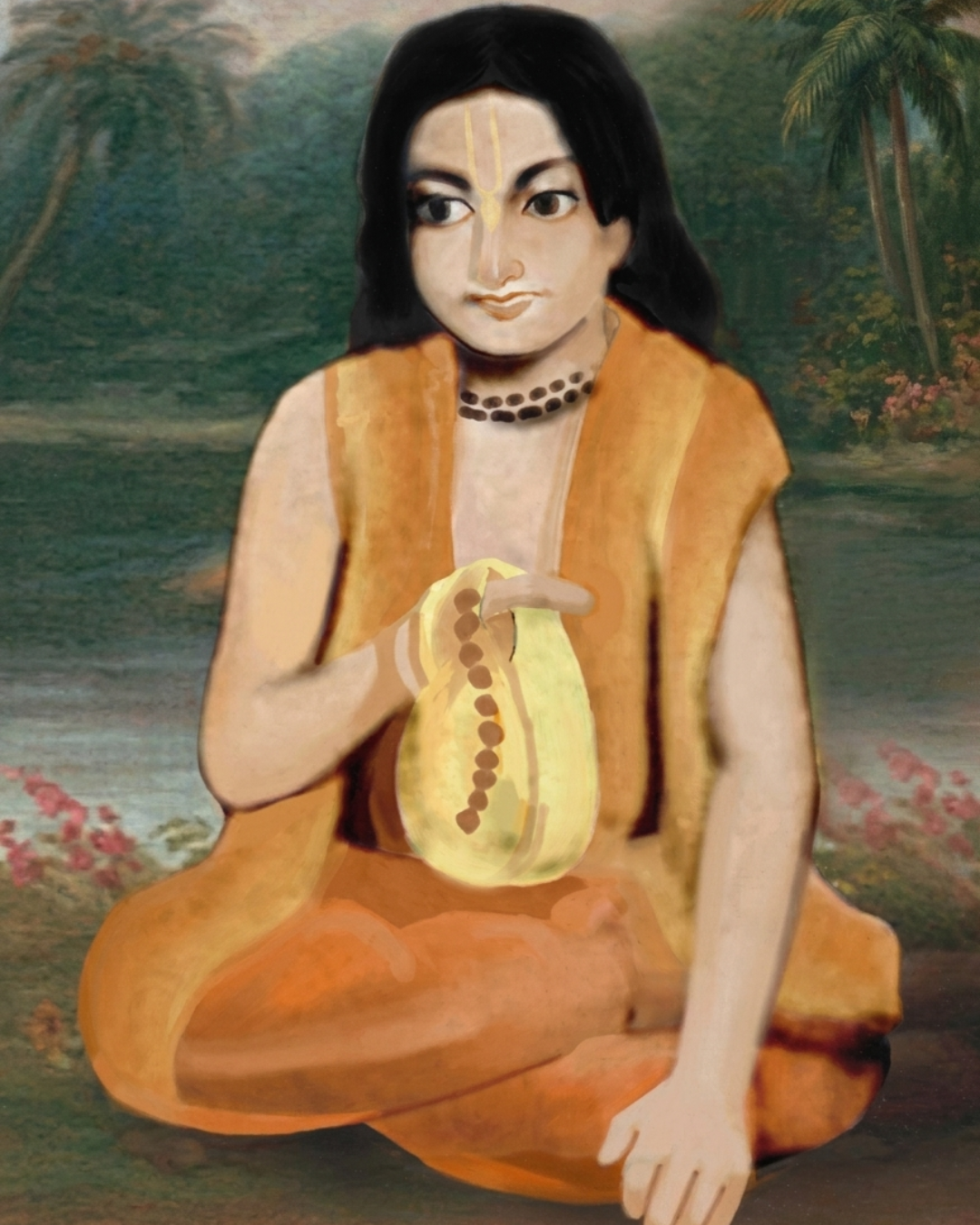
In the vast tapestry of Gaudiya Vaishnava history, few figures occupy as pivotal a position as Sri Srinivasa Acharya. He was not merely a saint — he was the living bridge between two worlds: the Six Gosvamis of Vrindavana and the entire subsequent tradition, down to Srila Prabhupada and the worldwide Hare Krishna movement. Without Srinivasa Acharya, the great scriptures of the Gosvamis might never have reached Bengal, and the flame of pure devotion might have dimmed before it could spread across the world.
His life is one of extraordinary sacrifice, surrender, and divine protection. On his appearance day, devotees pause to reflect on the immense debt every practitioner of bhakti owes to this selfless acharya.
Early Life and the Longing for Vrindavana
Sri Srinivasa Acharya was born in the village of Cakulia, in the Burdwan district of Bengal, to Chaitanya dasa and Laksmipriya. His birth was auspicious — his father had been a devoted servant of Sri Chaitanya Mahaprabhu, and the household was saturated with the mood of pure devotion.
From his earliest years, Srinivasa was overwhelmed by love for Sri Chaitanya Mahaprabhu. When he heard that the Lord had accepted sannyasa and departed for Puri, the young boy was inconsolable, weeping uncontrollably at the thought of separation. This intensity of feeling was not ordinary — it was the sign of a great soul destined to carry the most sacred mission.
After the passing of his father, Srinivasa resolved to go to Nilachala (Puri) to see Mahaprabhu. But before he could complete the journey, the Lord departed from this world. The grief that engulfed Srinivasa was immeasurable. He fell unconscious, and only through divine vision — the mercy of the Lord Himself — was his life preserved.
Training Under the Gosvamis in Vrindavana
Directed by divine instruction and the guidance of Srila Jiva Gosvami, Srinivasa eventually arrived in Vrindavana. There he sat at the feet of the very disciples of Sri Chaitanya Mahaprabhu — Rupa Gosvami, Sanatana Gosvami, and Gopala Bhatta Gosvami — absorbing their teachings, their devotion, and their vision of the eternal realm of Vrindavana.
He received formal initiation from Gopala Bhatta Gosvami and studied deeply under Srila Jiva Gosvami, who recognized in him a vessel fit to carry the entire treasure of the Gosvami literature to the waiting world. It was Jiva Gosvami who entrusted Srinivasa with the sacred mission that would define his life: to carry the books of the Six Gosvamis from Vrindavana to Bengal and preach their teachings throughout the land.

The Great Treasure — and the Great Theft
With great care and reverence, Srinivasa Acharya, along with his dear companions Narottama dasa Thakura and Shyamananda Prabhu, set out from Vrindavana carrying a chest filled with the manuscripts of the Gosvamis — texts such as the Bhakti-rasamrita-sindhu, the Ujjvala-nilamani, the Hari-bhakti-vilasa, and many other priceless works.
But the journey was not without trials. As the three preachers passed through the forest of Vishnupura, the chest of manuscripts was stolen by thieves acting under the order of the local king, Vira Hambira. The loss was devastating. Yet Srinivasa did not despair. He entered the kingdom alone, and through his extraordinary devotion, spiritual knowledge, and the power of Krishna's grace, he gradually won the trust of the king's minister and then the king himself.
King Vira Hambira listened to Srinivasa recite and explain the Gosvami texts. Moved to the core, the king became a devoted disciple of Srinivasa Acharya, returned the manuscripts, donated vast wealth, and ultimately surrendered himself fully to the Vaishnava path. It was a miracle born of patience, love, and unwavering faith.
What thieves could steal with their hands, they could not steal from the heart. The knowledge was already living within Srinivasa — and through him, it reached a king, a kingdom, and countless souls.
— Reflecting on the preaching of Srinivasa Acharya
Preaching Throughout Bengal and Orissa
After recovering the manuscripts, Srinivasa continued his preaching mission with boundless energy. He established centres of devotion throughout Bengal and beyond, initiating thousands of disciples and transforming entire regions through the power of kirtana and philosophical teaching.
Together with Narottama dasa Thakura, he arranged grand festivals of kirtana and bhagavata-katha that drew enormous gatherings of seekers. Sannyasis and panditas who came to challenge were humbled and transformed. Even those from other spiritual traditions found themselves drawn into the devotional tide that Srinivasa generated.
His preaching style combined the highest philosophical precision — inherited directly from Jiva Gosvami — with the deep emotional potency of Chaitanya Mahaprabhu's sankirtana movement. He was equally at home explaining theacintya-bhedabheda philosophy and leading ecstatic kirtana that melted the hearts of those present.
The Sad-gosvamy-ashtaka — A Gift to the World
Among Srinivasa Acharya's greatest contributions to the Gaudiya tradition is the composition of the Sad-gosvamy-ashtaka — the famous eight-verse prayer glorifying the Six Gosvamis of Vrindavana. This prayer is sung daily in ISKCON temples around the world and encapsulates the exalted qualities and the divine mission of the Gosvamis.
kṛṣṇotkīrtana-gāna-nartana-parau premāmṛtāmbho-nidhī
dhīrādhīra-jana-priyau priya-karau nirmatsarau pūjitau
śrī-caitanya-kṛpā-bharau bhuvi bhuvo bhārāvahantārakau
vande rūpa-sanātanau raghu-yugau śrī-jīva-gopālakau
I offer my respectful obeisances unto the Six Gosvamis, namely Sri Rupa Gosvami, Sri Sanatana Gosvami, Sri Raghunatha Bhatta Gosvami, Sri Raghunatha dasa Gosvami, Sri Jiva Gosvami, and Sri Gopala Bhatta Gosvami, who are engaged in chanting the holy names of the Lord and dancing, who are filled with the ocean of nectarean love for Krishna, who are brilliant as stars in all directions, who are the favourites of both the gentle and the ruffians, who are leaders in devotional service, who are without any rivalry, and who are the receivers of the grace of Sri Chaitanya Mahaprabhu.
— Sad-gosvamy-ashtaka 1, by Sri Srinivasa AcharyaThis single verse — sung every morning by devotees worldwide — was composed by Srinivasa Acharya out of pure love and gratitude. The Sad-gosvamy-ashtakadoes not merely praise the Gosvamis; it describes the very qualities a Vaishnava must cultivate: intense devotion, humility, renunciation, and the constant chanting of the holy names.
What Every Devotee Owes Srinivasa Acharya
The debt of the Vaishnava world to Srinivasa Acharya is incalculable. Consider: without his determination to reach Vrindavana, he would never have received the training of the Gosvamis. Without his willingness to carry the manuscripts to Bengal, those texts might have remained confined to the forest of Vrindavana. Without his courage in entering the kingdom of Vira Hambira alone, the books might never have been recovered. Without his preaching, entire generations in Bengal would not have had access to the jewel of Gaudiya Vaishnavism.
Srila Prabhupada, who himself descended in the parampara flowing from this very tradition, honoured Srinivasa Acharya as an essential pillar of the sampradaya. The books that Srinivasa carried — many of which Prabhupada himself translated and commented on — are the very foundation of the teachings of ISKCON and the global Krishna consciousness movement.
- Carrier of the Sacred TextsHe carried the manuscripts of all Six Gosvamis from Vrindavana to Bengal, ensuring their preservation and spread.
- Transformer of KingsThrough patience and devotion, he converted King Vira Hambira and opened an entire kingdom to the Vaishnava path.
- Author of the Sad-gosvamy-ashtakaHis famous eight-verse prayer is sung daily in temples worldwide, eternally glorifying the Six Gosvamis.
- Master Preacher and InitiatorHe initiated thousands and established centres of devotion throughout Bengal, Orissa, and beyond.
- Living Parampara LinkHe is the direct link in the chain of disciplic succession connecting the Gosvamis to all subsequent acharyas down to the present day.
His Divine Associates
The three great preachers of the post-Chaitanya era — Srinivasa Acharya, Narottama dasa Thakura, and Shyamananda Prabhu — are often praised together as a triad of pure devotees who jointly carried the light of Mahaprabhu's movement into the world after the departure of the Gosvamis.
Narottama dasa Thakura, the great songwriter of Bengal whose padavali kirtanas still fill hearts with transcendental emotion, was a dear brother and companion of Srinivasa. Together they organized the famous Kheturi festival — one of the greatest gatherings of Vaishnavas since the time of Mahaprabhu Himself — where the sacred images of Vishnupriya Devi were brought and hundreds of devotees assembled in an outpouring of divine love.
Shyamananda Prabhu, who preached in Orissa, was another dear associate whose own mission complemented that of Srinivasa. Together these three names represent the flowering of the Chaitanya tradition in the generation after the Gosvamis.
Srinivasa Acharya, Narottama dasa, and Shyamananda together illuminated the three corners of devotional life — scholarship, song, and service. Each carried a different facet of the same jewel.
— Gaudiya Vaishnava tradition
His Later Life and Samadhi
Srinivasa Acharya spent his later years at Yajigrama (present-day Jajigram in West Bengal), where the temple he established continues to this day. His samadhi — the place where his transcendental body rests — is a pilgrimage destination for Gaudiya Vaishnavas who come to offer their respects and absorb the devotional atmosphere he left behind.
He accepted as his primary disciple Sri Ramachandra Kaviraja, from whom the lineage continued through Vishvanatha Chakravarti Thakura — one of the most celebrated Gaudiya commentators — and onward through Baladeva Vidyabhushana, Jagannatha dasa Babaji, Bhaktivinoda Thakura, Gaurakishora dasa Babaji, and ultimately to Srila Bhaktisiddhanta Sarasvati Thakura — the spiritual master of Srila Prabhupada.
Every time a devotee opens Bhakti-rasamrita-sindhu, every time the words Hare Krishna fill a kirtana hall, every time the Sad-gosvamy-ashtaka is sung in the early morning — Srinivasa Acharya is present. His mission lives on.
namas te sārasvate deve gaura-vāṇī-pracāriṇe
nirviśeṣa-śūnyavādi-pāścātya-deśa-tāriṇe
— Daily obeisances to Srila Prabhupada, who came in the line of Srinivasa
Frequently Asked Questions
Who was Sri Srinivasa Acharya?
Sri Srinivasa Acharya was a great Gaudiya Vaishnava saint born in Bengal in the 16th century. He was personally trained by Gopala Bhatta Gosvami and Jiva Gosvami in Vrindavana and was entrusted with carrying the manuscripts of the Six Gosvamis to Bengal.
What is the Sad-gosvamy-ashtaka?
The Sad-gosvamy-ashtaka is an eight-verse prayer composed by Srinivasa Acharya glorifying the Six Gosvamis of Vrindavana. It is sung daily in ISKCON and Gaudiya temples worldwide and is considered one of the most important devotional prayers in the tradition.
Why is Srinivasa Acharya called "the link"?
He is called the link because he physically carried the books of the Six Gosvamis from Vrindavana to Bengal, bridging the Vrindavana Gosvamis with all subsequent acharyas and lineages. Without him, the literature and teachings of the Gosvamis might not have reached the wider world.
Who were his close associates?
His closest associates in preaching were Narottama dasa Thakura and Shyamananda Prabhu. Together they are celebrated as the three great post-Chaitanya preachers who spread the Gaudiya Vaishnava tradition throughout Bengal, Orissa, and beyond.
Celebrate at Dakshina Dwaraka Dham
🏛 Hare Krishna Movement Chennai
Special kirtana and lecture programmes on Srinivasa Acharya's appearance day
- Morning Mangala Arati
- Sad-gosvamy-ashtaka Kirtana
- Discourse on His Life
- Maha Prasadam
Continue reading
Connect with Srila Prabhupada's ISKCON Thiruvanmiyur
Follow us for daily darshana updates, event announcements, and spiritual content.